
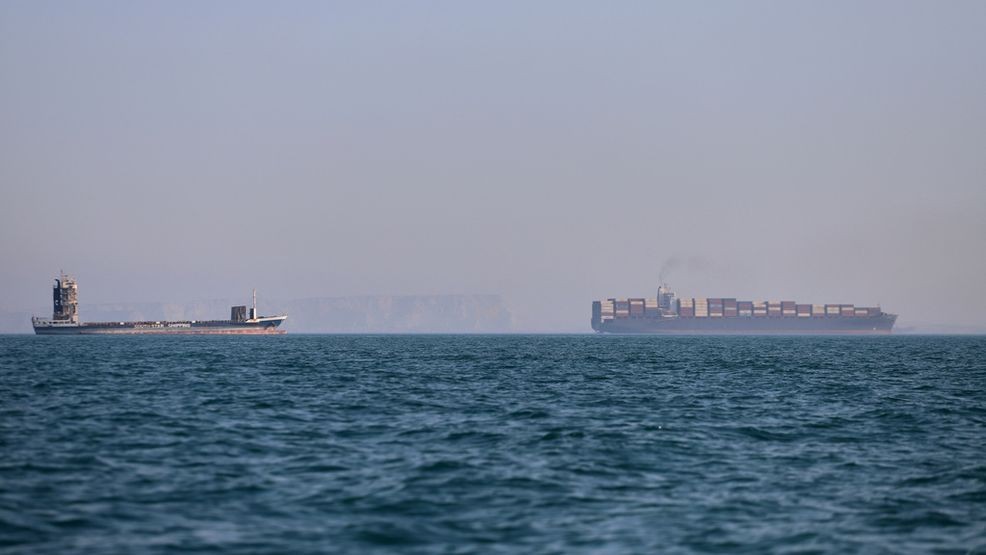
(TNND) — Three tankers were struck by projectiles in the Strait of Hormuz on Tuesday, the British military said, marking the latest maritime attacks in the strategic waterway despite a pause in the war between the U.S. and Iran.
The United Kingdom Maritime Trade Operations center said one of the tankers caught fire while traveling off the coast of Oman. Iranian state television reported the targeted vessel was the Qatari liquefied natural gas tanker Al Rekayyat, claiming it came under attack after ignoring Iranian warnings, though Tehran did not directly claim responsibility.
Two other tankers were also hit, including one struck by a drone, though it was not immediately clear where those attacks occurred. No injuries were reported, and at least one vessel continued its voyage after the incident, according to the maritime agency.
Majed Al-Ansari, a spokesperson for Qatar’s Foreign Ministry, called the attack on Al Rekayyat an “unacceptable attack” on international navigation and global energy security, describing it as a “serious and explicit violation” of international law.
“We hold it [Iran] fully legally responsible for this attack & for any resulting damages & consequences,” he wrote on X.
The attacks come days after Iran’s joint military command warned that all oil tankers transiting the Strait of Hormuz must use Tehran’s approved routes, adding that any interference by U.S. forces “will be met with a rapid and decisive reaction.”
But the Joint Maritime Information Center, a multinational body overseen by the U.S. Navy, told shippers Monday that the route around Oman “has been expanded and remains available for all traffic.”
Speaking Monday at the White House, President Donald Trump warned Iran it would need to “make a deal, or we’re going to finish the job.”
“I’d rather make a deal, because I don’t want to affect 91 million people,” Trump said. “We can knock down their bridges in one hour. We can knock out their energy supply.”
Under an interim agreement, Iran and the United States agreed to allow ships to transit the strait without paying fees for 60 days. However, Tehran has insisted it should control shipping routes and eventually charge vessels for passage, a move that would upend decades of international practice.
The U.S. and several Gulf Arab states have rejected that proposal. A previous effort by Oman and a United Nations agency to establish a new shipping route closer to Oman’s coastline also sparked attacks across the region.
For now, negotiations between Washington and Tehran appear to be on hold following the burial of Iran’s Supreme Leader Ayatollah Ali Khamenei, who was killed at the start of the war. Mourners at his funeral chanted calls for Trump’s death.
_____
Editor’s note: The Associated Press contributed to this article.