
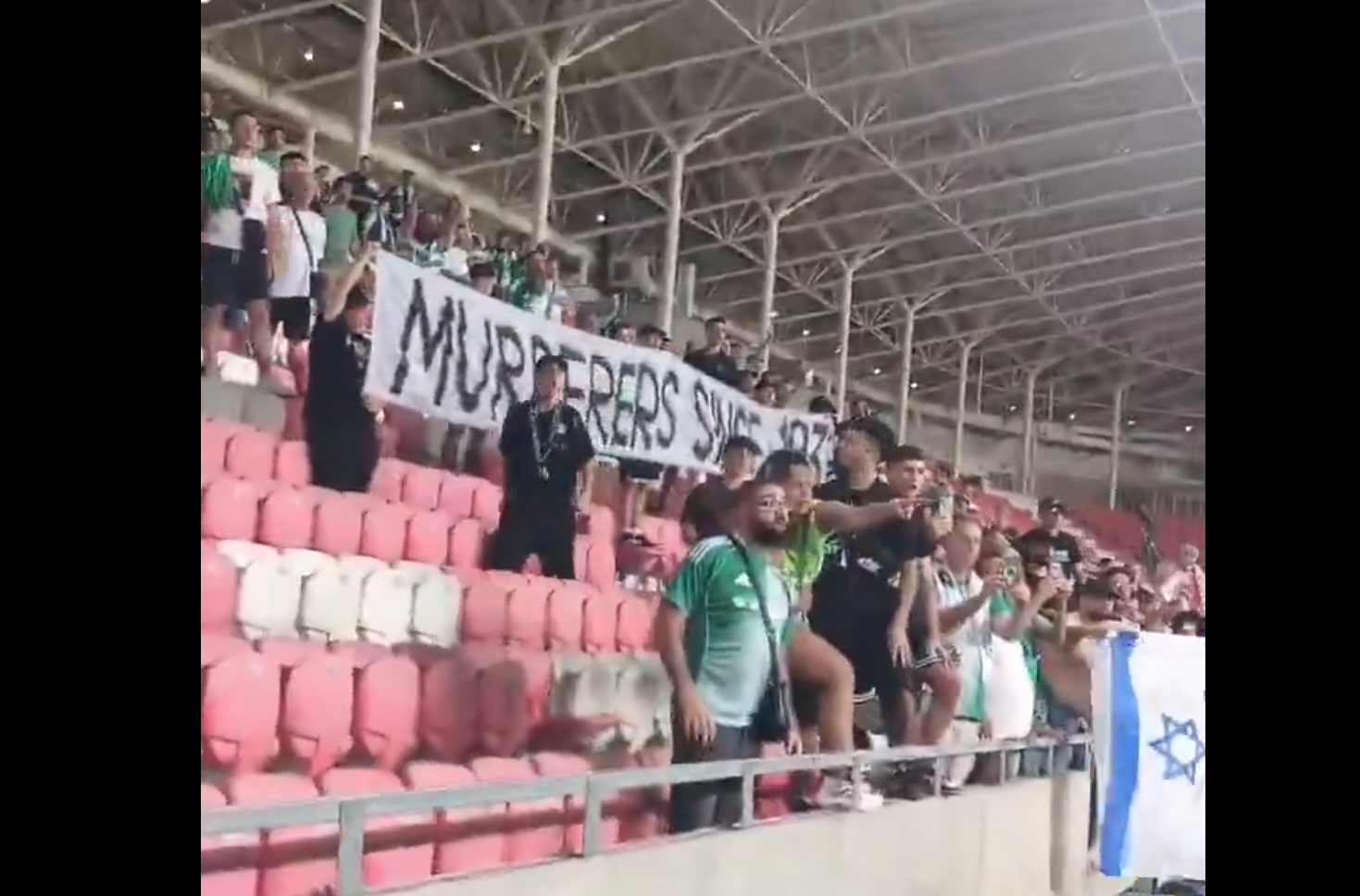
Israeli soccer fans held up a banner reading “Murderers since 1939” during a match against a Polish team Thursday night, leading Polish fans to attack an Israeli fan bus following the game. Both Poland and the Israeli embassy in the country condemned the banner.
The “Murderers since 1939” banner was displayed prominently across a row of seats by fans of Israeli club Maccabi Haifa during their Europa Conference League match against Raków Częstochowa, which was played in Debrecen, Hungary, for security reasons.
Following the match, in which Maccabi Haifa lost 2:0, a group of Raków Częstochowa fans threw stones at an Israeli fan bus, in an incident caught on video.
There were no reports of injuries as a result of the violence.
According to Channel 13, the banner displayed by Maccabi Haifa fans was a response to the banner held up by Polish soccer fans at a match the previous week, which read “Israel is murdering and the world is silent,” in reference to the war in Gaza.
Get The Times of Israel’s Daily Edition
by email and never miss our top stories
By signing up, you agree to the terms
The “Murderers since 1939” banner caused outrage in Poland, with the country’s President Karol Nawrocki writing on X that the “scandalous banner…insults the memory of Polish citizens — victims of World War II, including 3 million Jews.”
Kibice z Izraela wywiesili transparent “Mordercy od 1939 roku” podczas meczu Raków Częstochowa z Maccabi Hajfa w trzeciej rundzie eliminacji do Ligi Konferencji.
Szanowna Ambasado @IsraelinPoland czy będzie reakcja? CC: @MSZ_RP pic.twitter.com/D2QVbELOGk
— August Żywczyk (@august_zywczyk) August 14, 2025
Polish Interior Minister Marcin Kierwinski said the banner was a “scandalous distortion of Polish history” on behalf of the “Israeli hooligans.”
The foreign ministry in Warsaw said it “firmly condemns the behavior of certain supporters,” and called on European football’s governing body, UEFA, “to respond appropriately to this incident.”
The Polish foreign ministry said one of its officials met with the Israeli ambassador on Friday and “expressed his utmost indignation at the outrageous content of the banner.”
“Polish-Israeli relations cannot — and will not — be destroyed by extremists,” added the ministry.
The Israeli Embassy in Warsaw also condemned the banner, writing on X that the “shameful incidents do not reflect the spirit of the majority of Israeli fans.”
זה האוטובוס של אוהדי מכבי חיפה אחרי המשחק מול ראקוב. באמצע כביש מהיר עקפו אותם חבורה של אוהדים פולנים שעקבו אחריהם עוד מתחנת דלק בה עצרו, והתחילו לזרוק אבנים על האוטובוס ולנסות לפגוע בהם. הם הצליחו לברוח לבסוף, ובנס אף אחד לא נפגע, אבל זה אירוע קשה שהיה יכול להיגמר אחרת pic.twitter.com/Ovu2K7FUoX
— Yotam Koren (@yotam_koren) August 15, 2025
Meanwhile representatives from President Isaac Herzog’s office also reached out to the Polish Embassy in Tel Aviv.
“Both sides expressed dissatisfaction with provocative behavior of a small number of fans on both sides, and noted that such behavior cannot be allowed to harm the important dialogue between the countries,” Herzog’s office said.
The Holocaust continues to create tensions between Israel and Poland.
The Poles contend that they were the victims after being invaded by Nazi Germany in 1939. Six million Poles, including three million Jews, perished during World War II.
However, Israel has accused Poland of Holocaust revisionism by trying to whitewash the role local Poles played in killing Jews.
UEFA to take action
UEFA later opened a disciplinary case against both clubs.
UEFA said Friday both clubs have been charged with “transmitting a message not fit for a sports event” in a case that will be judged by its disciplinary panel.
No timetable was given for imposing sanctions, which could be fines and closing part of a stadium at a future game.
Thursday’s incident came a day after UEFA displayed a banner reading “Stop killing children – Stop killing civilians” across the pitch, a statement understood to be condemning Israel, at the UEFA Super Cup final in Udine, Italy.
The Union of European Football Associations declined to call out Israel by name, posting on X, “From the UEFA Super Cup in Udine, the message is loud and clear.”
The banner was displayed as players lined up before the game at the Stadio Friuli in Udine, Italy, between Tottenham Hotspur and Paris Saint-Germain. The Super Cup is the annual early-season match between the winners of the Champions League and Europa League, watched by millions around the globe.
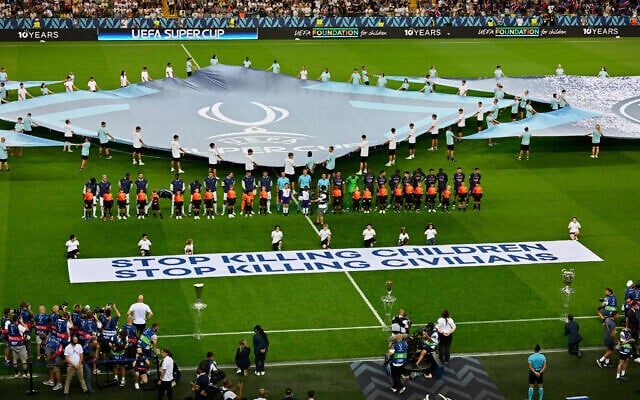
The players line up before the UEFA Super Cup soccer match between Paris Saint-Germain and Tottenham Hotspur in Udine, Italy, Wednesday, Aug. 13, 2025. (AP Photo/Denes Erdos)
UEFA rules prohibit political, ideological and religious messages from being displayed in stadiums before, during, or after matches.
Israel’s Channel 12 news reported Thursday that Israel was aware of the plan to display the banner at the game, and was working behind the scenes to try to block it. In the end, a compromise was reached to display the banner without calling out Israel by name.
During the same match, two refugee children from Gaza were honored during a medal ceremony that included nine children who are refugees from conflict zones, including Afghanistan, Iraq, Nigeria and Ukraine.
A ban for Israel?
The Ynet news site reported Friday that Israeli officials are growing increasingly worried that UEFA and other international sporting bodies could exclude Israeli national and club teams from competitions, as was the case with Russia after its invasion of Ukraine in 2022.
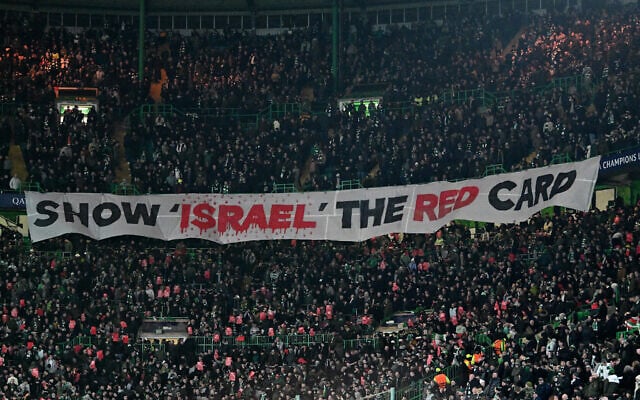
Celtic fans unveil a banner reading ‘Show Israel The Red Card’ during the UEFA Champions League play-off first leg football match between Celtic and Bayern Munich at Celtic Park stadium in Glasgow, Scotland on February 12, 2025. The word ‘Israel’ is in quotation marks (ANDY BUCHANAN / AFP)
In a recent interview, UEFA Chairman Aleksander Čeferin was asked by a Slovenian news outlet whether he had considered banning Israel from competition, to which he responded that it was “a legitimate question.”
However, Čeferin insisted that “in principle, I’m not in favor of not allowing athletes to compete in competitions.”
“In the case of Russia, we see that athletes haven’t competed for three and a half years and the war is even worse than it was. I know that many are opponents of the regime, but they still can’t play. In principle, I’m against denying athletes the right to compete,” he said.
As for whether he has immediate plans to exclude Israel from competition, he said: “Right now, they are not being expelled; it is our decision. It is very difficult for me to comment on what could happen in the future.”