
The old case, the new audience
Earlier this week, I wrote that Benjamin Netanyahu had delivered, twice in one day and with undiminished skill, an argument written for an America that no longer exists. That earlier America remembered Israel as small, endangered, and surrounded; saw its wars as plainly defensive; and treated the alliance, broadly, as a moral inheritance. The America listening now inherited none of those assumptions.
Several readers asked the fair question: fine — then what should he be saying? What does the new argument sound like?
Let me try to answer plainly, because criticism without prescription is only commentary, and this moment calls for more than commentary.
The skeptics we failed to see
Start with the skeptics themselves. It is tempting to sort them by party: the progressive who marched last spring; the young conservative nodding along to a podcast host asking why America underwrites foreign wars. Their politics could hardly be more different, and any strategy that treats them as one audience will fail.
But before the differences, notice what they share — because what they share is exactly what defeats the old script.
They share an absence. They do not remember Entebbe, or the Yom Kippur War, or the image of a small state surrounded and outnumbered. Their earliest picture of Israel is a regional power at war, because that is what Israel has been for all of their conscious lives. The old argument assumed a listener who arrived with the founding story already installed and needed only to be reminded of it. These listeners arrive with two decades of war on their screens, and lately the worst of it. No argument that ignores their opening picture will replace it.
They share a media diet. They did not grow up on the eight-minute cable interview, where a disciplined communicator controls the frame and the clock runs out before the third follow-up. They grew up inside the internet, where every claim meets its counterclaim within seconds, where the comment section is part of the broadcast, and where fluency itself can sound suspicious. A generation trained to detect talking points does not necessarily hear polish as command. Often, it hears polish as evasion.
And they share an allergy: to being managed. That is exactly how the current approach, however expertly executed, often feels to them.
If that is the audience, then the new argument is not simply a new list of facts. Israel’s advocates do not lack facts. The new argument is not “Israel is good and its critics are wrong.” It is: here is what you have seen, here is what we owe, here is why the alliance still matters, and here is the future we are prepared to build.
This is what political skepticism looks like after years of asking for loyalty without offering transparent plans: distance, not hatred.
What has to change is the order, the idiom, the venue, and the voice.
First, reverse the order
The old argument opens with Israel’s virtues and arrives at the hard parts late, if at all. With this audience, that sequence fails.
Reverse it.
For these listeners, acknowledgment is not a concession that weakens the case. It is the toll paid to be heard at all. A speaker who begins by naming what the listener has seen — the destruction in Gaza, the suffering of Palestinian civilians, the length and cost of this war — has done something the talking points rarely do: confirmed that he and the listener are looking at the same world. Only then does the rest become audible.
This is not moral theater. It is the entry fee for credibility in an information environment where the counterargument is always one swipe away. The advocate who concedes nothing is not protecting the case. He is forfeiting the second sentence.
A prime minister who opens a campus forum by saying, “What you have seen from Gaza is real and horrifying, and I am not here to talk you out of your grief,” buys five more minutes of attention. Those five minutes are where persuasion lives now.
Then, change the idiom
Here the flanks divide, and the argument must divide with them.
To the young right, the question is not whether Israel is admirable. It is whether the alliance serves America — asked in an idiom of interests, burdens, and costs that their own movement now speaks fluently.
There is a serious answer, but it has to be made the way this essay says every argument must now be made: costs first. This generation of conservatives knows what the alliance costs America, down to the interceptors — they have heard the numbers on their podcasts, and an advocate who pretends otherwise has lost them by the second sentence. The honest version starts there: yes, American munitions have defended Israeli skies, and American stockpiles have paid for it. No American soldier has been asked to fight on the ground for Israel, and none will be. And then the part almost no one has heard: Israel’s own leadership is now proposing to phase out direct American military aid entirely — billions a year — in favor of joint development and co-production. An ally asking to be taken off the payroll is the single best answer to the America First question, and it is barely in the conversation.
That is the tell. When the strongest card in the deck finally gets played, it gets played in an eight-minute cable interview — to the audience that never doubted, in the format the skeptics never watch. The drift among Republicans under 45 is not proof that this argument has failed. It is evidence that the argument was neglected, and that even now, when it is made at all, it is made in the wrong room.
To the young left, the threshold question is different: not what Israel does for America, but whether Israel’s story has room in it for Palestinian dignity.
For this audience, an argument that talks around Palestinians — that treats them as a security file rather than a people — disqualifies itself in the first paragraph. The advocates who reach these listeners will be the ones able to say, without flinching, that Palestinian children deserve the same future as Israeli children, and then explain — concretely, not liturgically — what Israel is prepared to do about it.
That could mean committing, in plain language, to a political horizon in which Palestinian children grow up with freedom of movement, civic rights, economic prospects, and a plausible path to self-government — and then describing the steps toward that horizon. Security does not disappear from that argument; it becomes more credible when it is tied to an end state beyond permanent management.
That is a harder speech to give, in part because it commits the speaker to something. Which is exactly the point. This generation has heard enough arguments in which the speaker risks nothing and promises nothing.
Shift the venue of persuasion
Retire the cable hit as the centerpiece.
Not entirely. The eight-minute segment still reaches somebody’s parents and grandparents. But as the center of gravity, it is finished.
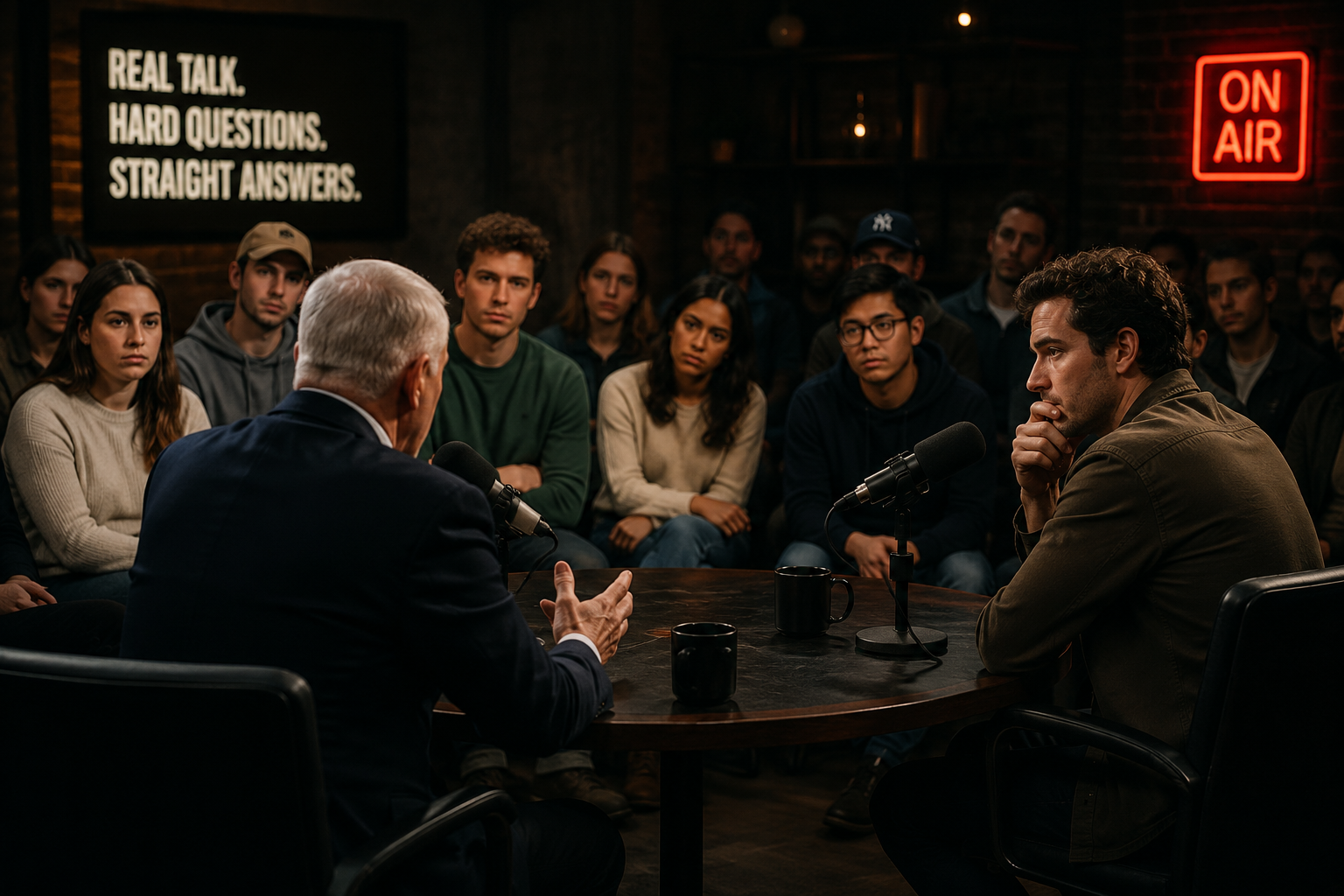
For Americans under 45, left and right, opinion is increasingly formed in long-form: the three-hour podcast, the campus exchange, the YouTube interview where the host is unfriendly and the clock never rescues you.
Those venues terrify message-disciplined operations, and for good reason: they cannot be controlled. But that is exactly why they persuade. The willingness to sit for three hostile hours is itself the message. It says the case can withstand examination.
Every serious long-form invitation declined confirms the skeptic’s suspicion that it cannot. Israeli leaders keep choosing the format their training mastered over the format their audience inhabits. Each choice is legible to that audience as fear.
A strategy that takes this generation seriously would do something simple and radical: say yes. Yes to the campus town hall where half the questions are hostile. Yes to the podcast whose host has already declared the war immoral. Yes to the livestream where the chat scrolls with criticism in real time.
The argument that survives there is the only argument that will survive at all.
Let different voices carry the cost
Finally, the hardest prescription, because it is about the man himself.
The 1980s made Netanyahu because television rewarded exactly what he had: composure, fluency, command of the lens. This era rewards something television never asked for — the unguarded moment, the visible cost, the answer that sounds discovered rather than retrieved.
Authenticity cannot be simulated by the polished. The attempt reads as one more performance.
Which means the new argument cannot be carried by one voice, however gifted. It needs the 26-year-old reservist who can talk about what the war took from him; the Arab citizen of Israel describing her country without a script; the bereaved father from one of the Gaza-border communities; the Israeli working with Palestinians on the ground who can speak honestly about both fear and obligation; the founder in Tel Aviv who can explain, in the cadence of his generation, why the place is worth defending.
Not surrogates deployed by a ministry. People credentialed by experience, speaking in venues no ministry controls.
For this audience, the messenger is not incidental to the message. The messenger is most of the message.
If the only faces making the case are the ones whose careers have depended on managing impressions, the alliance will look, to a generation fluent in performance, like one more show.
Repointing the wall while there is still time
I ended my recent post with firewalls: built, maintained, and cracking quietly when a generation of builders decides the wall will stand on its own. The follow-up thought is simpler, and more hopeful than the diagnosis may have sounded.
Nothing in the polling says this generation is unreachable. It says they have not been reached. For a decade, the strategy treated persuasion as a solved problem on the right and a lost cause on the left, and so stopped doing it seriously on both flanks at once.
Skepticism is not hostility. It is the natural condition of an audience that has been shown a great deal and told very little it found credible.
The case for this alliance — made in this generation’s language, in this generation’s venues, with this generation’s tolerance for complexity — has not failed.
It has barely been attempted.
That is the indictment, and also the opportunity. A country that produced the best advocate of the last era can, if it chooses, produce the advocates of the next.
The wall will not stand on its own. But walls can be repointed.
The work starts with something deceptively simple: noticing where the audience went, following them there, and staying long enough to answer the third, fourth, and fifth question.