
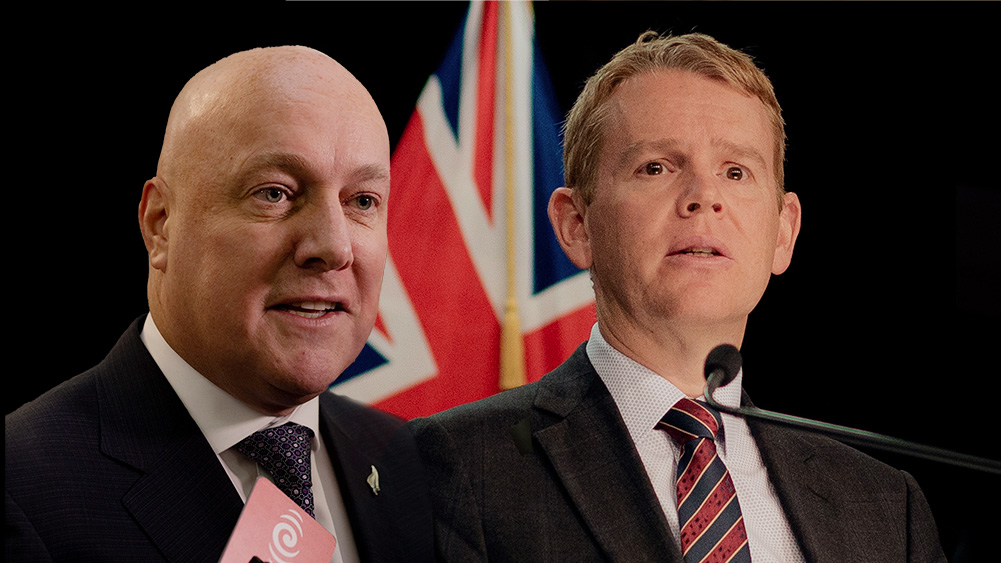
It has become rather fashionable to speculate about the possibility of caucus coups to oust both National and Labour’s fairly unpopular party leaders.
Hopefully our politicians are smart enough to know either would be a stupid idea.
The next election looks likely to be fought on a knife’s edge and commentators have suggested some backbenchers, activists, and party members are getting nervous.
Both Christopher Luxon and Chris Hipkins have poor favorability ratings and neither are the sort of Prime Minister that anyone would want to film a biopic about.
While they are unimpressive compared to John Key, Jacinda Ardern, and Helen Clark, they aren’t obviously weaker than previous contenders: Bill English, Andrew Little, Jenny Shipley, or Simon Bridges.
Many political hacks think to themselves: If only Hipkins/Luxon would move aside, my preferred party would easily sweep the next election with a charismatic leader.
This analysis generally fails to consider whether there is a credible candidate immediately available to step into the role. Dreamers are subconsciously imagining a perfect replacement.
You see this happen in American political polling where a “generic” unspecified Democrat or Republican will outpoll the actual real-life candidate, with their human flaws and downsides.
Crisis candidates
The National Party does have a stronger frontbench than Labour: Nicola Willis, Chris Bishop, Erica Stanford, and Mark Mitchell are all plausible Luxon replacements if push came to shove.
(By the way, National also has a stronger crop of talent sitting on its backbench, which ought to have Labour worried about its longer-term political fortunes.)
But a leadership coup in National would still be very hard. It would have to happen without the caucus cutting each other to bits while fighting for positions in the new administration.
Plus, the new leader would have to call Winston Peters and David Seymour and explain that they are their new boss now. Have fun with that!
It would only be worth the risk to caucus and coalition stability in extremely desperate times, or if the challenger was an unusually popular candidate.
Would Chris Bishop really poll any better than Chris(topher) Luxon?
As for Labour, its bench has been weakened by dismissals, a poor election result, and early retirements. Hipkins is really the only show in town when it comes to leadership candidates.
Carmel Sepuloni isn’t a strong performer, Barbara Edmonds doesn’t want to lead, and Megan Woods has all but announced her resignation. Peeni Henare or Willie Jackson might be interested in the job, but neither are obvious vote winners.
Generally, Keiran McAnulty is considered to be Labour’s Plan B. He’s a good communicator and would be a fresh start, but also a highly inexperienced Prime Minister if elected.
That never stopped Ardern or Luxon, of course, although the former was a superstar and the latter had a substantial business career to draw from.
Still, it’s hard to make a case that McAnulty would be worth the transaction costs of a leadership coup or even a managed transition. He also says he doesn’t want the job.
It would make more sense for him to wait and see how the election plays out. If Labour loses, then he is first in line to assume the leadership and become Prime Minister in the 2030s.
Leadership detritus
History buffs will know there are very few examples of a leader taking over in the middle of a term and going on to win the next election.
Ardern is the famous example, but she took over without having to challenge Andrew Little and was only able to form a Government through coalition negotiations with NZ First.
Christopher Luxon is actually a better example. He became opposition leader in late 2021 when Judith Collins was ousted after trying to pre-empt a challenge from Simon Bridges.
But for each success there are more failures. Geoffrey Palmer, Jenny Shipley, Bill English, and Chris Hipkins are all Prime Ministers who took over during a term only to lose the next race.
The list of unsuccessful opposition leader changes is even longer: Bill Rowling, Jim McLay, Helen Clark, Phil Goff, David Cunliffe, Simon Bridges, Todd Muller, and Judith Collins.
Journalists and news consumers certainly enjoy the drama of leadership challenges but the general public rarely ends up with a favourable view of the victor.
Successful challengers are seen as overly-ambitious, destabilisers. That’s not what voters want after five years of economic and global instability.
As things stand, it is almost certain Christopher Luxon and Chris Hipkins will lead their political parties into the election. Only afterwards will the loser step aside for a successor.