
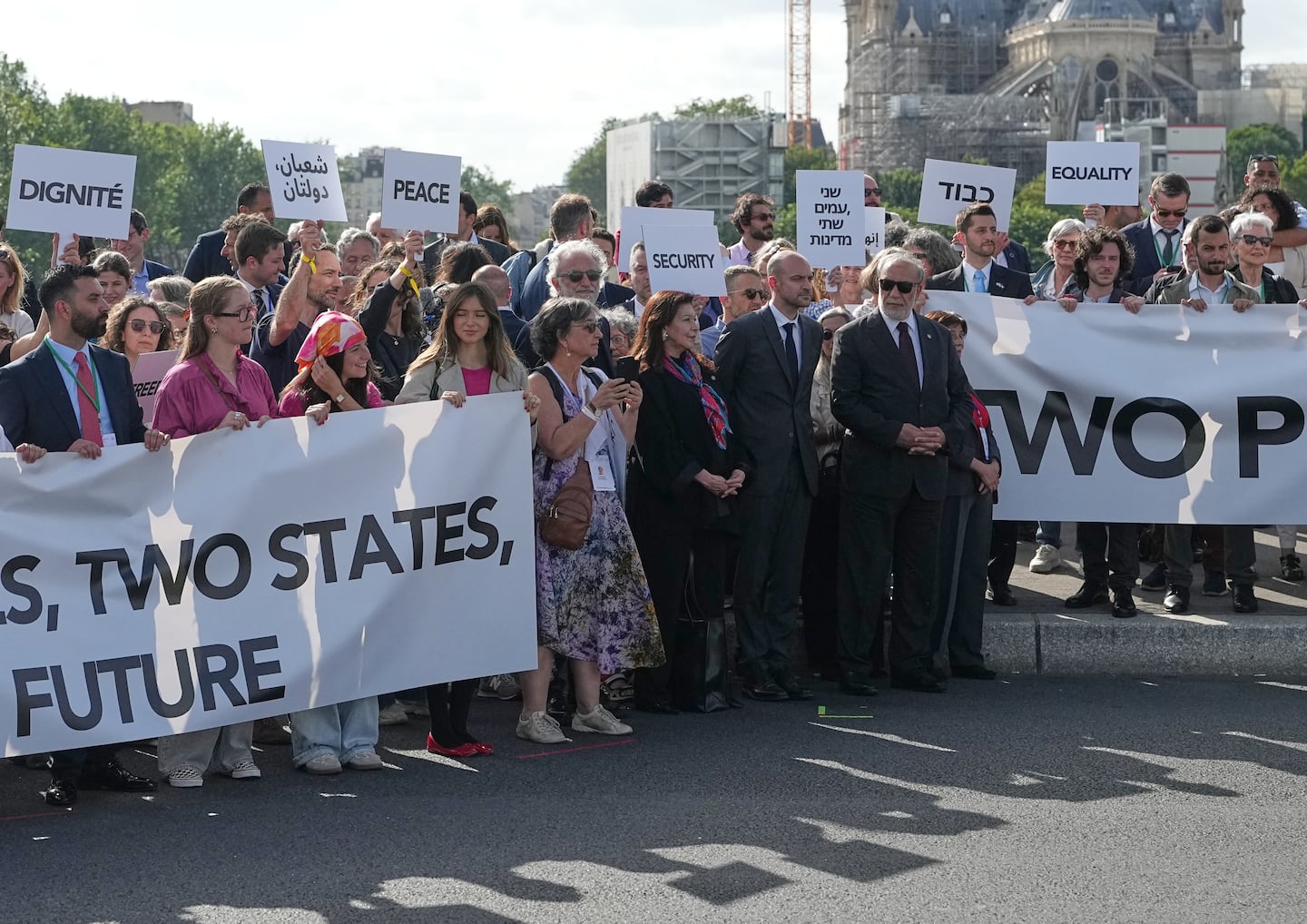
They have captured the dilemma openly and honestly, humbly and eloquently, while affirming their unwavering commitment to the state of Israel and its right to exist as a Jewish homeland. They are equally firm and clear about the rights of the Palestinian people to have their own state. I hope, as they do, and as I believe the vast majority of American Jews do, that peace is still possible in Israel and throughout the Mideast.
Get The Gavel
A weekly SCOTUS explainer newsletter by columnist Kimberly Atkins Stohr.
Gene Wintner
Newburyport
‘I cannot criticize Israel’s military actions’
I read the op-ed by Steve Grossman and Alan Solomont with interest. I agree entirely with their love for Israel. Like them, if I lived in Israel, I would not vote for Benjamin Netanyahu, and I abhor the conduct of the settlers who attack and denigrate the indigenous population in the territories.
However, I do not live in Israel, and friends who live in Haifa, who also do not support Netanyahu, remind me that my life is not threatened as theirs is daily.
Where I disagree with the authors is over what they assert is the responsibility of American/diaspora Jews. I have lived my entire life in the freedom and relative safety of the diaspora in America. I believe deeply that thousands of Israeli soldiers and civilians have died for me. I, therefore, cannot and will not criticize Israel’s military actions.
I also believe that if Israel had existed in the 1930s, it would have provided a safe haven for many, but not all, European Jews. The Holocaust would have occurred but fewer Jews would have died.
A Palestinian state in the near term is a fantasy. Hamas has been in Gaza and Hezbollah in Lebanon because Israel withdrew, and both entities wish to destroy Israel and Jews. A Palestinian state would want to do the same.
I was a J Street member, and now I am an AIPAC supporter. I switched after the massacre in Pittsburgh at the Tree of Life Synagogue. Antisemitism is growing rapidly, and Israel must exist.
I conclude with a quote from a speech by Rabbi Abba Hillel Silver in 1939: “And now I see the night descend again, and into the dark and the storm my people are wandering forth again. Shall I leave them now? Can I leave them now? Shall I part company with this immortal band? They have become too dear and precious to me.”
A. Eric Rosen
Brighton
Are Palestinians included in those ‘shared values and aspirations’?
What exactly do Steve Grossman and Alan Solomont mean about “a viable Palestinian state” when an estimated 750,000 Israeli settlers now live in East Jerusalem and the West Bank and when Israel is in the process of cutting the West Bank in two with its E1 settlement plan?
What happens to the largely obliterated Gaza Strip where, despite President Trump’s so-called cease-fire, 2.1 million Palestinians continue to be bombarded and relentlessly pushed toward the sea?
Grossman and Solomont call for a return to “shared values and shared aspirations” that include “a future in which Israel, America, and the Jewish people are once again united by a shared commitment to democracy, security, equality, and peace.”
It is notable that there is no mention of Palestinians in that concluding sentence. For nearly 80 years they have been absent from that commitment to democracy and equality while Israel has built what international rights groups have called an apartheid state that gives second–class citizenship to the 15 to 20 percent of Palestinians who were not forced from their homes when Israel was created. Most Palestinians were driven into exile, confined to dismal refugee camps around the region, or subjected to a brutal military occupation.
For Israel, as for the United States, acknowledging the original sins on which their states were built is an essential step toward making those “shared values” more than empty words.
Nancy Murray
Cambridge
The US government and American Jews do not own the peace process
I appreciated that Steve Grossman and Alan Solomont admitted to the inhumanity of the Netanyahu regime and repeatedly mentioned that peace was the only path to Israel’s continuation.
Their op-ed, however, is biased in its assumption that the actors that will affect peace are the US government and American Jews of, one assumes, Ashkenazi heritage.
The authors do not elevate other nations in the West Asia region, such as Pakistan, Qatar, Egypt, and Turkey, that are critical to Israel’s path to peace.
It is Western settler colonial dictatorship that created the failed fortress state of Israel and caused tremendous enmity among Israel’s neighbors. Grossman and Solomont should not be so comfortable in perpetuating Israel as a Western colony unless they want it to remain fortress Israel.
If Grossman and Solomont believe that Israel should be integrated into West Asia, they should speak less of American military security and should call to the diverse faiths, cultures, and countries in the region for peace.
Stephen Patterson
Braintree
Iran’s looming presence blocks the path to peace
Steve Grossman and Alan Solomont describe many of the current problems facing US and Israeli Jewish communities. Their op-ed sets out goals for solving problems. However, there are glaring omissions.
There is only passing mention of Hamas and no word about Hezbollah or about Iran’s role in support of both, and how they’ve all sworn to destroy Israel.
Other countries bordering Israel or nearby have peaceful relations, trade, and tourism ongoing.
Oct. 7, 2023, was not just a minor incident.
There was a cease-fire in place when Hamas launched the most vicious attack imaginable on Israel, a long-planned action.
What is Israel to do when the attackers hide in miles of sophisticated tunnels or under hospitals but leave the people of Gaza exposed without shelters?
How are Israel’s growing numbers of American critics, many of them young people, able to understand Israel’s vulnerability without balanced reporting in the media and balanced presentation on campuses?
I agree with Grossman and Solomont’s goals, but I can’t see a pathway to peace with the current Iranian government as a partner in the region.
Greta Lee Splansky
Framingham