
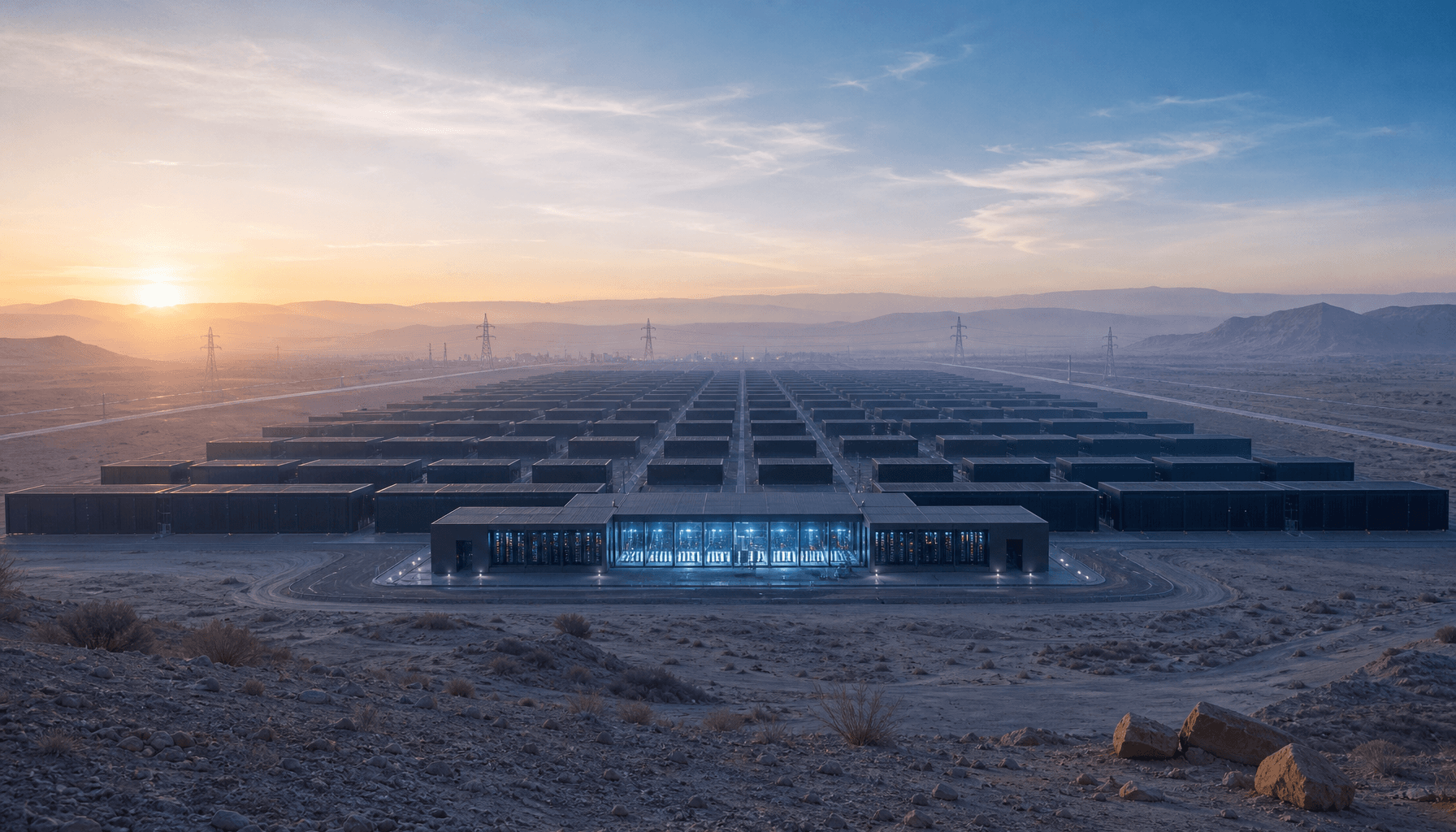
The first phase of Israel’s national AI supercomputer went live in January: 1,000 Nvidia B200 chips that Israeli startups can rent in slices as small as sixteen. On June 16, the cabinet approved a national target of 100,000.
The gap between those two numbers is now official state policy, and the three weeks that followed the vote tell you how seriously to take it. Between June 16 and July 8, in three announcements that almost nobody has connected, Israel’s government, its tech industry, and its army all began reorganizing themselves around artificial intelligence.
On June 16 the cabinet passed the new national AI program, Government Decision 4255. Its centerpiece is access, within five years, to computing power equivalent to 100,000 AI accelerators, alongside a National AI Institute, a national quantum computer built as far as possible on Israeli technology, Hebrew-language models, and a directive to treat the government’s own data as a strategic national asset. On July 5 the National AI Directorate held its first working session with industry at Industry House, with Oracle, Check Point, Armis, Kaltura, ELTA and others in the room to map who builds what. And on July 8, IDF Chief of Staff Eyal Zamir told graduates of the National Security College that the army will soon finalize a new General Staff structure dedicated to robotics, drones, and artificial intelligence.
Netanyahu compressed the strategy into one sentence:
We will turn Israel into a global AI superpower, just as we did with cyber.
The cyber playbook, run again
That line is not rhetoric; it is a literal description of the org chart. In August 2011, Government Resolution 3611 created a National Cyber Bureau inside the Prime Minister’s Office, answering directly to Netanyahu. In 2014 he stood in Beersheba and promised that the desert city would become “one of the most important places in the cyber security field in the world.” People smiled politely. A decade after 3611, in 2021, Israeli cybersecurity companies raised $8.8 billion, roughly 40 percent of all private cyber investment on the planet, and exported some $11 billion.
Now watch the rerun. September 2025: a National AI Directorate is created inside the Prime Minister’s Office, answering directly to Netanyahu. October: Brig. Gen. (res.) Erez Askal, former commander of the IDF’s visual-intelligence Unit 9900, becomes Israel’s first AI chief. June 2026: the strategy resolution. July 2026: the industry convening. Same office, same reporting line, same security-establishment operator, same playbook.
The army is running its own version in parallel. Nobody has published a link between the two tracks, but the direction is identical. In December the IDF announced its biggest tech restructuring in years, creating a dedicated operational AI division called Bina. In January, Zamir unveiled Hoshen, a five-year plan that makes AI, robotics and bigger data centers central to rebuilding the military, inside a defense envelope Netanyahu has sized at roughly NIS 350 billion over a decade. In May it inaugurated Alumot, a unit whose entire job is pushing AI tools to soldiers at the front. July 8 was the capstone: “I have set a goal for the IDF to be a global leader in unmanned systems in both defense and offense,” Zamir said.
What the plan does not have yet
Money, first of all. Decision 4255 is a strategy document, not an appropriation; the real multi-year budget arrives, or does not, with the 2027 state budget. The directorate meanwhile runs on about NIS 120 million and twenty staff positions. Tel Aviv University’s Prof. Nadav Cohen told Ynet that the 100,000-unit goal “could easily cost tens of billions of dollars,” and estimates in the Israeli press put the infrastructure bill at $20 to 30 billion. As of today, none of that is committed.
Scale, second. xAI alone passed 200,000 GPUs in Memphis more than a year ago. A single Stargate campus in Texas is being built toward roughly 450,000. The UAE is assembling a five-gigawatt AI campus in Abu Dhabi with Washington’s explicit blessing. Israel’s target, audacious by its own history, is half of what one American company was already running last May.
Physics, third. A hundred thousand accelerators would draw power like a mid-sized Israeli city, and Ynet flagged electricity as one of the plan’s biggest hurdles. Israel imports every AI chip it uses: Intel’s Kiryat Gat fab expansion has been paused for two years, and access to Nvidia’s best silicon runs through an American export policy that changed twice in five months last year, a January rule that capped Israel as a second-tier buyer, then its rescission in May. The decision sensibly keeps the state out of the server-farm business and directs partnership models instead. But partnerships still need land, power lines and permits, and in Israel those are measured in years.
And history, honestly. This is Israel’s third run at a national AI program. A 2019 expert plan went unfunded. The 2020 program was approved at more than NIS 5 billion over five years; the Innovation Authority’s own status report shows about NIS 1 billion actually moved. In November 2024 the State Comptroller found that Israel had no long-term national AI strategy at all and documented the slide: fifth in the world in the Tortoise Global AI Index in 2019, ninth by 2024. The war explains much of that. It does not refund the years.
Why I would not bet against it
Because the state is not trying to conjure an industry out of sand; it is laying rails under one that is already sprinting. Israel hosts more than 2,300 AI companies by Startup Nation Central’s count. Israeli startups raised $7.6 billion in the first half of 2026, up 52 percent year over year by IVC-LeumiTech’s tally, with AI infrastructure and AI-heavy cyber dominating the mega-rounds. Anthropic’s Economic Index has ranked Israel the most intensive user of its Claude models, per working-age adult, in the world. Israeli firms are even selling sovereignty itself: Dream, co-founded by former NSO chief Shalev Hulio, raised $260 million in June at a $3 billion valuation building sovereign AI systems for other governments. The demand side of this plan is the most proven thing about it.
But one real difference separates this play from the cyber play. Israel’s cyber miracle ran on talent, and talent was something the army minted for free, cohort after cohort of alumni who walked out of service and into startups; skeptics note, fairly, that the government mostly organized and amplified what the private sector was already doing. AI’s scarce input is different. It is compute, and compute is bought with capital and megawatts, not conscription. You cannot graduate a gigawatt from Unit 8200.
So the three weeks that just passed are real, and the shape of the plan is the shape that worked before. What turns an announcement into a superpower is follow-through, and the follow-through has a date: the 2027 state budget, where the 100,000-chip ambition either becomes a line item or becomes a memory. Israel has run this play before and won. This time, the play costs money up front.
Alex Vainer is an AI expert based in Brooklyn, NY. He works hands-on with the most advanced AI systems in the world, and writes about what they actually make possible. His subject is the frontier where artificial intelligence collides with ordinary life, in Israel, in Jewish life, and everywhere else: what is genuinely new, what is only hype, and what it means for the rest of us.