
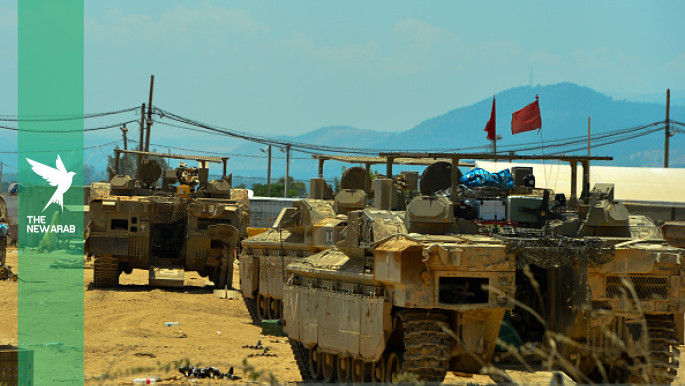
Israeli military vehicles are seen near Israel’s northernmost city, Kiryat Shmona, near its border with Lebanon [Getty]
Israel’s political leadership has instructed the military to freeze all operations classified as “sensitive” in southern Lebanon following a request from the United States, Israel’s public broadcaster reported Friday evening.
According to Kan, the directive will remain in force until further notice, pending greater clarity over the current escalation between the US and Iran, as well as the ongoing negotiations between Israel and Lebanon.
It was not made immediately clear what types of operations were considered “sensitive”.
Kan reported that US officials, who have in recent days focused on the war with Iran, are concerned that Israel could be drawn into the conflict again if fighting in Lebanon worsens. Iran insists Lebanon be included in Tehran’s memorandum of understanding with Washington.
Israel and Iran last exchanged direct attacks in June, with tensions escalating again this week after multiple tankers were hit by reported Iranian fire in the Strait of Hormuz on Tuesday, and the US struck targets inside Iran as a responde.
Despite the flareup and US President Donald Trump saying the memorandum with Iran was “over,” mediators including Pakistan and Qatar are still attempting to salvage a diplomatic track.
Quoting an Israeli security source, Kan said Israel was prepared to exploit any Iranian attack to launch large-scale strikes inside Iran but that, following pressure from the White House, the Israeli military was instructed to temporarily pause the plans in order to avoid widening the current confrontation even further.
Israeli withdrawal before Rome talks unlikely
Israeli airstrikes and shelling continued on Friday night into Saturday morning in southern Lebanon, with hits reported in the town of Kfar Tebnit – a strategically located area overlooking key approach routes in the Nabatieh governorate where Israeli forces have for weeks been operating and trying to capture the nearby Ali al‑Taher Ridge.
In a related development, Kan reported that the Israeli military expects to begin withdrawing from the designated “pilot zones” in southern Lebanon as early as this week, coinciding with a new round of talks between Lebanon and Israel in Rome.
The broadcaster added that a US delegation responsible for coordinating the two sides visited Israel last week and is expected to travel to Lebanon in the coming days to attend meetings aimed at finalising the remaining security arrangements ahead of a planned Israeli withdrawal from the villages of Zawtar al-Gharbiya and Froun.
The Financial Times previously reported that a US military delegation was expected to arrive in Beirut to help implement the US-brokered framework agreement, which was signed on 26 June between Israel and Lebanon but rejected by Hezbollah.
Citing two senior Lebanese officials, the newspaper said a delegation from the US Central Command is expected to visit Lebanon ahead of the talks in Rome.
FT also reported that an undisclosed security annex to the framework agreement contains details on the deployment of the Lebanese army in areas vacated by Israeli forces. It does not specify, however, which two pilot zones are expected to be handed over during the initial phase.
Citing two senior Lebanese officials and a Western diplomat, the newspaper said Beirut expects “some movement” from Israel soon regarding one of the pilot zones, although expectations remain low that any withdrawal will take place before the Rome talks.
Israel has repeatedly threatened to remain in southern Lebanon if Hezbollah is not disarmed. The Iran-backed group has refused to disarm as long as the occupation continues. Israeli attacks on Lebanon since March have killed more than 4,300 people and wounded thousands more.