
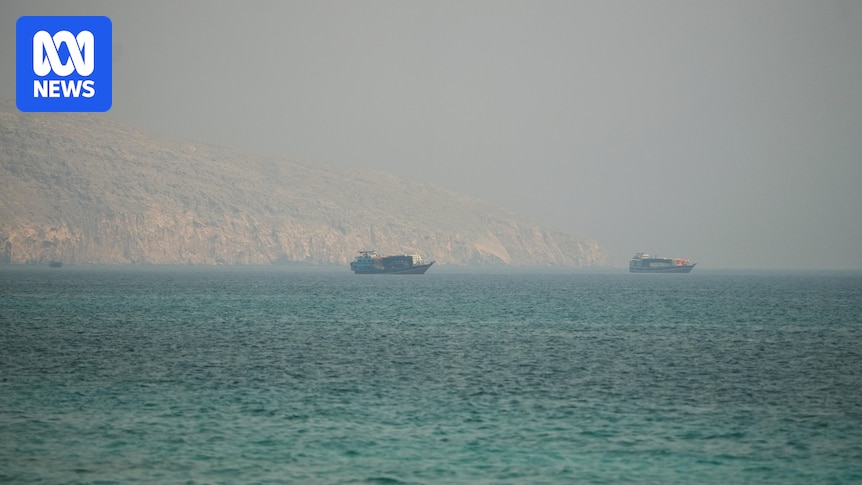
The United States Central Command (CENTCOM) says the US has begun launching a third round of strikes on Iran at the direction of US President Donald Trump in response to an attack on a civilian ship transiting the Strait of Hormuz.
A crew member on the M/V GFS Galaxy, a Cyprus-flagged container ship, is missing, according to CENTCOM, and the ship is stuck in the strait due to an onboard fire and significant engine room damage.
“Iran was provided yet another opportunity to demonstrate adherence to the Memorandum of Understanding after being held accountable for earlier attacks on commercial vessels, but has again failed,” CENTCOM’s statement said.
“In response, the United States is imposing a heavy cost by continuing to degrade Iran’s ability to attack civilian mariners and commercial ships freely transiting the strait.”
Explosions have been heard in the Iranian port cities of Bandar Abbas, Sirik and Chabahar, according to Iranian media, as well as on Qeshm Island, the largest island in the Persian Gulf and home to an underground Iranian missile base.
Iran earlier acknowledged the attack on the GFS Galaxy, saying it now considered the Strait of Hormuz to be closed “until further notice” after the ship travelled on an unapproved route, prompting the Revolutionary Guards to fire a “warning shot”.
“A vessel that had jeopardised maritime security by switching off its systems was struck and brought to a halt,” the Islamic Revolutionary Guard Corps navy said in a statement, adding that any retaliation would itself be met with a “severe response”.
The US is demanding that Iran publicly state it will stop attacking ships in the Strait of Hormuz and commit to opening all of the waterway’s shipping lanes with no tolls, senior US officials said on Friday.
Iranian foreign minister meets Omani counterpart
Efforts to quell the renewed violence are underway on both sides, with a senior Iranian source telling the Reuters news agency that Iran, the US, Qatar and Pakistan had agreed to negotiate.
The negotiation was intended to take place in a call that mediators were trying to arrange for Saturday, while Iran’s Foreign Minister Abbas Araghchi was in Oman.
It was not immediately clear whether the efforts were successful.
Mr Araghchi did meet Omani Foreign Minister Sayyid Badr Albusaidi to exchange “views on appropriate mechanisms for the safe passage of ships through the Strait of Hormuz,” according to a statement from his office.
However, Oman’s state news agency later said that Omani and Iranian negotiators would continue talks “at the technical and political levels”, and no further announcements were made.
Oman is helping to mediate an end to the war that has destabilised the Persian Gulf and raised prices around the world since the US and Israel launched air strikes on Iran in February.
About one-fifth of the world’s oil supply transited through the Strait of Hormuz before the war, and Iran’s effective blockade of the waterway has caused energy prices to surge, fuelling global inflation.
US cable news outlet CNN reported on Saturday that Oman had proffered a draft proposal for the strait, including free navigation through its southern corridor in Omani territorial waters.
The plan called for vessels transiting the northern corridor through Iranian territorial waters to obtain prior approval from Iran, although no tolls would be imposed, CNN said.
The White House and State Department did not immediately respond to requests for comment on the CNN report.
ABC/Wires
Loading