
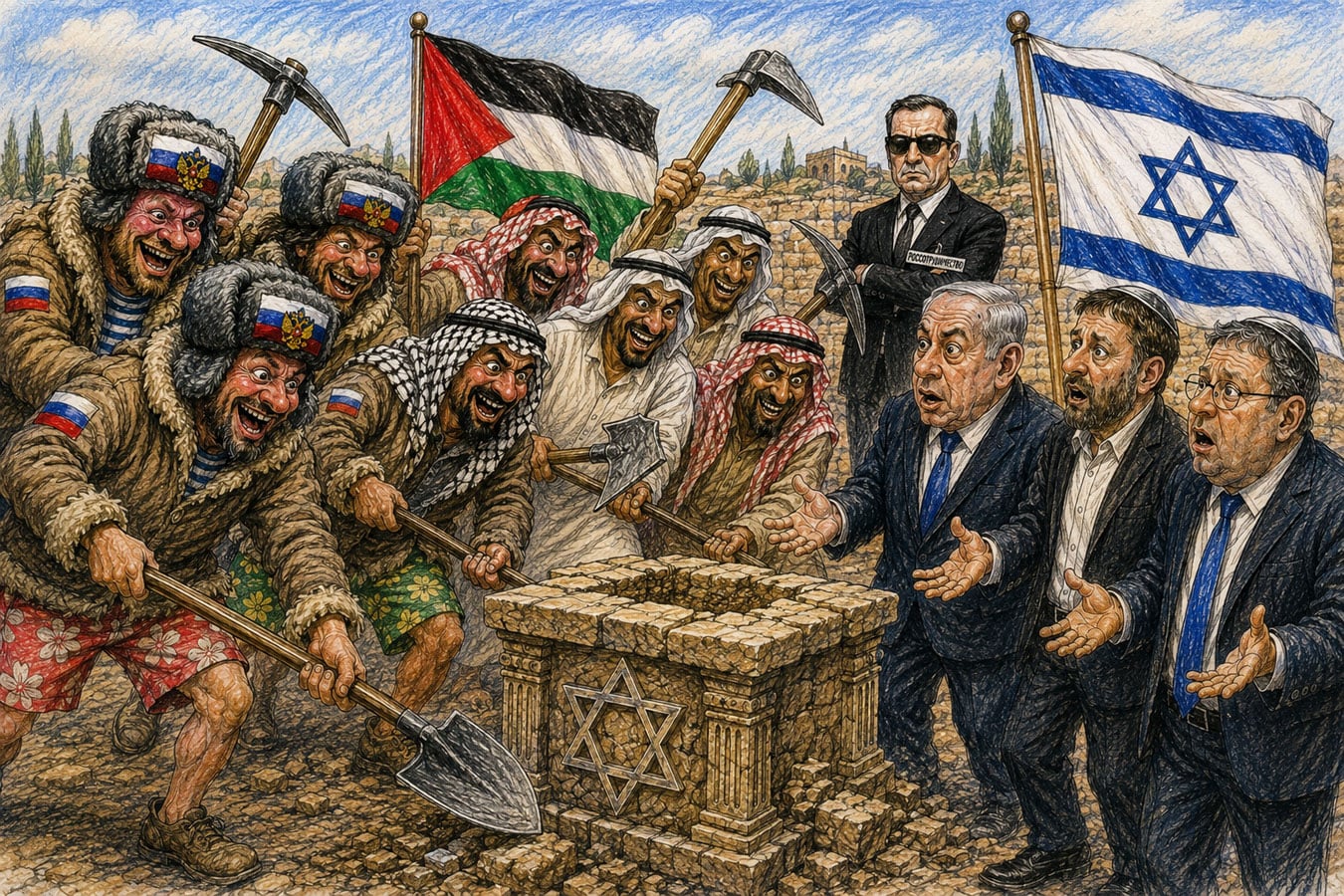
Russia has found another way to challenge Israel, and this time the battlefield is not military, diplomatic, or economic. It is archaeological.
On July 9, 2026, the Rescue Archaeology Center of the Institute for the History of Material Culture of the Russian Academy of Sciences signed a memorandum of cooperation with the Palestinian Authority’s Ministry of Tourism and Antiquities. The document was presented as a professional agreement devoted to the protection, study, and digital documentation of cultural heritage, yet the political meaning of the project becomes difficult to ignore once one examines who stands behind it, which sites have been selected, and how those sites are being described.
The central question is not whether ancient monuments should be preserved. They should. Nor is the problem that Palestinian institutions wish to study historical sites located under their administration. The real issue is that Russian state structures are entering one of the most sensitive historical disputes in the region and helping one side establish an international narrative in which monuments connected with biblical history, the Second Temple period, and ancient Jewish Jerusalem are presented primarily as the “cultural heritage of Palestine.”
That is not a neutral scientific position. It is a political choice.
A memorandum backed by the Russian state
The agreement was signed by Natalia Solovyova, director of the Russian Rescue Archaeology Center, and Hani al-Hayek, the Palestinian Authority’s minister of tourism and antiquities. The ceremony took place by video conference and included Mikhail Piotrovsky, director of the State Hermitage Museum, as well as Russian diplomatic representatives.
The meeting was moderated by Timofey Bokov, head of the local office of Rossotrudnichestvo. The Russian House in Palestine later stated that it had coordinated the project and was prepared to continue supporting Russian-Palestinian cooperation in the field of cultural heritage.
That detail matters because the Russian House is not an independent cultural society or a private academic foundation. It is the local representation of Rossotrudnichestvo, the Russian federal agency responsible for cultural diplomacy and humanitarian influence abroad.
The project therefore brings together the Russian Academy of Sciences, the Hermitage Museum, Russian diplomacy, and Rossotrudnichestvo. This is not a small expedition organized by a few scholars working outside the political system. It is a state-backed Russian initiative with institutional, diplomatic, and cultural weight.
The memorandum also forms part of a much larger program called the “Digital Archive of Monuments of Africa and the Islamic World.”
The project is being implemented by the State Hermitage Museum and the Rescue Archaeology Center of the Institute for the History of Material Culture. Mikhail Piotrovsky presented it on March 25, 2026, at a meeting of Russia’s Presidential Council for Culture, after which Vladimir Putin publicly promised support.
This raises an obvious question. Why are sites connected with the Second Temple, the Temple Mount, and biblical Jericho being included in a state program devoted to “Africa and the Islamic World”?
The modern political status of a territory does not determine the historical identity of the monuments located there. Nor does current administration erase the civilizations that created those monuments centuries or millennia before the Arab conquest or the emergence of Islam.
Only two concrete sites have been named
Russian specialists have said that three or four sites may be selected for the first stage of the project according to the priorities of the Palestinian Authority. However, only two specific locations have been publicly identified.
The first is Solomon’s Pools — בריכות שלמה — south of Bethlehem.
The second is Tell es-Sultan — תל א־סולטאן, also known in Israel as Tel Jericho, תל יריחו.
Other categories, including Roman cisterns, ancient water systems, Christian churches, and Islamic structures, were mentioned more generally. They should not be confused with a confirmed initial list of selected monuments.
Both named sites have been presented in Russian and Palestinian communications as part of the “cultural heritage of Palestine.” Yet neither Solomon’s Pools nor Tell es-Sultan was created as an Islamic monument.
This distinction is not semantic. It goes to the heart of the entire dispute.
Solomon’s Pools and the infrastructure of Jewish Jerusalem
Solomon’s Pools are connected with the ancient water system known in Israeli archaeology as the Lower Aqueduct to Jerusalem — אמת המים התחתונה לירושלים.
The aqueduct carried water from the area of the pools toward Jerusalem and the Temple Mount. Israeli archaeological research associates its construction with the Second Temple period, most likely with the Hasmonean or Herodian era.
That does not mean every surviving wall, channel, or repair belongs to a single phase. The system continued to be used, restored, and modified during Roman, Byzantine, Islamic, Mamluk, and Ottoman rule, and those later layers form a legitimate part of the site’s history.
But later use does not erase the identity of the system’s central ancient layer.
The Lower Aqueduct was part of the infrastructure of Jewish Jerusalem. It carried water toward the city and the Temple Mount during the Second Temple period, when Jerusalem stood at the center of Jewish religious and national life.
To describe the entire complex merely as “Palestinian cultural heritage,” without clearly acknowledging its relationship to the Second Temple, Hasmonean rule, and the Temple Mount, is therefore not a neutral act of classification. It is an interpretive decision that can push the Jewish origin and significance of the system into the background.
That is precisely why the site has become politically sensitive.
Why the timing of the agreement matters
The memorandum was signed at a moment when Solomon’s Pools were already at the center of a renewed confrontation between Israel and the Palestinian Authority.
In 2026, Israeli officials, including Finance Minister Bezalel Smotrich, visited the site and emphasized its connection with the Hasmonean and Second Temple periods. Israeli participants argued that leaving such a historically significant location under Palestinian administration had been one of the mistakes created by the Oslo process.
The Palestinian Authority responded by presenting the pools as an integral part of Palestinian national identity and accusing Israel of attempting to “Judaize” the site. Hani al-Hayek, the same minister who later signed the memorandum with Russia, announced efforts to defend the site through local and international channels.
Natalia Solovyova herself acknowledged that there was a “very difficult situation” around Solomon’s Pools.
The difficulty is not only archaeological or technical. It is a struggle over administration, historical terminology, political legitimacy, and the right to decide what the site represents.
Only weeks after the conflict intensified, the Palestinian Authority secured the involvement of Russian state institutions.
That sequence cannot simply be dismissed as coincidence.
Tell es-Sultan: prehistoric Jericho and biblical memory
The second named location, Tell es-Sultan, requires the same historical precision.
Tell es-Sultan is one of the oldest known permanent settlement sites in the world. Its earliest monumental layers predate the Jewish people by thousands of years, which means it would be historically incorrect to claim that the entire site was built by Jews.
But it would be equally incorrect to present it as a monument of Arab or Islamic origin.
Its earliest layers existed many millennia before the Arab conquest of the region. At the same time, Jericho occupies a central place in the Hebrew Bible and in Jewish historical memory, particularly in the story of the Israelites crossing the Jordan and entering the land under Joshua.
Israeli archaeological terminology identifies Tell es-Sultan with biblical Jericho — יריחו המקראית.
This does not make every archaeological layer Israelite, nor should it. Tell es-Sultan is a multilayered human monument of global significance, but its biblical and Jewish importance cannot honestly be detached from its identity.
The problem begins when a prehistoric site that is also deeply connected with biblical memory is placed within a Russian state archive devoted to the “Islamic World,” while its Jewish and biblical dimensions are treated as secondary or politically inconvenient.
Tell es-Sultan was not created by Islamic civilization. Its deepest layers long predate Islam, and the city’s place in Jewish tradition is fundamental.
Archaeological sovereignty
The larger issue is what might be called archaeological sovereignty.
This is not only the question of who physically controls a site or who sends a team to scan it. It is also the question of who names the monument, who determines its official periodization, who writes the historical summary attached to its digital model, and who owns the raw data.
A serious digital archive does not consist only of photographs or three-dimensional shapes. It includes official names, geographic classifications, historical descriptions, bibliographic material, cultural attribution, restoration priorities, educational explanations, and records of which authority is considered responsible for the monument.
Once that archive is created by respected institutions, it can be used by museums, universities, tourism agencies, journalists, researchers, and international organizations. It can influence future exhibitions, educational materials, heritage campaigns, and perhaps even later discussions in bodies such as UNESCO.
The important question is therefore not only who scans the stones.
It is who writes their digital biography.
What NAnews found
At NAnews – Israel News, an Israeli media project created by Israelis with Ukrainian roots, we examined the Russian and Palestinian presentation of the July 9 memorandum alongside the Israeli archaeological description of the named sites.
The contrast is striking.
Israeli archaeology describes Solomon’s Pools and the Lower Aqueduct within the context of Second Temple Jerusalem, the Hasmonean or Herodian period, and the Temple Mount. The Russian-Palestinian framework places the same area inside a broader program dedicated to the monuments of “Africa and the Islamic World.”
Israeli terminology identifies Tell es-Sultan with Tel Jericho and biblical Jericho. The new partnership emphasizes its place within the national heritage of “Palestine.”
The problem is not that Palestinian institutions wish to preserve monuments under their control. The problem is that Russia is providing one side with state scientific institutions, technology, the prestige of the Hermitage, and the infrastructure of Rossotrudnichestvo, while Israel is excluded from a project involving sites inseparable from Jewish history.
This is why the memorandum deserves attention far beyond the archaeological community.
Russia has chosen a side
Russia is not acting as a neutral scientific mediator.
Moscow could have proposed a joint framework involving Russian, Israeli, and Palestinian archaeologists. It could have invited the Israel Antiquities Authority to participate. It could have required every digital entry to document all relevant periods openly and professionally: prehistoric, Canaanite, Israelite, Judean, Hellenistic, Roman, Byzantine, Christian, Islamic, Mamluk, and Ottoman.
There is no public indication that it did so.
Instead, Russia chose the Palestinian Authority as its only local governmental partner. The Palestinian side will help select the priority monuments. Rossotrudnichestvo coordinates the project. The Russian Academy of Sciences provides the technology. The Hermitage contributes prestige and institutional authority. Putin’s government has publicly endorsed the broader initiative.
Russia is therefore providing the Palestinian Authority with much more than scanning equipment.
It is supplying state institutions, diplomatic infrastructure, cultural legitimacy, and an international platform through which monuments of biblical and Jewish history may be established in global discourse specifically as the heritage of “Palestine.”
That is not neutrality. It is a political position.
It also fits a broader pattern in which Moscow presents itself as a defender of culture while using cultural institutions to strengthen influence, promote preferred narratives, and build alliances against Western countries and Israel.
In this case, archaeology becomes another instrument of political pressure.
The wider conflict over Sebastia
The issue does not end with Solomon’s Pools and Jericho.
A similar struggle surrounds Sebastia, ancient Samaria, near Nablus. The site contains remains connected with Samaria, the capital of the northern Kingdom of Israel, as well as later Hellenistic, Roman, Byzantine, Christian, Islamic, Crusader, and Ottoman layers.
Every one of those periods deserves study and preservation.
But the ancient Israelite identity of Samaria cannot be dissolved into a vague modern national label that hides the role the city played in the history of the Kingdom of Israel.
Israel and the Palestinian Authority are fighting not only about preservation. They are fighting about land, access, tourism, administration, infrastructure, and the historical story presented to visitors.
Who will build the visitor center? Who will guide the tourists? Who will determine whether Samaria is introduced first as the capital of an ancient Israelite kingdom or primarily as a site of “Palestinian national heritage”?
Those are not marginal questions. They shape how the past is understood.
Defending Jewish history does not erase anyone else’s
It is important to be clear about what this argument is not.
It is not a demand to erase Roman history. It is not an attempt to deny Byzantine or Christian heritage. It does not seek to remove Islamic, Mamluk, or Ottoman periods from the story of the land.
All those civilizations existed here, left monuments, and deserve serious scholarship.
The archaeology of the Land of Israel is complex precisely because one civilization followed another, sometimes building over earlier structures, sometimes adapting them, and sometimes preserving them.
But complexity cannot become an excuse for deleting origins.
If an aqueduct was constructed during the Second Temple period to bring water toward Jerusalem and the Temple Mount, that Jewish context must be stated clearly.
If Samaria served as the capital of the ancient Kingdom of Israel, that historical fact cannot be hidden behind a generic political label.
If Jericho’s earliest layers predate all modern nations, they cannot be transformed into Islamic heritage simply because a contemporary project places them inside that category. Nor can the city’s biblical role be dismissed as irrelevant to Jewish memory.
Modern administration and historical origin are not the same thing.
What Israel should do
The Israeli government should not remain silent.
The Foreign Ministry should request the full text of the July 9 memorandum, including its funding arrangements, the proposed list of sites, and the rules governing access to the resulting digital archive.
Israel should demand clear answers to several questions.
Who will own the raw scans and geospatial data?
Who will write and approve the historical descriptions?
Will research conducted by the Israel Antiquities Authority be included?
Will the Hasmonean, Herodian, Second Temple, ancient Israelite, and Judean periods be identified explicitly?
Can the archive later be used in museums, educational programs, international exhibitions, or heritage claims without Israeli participation?
Israel should insist on transparency, the participation of Israeli specialists, and full recognition of Jewish historical periods in every digital record connected with these monuments.
It should also accelerate its own high-quality digital documentation of heritage sites throughout Judea and Samaria and publish those materials in Hebrew, English, Arabic, and Russian.
Digital archives shape public memory. Once a politically framed description enters museums, universities, and international databases, correcting it becomes much more difficult.
Israel must not remain silent
Solomon’s Pools and the aqueduct leading toward the Temple Mount are part of the heritage of Jewish Jerusalem.
Samaria was the capital of the ancient Kingdom of Israel.
Jericho is one of the central cities of biblical memory, even though its earliest layers are older than every modern national identity in the region.
This heritage belongs to Jewish history because crucial structures and historical layers of these places were created during biblical, ancient Israelite, and Judean periods.
Recognizing that fact does not deny the connection of other peoples to the land. Nor does it erase the many later civilizations that lived here.
But modern agreements cannot change the origin of ancient monuments.
Russia has entered this struggle from the Palestinian side and wrapped its political involvement in the respectable language of archaeology, digital preservation, and cultural cooperation.
The stones themselves cannot be rewritten.
Their descriptions can.
And if Israel remains silent, Russia and the Palestinian Authority may succeed in changing how the world understands them.