
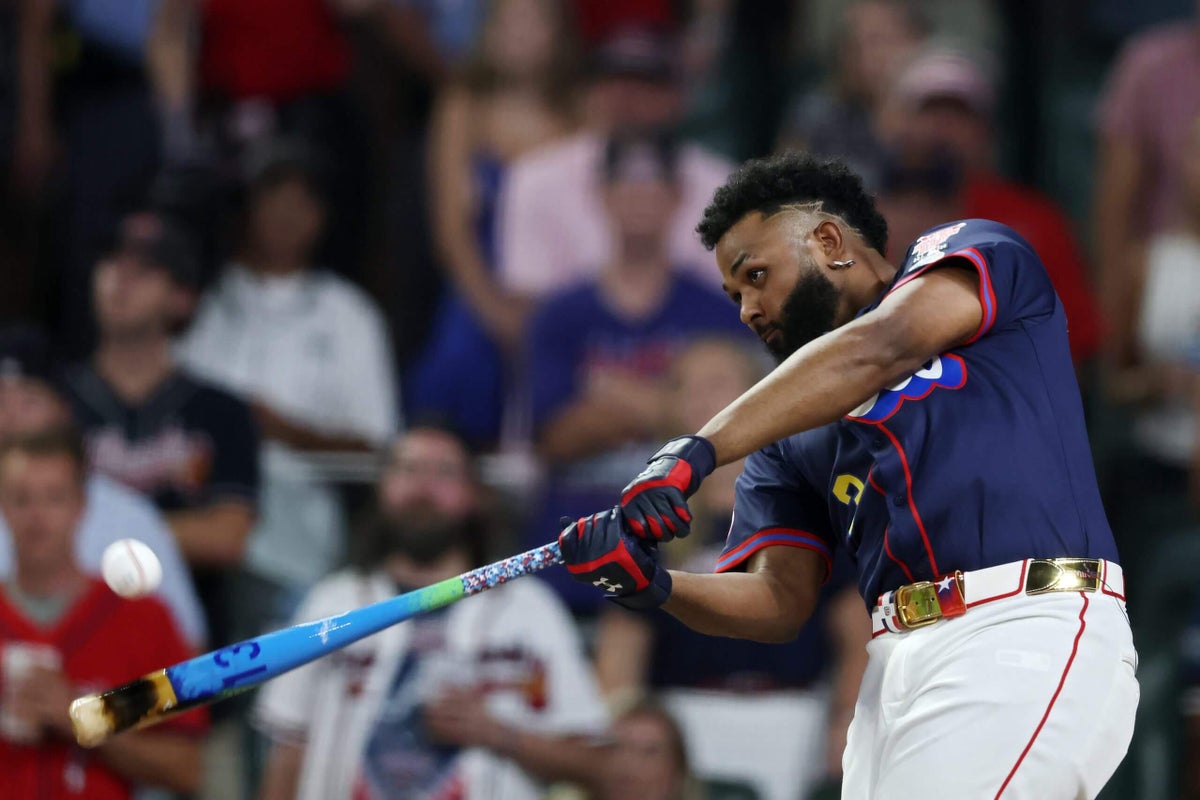
The Athletic has live coverage of the 2026 MLB Home Run Derby.
Few sporting contests, aside from perhaps a 50-yard dash, seem more straightforward than a home run derby. Played to backyard fences and playground swing sets all around the world, the basic concept appears clear-cut enough for both kindergarteners and washed-up has-beens: Just hit the most dingers.
If only it were that simple.
On Monday night, Major League Baseball will introduce a stripped-down, back-to-basics version of its classic all-star break feat of strength. No more clock. No more bonus rounds. Just a set number of swings to see which slugger can hit the most balls over the fence.
“The idea is to slow the pace down a little bit, simplify the rules a little bit,” MLB executive vice president of baseball operations Morgan Sword said.
The format change is not radical, but it’s the biggest Home Run Derby adjustment since the event moved to a clock-based format in 2015, and it comes as the event’s broadcast is moving from ESPN to Netflix, the streaming giant that has in recent years moved into the live sports landscape primarily by targeting premier events rather than day-to-day content.
“The volume play is not really our strategy,” Netflix vice president of sports Gabe Spitzer said. “Across sports, how can we show up at meaningful points across the season?”
For Netflix and Major League Baseball, the Home Run Derby is one of those meaningful points. It’s an opportunity for the league to showcase elite and emerging talent, for players to compete in a high-profile but low-stakes event, and for a streaming service to engage with a global market (Netflix was thrilled when Venezuelan slugger Willson Contreras joined the field, and then Japan’s Munetaka Murakami followed).
MLB has long tinkered with the derby, but Sword said these specific changes were based on feedback from fans, players and former players, including past Home Run Derby participants Albert Pujols, Ryan Howard and Prince Fielder.
Throughout those conversations, Sword said, two seemingly contradictory bits of criticism were consistent: The Home Run Derby had become too fast-paced, but it also took too long.
“It was hard as a viewer to follow along with what was going on,” Sword said.
Keeping track of the score was tough because some of the scoring was complicated (bonus rounds and such), and fans were left to monitor a swing and a clock at the same time. The moment one ball left the yard, another pitch was on the way, leaving no time to admire the truly majestic home runs that have been the main attraction of past derbies.
The hope is, with a set number of swings — 20 in the first round, 15 in the second and third rounds — the competition will move along at a reliable pace while still allowing time to admire the moonshots. There is no bonus round per se, but a player who homers on his final swing can keep going until he fails to go deep (so, in theory, there’s always a chance to catch up). The first-round tiebreaker is the longest home run. A three-swing swing-off will break ties in the semifinals and finals.
Netflix, which also broadcast MLB’s standalone season opener on March 25 and will air the Field of Dreams game Aug. 13, expects Monday night’s Home Run Derby to last roughly two hours. The broadcast will begin at 7 p.m. ET, the contest will start at 8, and much of the viewing experience should be relatively familiar, especially in the United States. Pujols and Barry Bonds will provide insight and analysis throughout. CC Sabathia will be one of the roving reporters. MLB Network mainstay Matt Vasgersian will lead the core group of on-set analysts and commentators. There will be some Netflix star power involved — Will Ferrell, Luke Wilson and Jimmy Tatro from the upcoming The Hawk comedy series are going to be involved — but otherwise, it shouldn’t look much different than in the past.
“We’re not trying to remake the derby,” Spitzer said.
But Netflix is trying to attract viewers all over the world, and so the broadcast will be presented in different languages. When the American League replaced Toronto Blue Jays superstar Vladimir Guerrero Jr. with Boston Red Sox first baseman Contreras — a player who just won the World Baseball Classic with Team Venezuela, a country most recently devastated by two large earthquakes — Netflix began talking to the league about getting Contreras included in the Derby.
“Not just because I’m a Red Sox fan,” Spitzer said. “Wouldn’t it be such an amazing story to have him in?”
Contreras and Murakami were added to the field alongside Tampa Bay Rays third baseman Junior Caminero, St. Louis Cardinals outfielder Jordan Walker, Kansas City Royals outfielder Jac Caglianone, New York Yankees first baseman Ben Rice and a pair of Philadelphia Phillies swinging in front of the home fans: first baseman Bryce Harper, one of the sport’s biggest stars, and major league home run leader Kyle Schwarber.
Harper won the Home Run Derby in 2018 while participating in his then-home ballpark in Washington D.C. He beat Schwarber, then of the Chicago Cubs, in the final round.
“Derby at home? Sure why not?” Harper wrote on Instagram to announce his participation again this year.
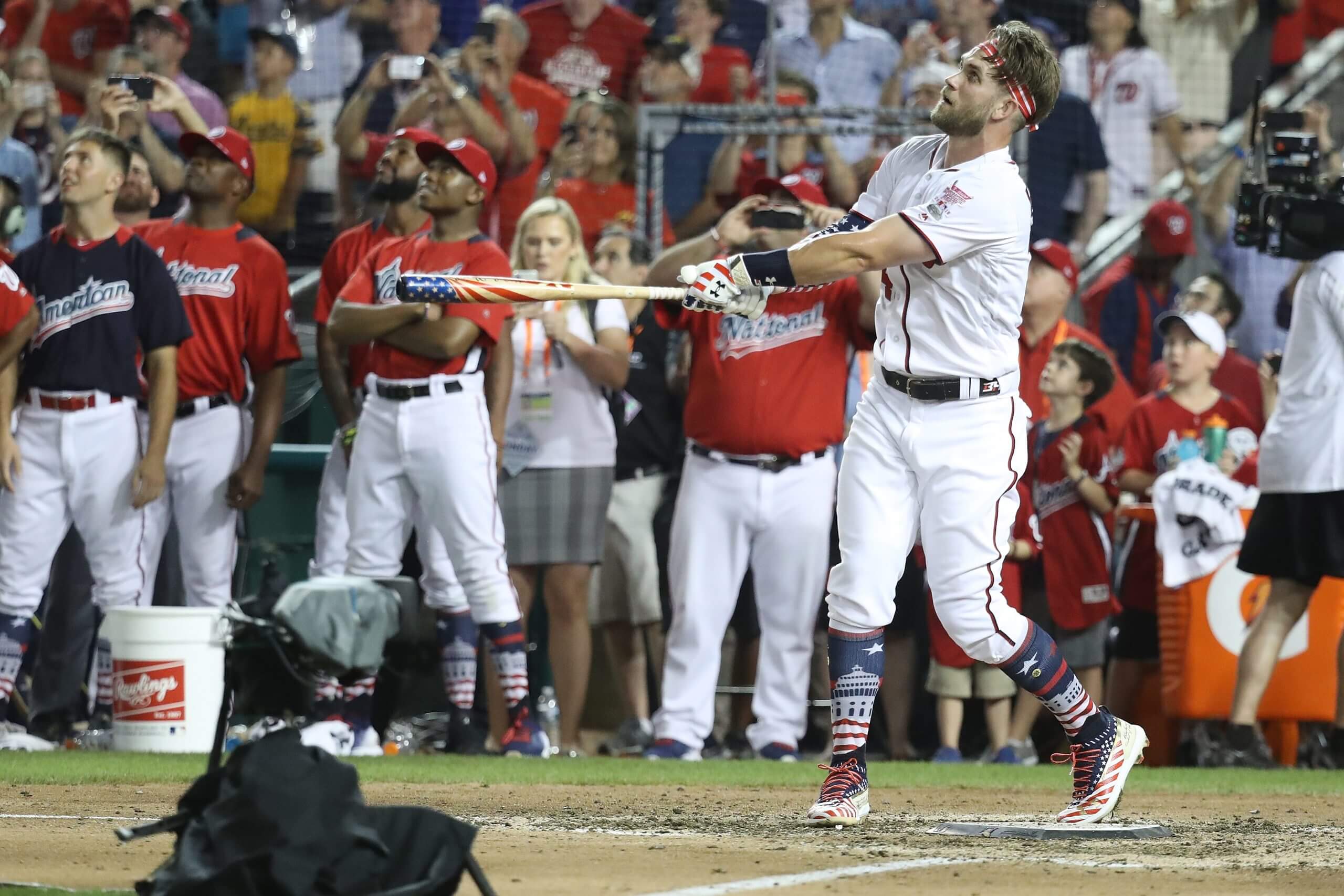
Bryce Harper won the 2018 Home Run Derby under the older clock format. (Rob Carr / Getty Images)
MLB first introduced the Home Run Derby in 1985, and for 30 years, the contest was based on outs. The details occasionally changed, but essentially, players tried to hit as many home runs as possible before making a certain number of outs (an out being any swing that didn’t result in a home run).
In 2015, the format was radically altered. The outs were eliminated and a clock was introduced. Players were tasked with hitting as many home runs as possible within a time limit, a format that initially added a spark.
“You had to pick the pace up a little bit,” Todd Frazier said in 2015 after he won that year’s derby and hit what was, essentially, a buzzer beater. “You felt like a little kid out there sometimes, in the backyard, swinging at everything. It was pretty cool.”
In the years to follow, “swinging at everything” became less feature and more bug. Players realized that an exceptional first round often left them exhausted. Seattle Mariners center fielder Julio Rodríguez, for example, hit a record 41 first-round homers in 2023 but was immediately knocked out in the semifinals. The final round that year was between Guerrero and Randy Arozarena, the players who hit the fewest first-round home runs of anyone who advanced. Under the new format, every hitter will be allowed the same number of swings — with some wiggle room at the end — which, ideally, will keep exhaustion in check and relatively consistent.
“Hopefully this will allow for a more natural pace for hitters,” Sword said, “where they can have more fun as well.”
The fun part of it is not lost on anyone.
“The other thing we were focused on was making the event a little bit easier to players to compete in,” Sword said.
The Home Run Derby is at its most thrilling when it has star power, which Sword acknowledged can come in three ways:
Getting the biggest names in the sport to participate. (Ken Griffey Jr. in the 1990s, young Aaron Judge in 2017, or 42-year-old Pujols in 2022.)
A hometown hero for the crowd to get behind. (Ryne Sandberg won it at Wrigley Field in 1990, Frazier won in Cincinnati in 2015, Harper completed a thrilling comeback at Nationals Park in 2018, and Rodriguez electrified Seattle in 2023.)
Singular performances that captivate the audience. (Mark McGwire hitting balls out of Fenway Park in 1999, Sammy Sosa hitting balls out of Wisconsin in 2002, Josh Hamilton’s iconic first round in 2008, Guerrero and Joc Pederson’s swing-off in 2019.)
Harper’s and Schwarber’s participation meaningfully boosted this year’s star power while also providing hometown sluggers to root for, but Caminero is one of the best young hitters in the game, Contreras could be a feel-good story, and Rice is the third-best hitter in baseball according to wRC+. Did the format change impact the desire to participate?
“I wouldn’t say it impacted the desire,” Rice said. “But I do like the new rules. I think it’s good. It also takes pressure off the BP thrower because I don’t have to swing at every pitch. I think, overall, it’s a positive change.”
The changes greatly diminish the possibility of a record-setting round, but for a straightforward contest that’s all about quantity, it’s often the quality of each round and each individual home run that captures the imagination.
“Try to give the audience an opportunity to really enjoy each of these homers,” Sword said. “Even if it may result in fewer overall homers hit at the event.”
With reports from The Athletic‘s Brendan Kuty