
The cuts, the outlet said, reflected the Islamic Republic’s failure to support people covered by the welfare system, particularly those with disabilities, during a deepening economic crisis.
“For me, the question is why they cut my living allowance when even they say my disability is severe and I have developed pressure sores,” 44-year-old Hossein, whose payments stopped last month, told ILNA.
Hossein said the State Welfare Organization also provides no meaningful assistance with medication costs and refused to reimburse expenses from a surgery because it was performed during the past year.
The worsening economic situation, he added, had also reduced the ability of charities to support people with disabilities.
Rising costs deepen hardship
Many people with disabilities, ILNA said, are unable to work and depend largely on modest welfare stipends and subsidies for their livelihoods.
The report argued that deteriorating conditions stem from ineffective state policies and a lack of equal social, economic and political opportunities, warning that services become even more limited outside the capital.
The economic downturn, coupled with sharply higher healthcare and medicine costs, has placed additional strain on people with disabilities, many of whom require continuous medical treatment, rehabilitation services and specialized equipment.
In May, Khabar Online news outlet reported that rising prices for hygiene and medical supplies had affected around 45,000 people living with spinal cord injuries. Prices for essential items including sterile dressings, catheters, catheter bags, syringes and medicines for pressure sores had increased two- to three-fold.
Subsidies cover only days of expenses
Raheleh, a 45-year-old woman with a spinal cord injury, told that the monthly hygiene subsidy of 15 million rials ($8.2) was far below what was needed.
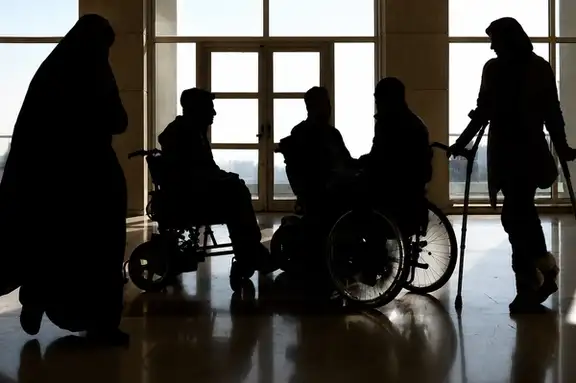 Silhouettes of people with disabilities gather inside a public building in Iran.
“I have to use disposable catheters every day, and this amount only covers one week or 10 days. It cannot cover the whole month … I have never had the opportunity to work, so in these conditions of inflation I have no salary,” she said.
She described the monthly caregiver allowance of 42 million rials ($23) as “close to nothing” given her medical expenses, adding that doctor visits, diagnostic tests and transportation costs leave her unable to meet basic needs by the middle of each month.
Fatemeh Abbasi, deputy head of rehabilitation at the State Welfare Organization, said in May that the agency had requested an 80% to 90% increase in caregiver allowances, but implementation depends on government approval.