
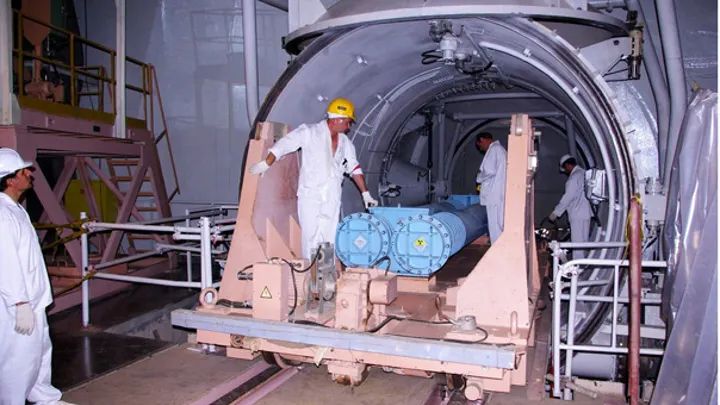
 The reactor building at the Russian-built Bushehr nuclear power plant in Iran received its first fuel load in 2010. (Credit: FARS News Agency)
Editor’s note: This is a response to an article by Sasan Karimi, titled “Beyond alarmism: A realistic assessment of Bushehr’s plutonium risk,” which itself was a response to an article by Henry Sokolski, titled “Missing from US-Iran talks: plutonium for more than 200 nuclear bombs.”
Iran has been taking steps to acquire nuclear weapons since the 1990s. These steps involved numerous violations of International Atomic Energy Agency safeguards, including conducting clandestine centrifuge enrichment. The Iranian effort also involved the partial testing and development of an unboosted levitated implosion nuclear weapon to be fitted onto a ballistic missile.
Key to this effort is obtaining the nuclear material required to produce nuclear weapons. This material could be either highly enriched uranium (HEU) or plutonium. The 2015 “Iran nuclear deal”—formally, the Joint Comprehensive Plan of Action or JCPOA—placed temporary limits on Iran’s centrifuge enrichment program, which could be used to produce HEU. The Iran deal also limited the plutonium production rate of Iran’s heavy water-moderated plutonium production reactor (euphemistically called a research reactor).
However, the Iran nuclear deal completely failed to address the large quantities of plutonium produced by Iran’s nuclear power reactor at Bushehr, which started commercial operation in 2013. If the reactor had operated as expected, it would have produced about 240 kilograms of plutonium per year, sufficient for somewhere between 24 and 40 nuclear weapons per year. Several analysts and experts, including the author, raised these concerns in the few months after the deal was signed, but no action was taken to strengthen the Iran deal.
In the aftermath of the US and Israeli attacks on Iran’s nuclear facilities in June 2025, the Trump administration has been attempting to negotiate limits on Iran’s nuclear program. This effort has focused mainly on Iran’s centrifuge enrichment program and, as in 2015, appears to be ignoring the large quantity of mostly reactor-grade plutonium that is stored in the spent fuel at Bushehr.
Bushehr’s IAEA safeguards are irrelevant. The spent fuel at the Bushehr nuclear plant is under International Atomic Energy Agency (IAEA) safeguards. This means that the IAEA inspects the spent fuel to ensure that it is still there. However, these inspections occurred only once every three months. Even if the frequency of inspections were to be increased, as we will see, with some preparation, Iran could separate the plutonium from the Bushehr spent fuel and produce metallic plutonium cores for nuclear weapons faster than the IAEA could sound the alarm and the world could react. This is the same issue that is related to Iran’s centrifuge enrichment program and its stockpile of 60-percent enriched uranium. IAEA safeguards applied to the uranium enrichment program as well, but it was recognized that Iran could use its centrifuge enrichment and stockpile of enriched uranium to produce the HEU it needed for a nuclear weapon faster than the IAEA could sound the alarm.
Bushehr’s spent fuel is still in Iran. As early as 2004, the State Department raised concerns about Bushehr’s plutonium possibly providing Iran with nuclear weapons. To allay these concerns, Iran signed an agreement with Russia, which supplied the reactor and fuel and obligated Russia to take back the spent fuel after operation. But because there was no enforcement mechanism in the JCPOA, Iran merely stated its intention to send the spent fuel back to Russia. It is unclear whether some of the spent fuel—if any—has been sent back to Russia. But in March, Russia’s Rosatom Director General Alexey Likhachev stated that 210 metric tons of spent fuel are being stored at Bushehr, suggesting that none of the spent fuel has been returned to Russia. This fuel probably contains over 2,000 kilograms of plutonium, sufficient for 200 to 300 nuclear weapons. The reactor’s capacity factor has not been as high as was expected in 2016, but the reactor is still probably producing about 200 kilograms of plutonium per year.
Sasan Karimi, a professor at the University of Tehran, attempts to downplay the significance of the continued presence of the Bushehr spent fuel by saying that its removal has just been “delayed.” However, the delay is already quite considerable—at least seven years with no prospect of it being removed any time soon. So long as the spent fuel remains at Bushehr, its plutonium will continue to be a concern.
Reprocessing plutonium doesn’t need a large plant. Various commentators have pointed out that Iran does not have the reprocessing plant needed to extract the plutonium from Bushehr’s spent fuel. For example, when Robert Pape, a professor at the University of Chicago, raised concerns about the plutonium in the Bushehr spent fuel on X, the social platform added an automated “reader added context” note that read, “Iran lacks the capability to extract it, as it has no operational reprocessing facility.”
This is not as big a barrier as one might imagine.
Sometime before 2003, in one of the many violations of its IAEA safeguards, Iran irradiated natural uranium targets in a research reactor and reprocessed the targets to extract small quantities of plutonium. It is unclear how much reprocessing was performed, since Iran did not present the recovered plutonium for inspection. The IAEA’s age-determination of plutonium traces did not match Iran’s claims as to when the reprocessing occurred.
Scaling up these reprocessing efforts will also be easier than many might think and would not require a full-scale commercial-style reprocessing plant. The basic technology used in reprocessing, solvent extraction, is used to refine uranium ores—including those mined in Iran. In 1977, Oak Ridge National Laboratory published the design of what it called a “simple, quick processing plant.” This plant would require equipment no more specialized than that obtainable from an oil refinery, could be built in four to six months, and could process full-burnup reactor fuel. This plant could be made ready before Iran removed any of the spent fuel from Bushehr.
Iran has already suggested that, due to the limited storage capacity of the spent fuel pond at Bushehr, some of the older spent fuel could be removed and stored onsite in a Russian-designed TK-13 cask. These casks are dual-purpose, meaning they can be used for spent fuel transport and storage. Any fuel more than 8 years old can be transferred from the storage pool to such casks, which would be more than one-third of the current spent fuel at Bushehr. A single cask can contain up to 12 fuel assemblies, which together would contain between 21 and 52 kilograms of plutonium, depending on the fuel burnup. If Iran were to store spent fuel in these casks, the fuel could be rapidly moved to such a simple processing plant, which could be built not far away from Bushehr.
Once the spent fuel is transported, the plant could process one fuel assembly per day, giving an output of between two and five kilograms of separated plutonium per day, depending on the spent fuel burnup. This would be sufficient plutonium for several nuclear weapons per week. Moreover, since some of the Bushehr spent fuel has cooled for more than a decade, the reprocessing would be somewhat easier. The plant would be small (about 130 feet by 20 feet, or 40 meters by 6 meters) and inconspicuous, and, as with a clandestine centrifuge enrichment plant, locating this plant before it started operation would depend on intelligence.
Production of plutonium metal is not hard. Converting the plutonium solution recovered by reprocessing into plutonium metal requires the same sort of thermite-type reaction that Iran has used to produce uranium metal. Some specific details are different, but there are several published methods,[1] and Los Alamos National Laboratory even put up a how-to video detailing each step of converting plutonium nitrate to plutonium metal.
Based on the United States’ World War II experience, the conversion from plutonium solution to metallic plutonium core would take less than one week. For Iran, the entire process from spent fuel removal from Bushehr to the production of a metallic plutonium weapon core would take less than two weeks. This would happen before the IAEA would even notice and alert the world to a possible removal of spent fuel at Bushehr.
Iran’s plutonium can be used in weapons. One of Karimi’s main arguments as to why the plutonium at Bushehr should be of little concern is that the plutonium is reactor-grade. (Grades of plutonium are defined by the concentration of the isotope plutonium 240. Reactor-grade plutonium has 19 percent or more of plutonium 240, fuel-grade between 7 and 19 percent, and weapon-grade less than 7 percent. The higher the plutonium-240 content, the larger the spontaneous fission neutron background in the weapon. If the weapon design does not take the spontaneous fission neutron background into account, the weapon might not achieve its full design yield.)
Karimi claims that “Any attempt to manufacture a reliable weapon from reactor-grade plutonium would therefore require extremely advanced implosion engineering, sophisticated diagnostics, and repeated nuclear testing.” But he refers to a Nagasaki nuclear weapon design, not to the more sophisticated unboosted levitated implosion weapon that was Iran’s actual design.
Simply reducing the amount of plutonium in the core of an unboosted levitated implosion weapon reliably solves the problems of using reactor-grade plutonium in weapons. There would be no need to make any changes to the weapon design: The reduction of the mass of plutonium would simply result in a reduced yield,[2] but it would still produce a powerful nuclear explosion. Even using high-burnup reactor-grade plutonium would only reduce the yield to 5 kilotons instead of the 20 kilotons that would be obtained using weapon-grade plutonium. The lethal area of a reduced-yield weapon would be about 40 percent of that of a full-yield weapon.
Furthermore, even though most plutonium in spent fuel is reactor-grade, the very large plutonium inventory stored at Bushehr still contains a significant fraction that is fuel-grade, that is, not reactor-grade. In 2001, researchers showed that the first-discharge fuel from a pressurized light-water reactor such as Bushehr would not be reactor-grade, but rather fuel-grade. And in 2016, using Iran’s published information, I found that Bushehr’s first discharge fuel contained about 93 kilograms of fuel-grade plutonium. This quantity is sufficient for about 13 nuclear weapons—about as many nuclear weapons as Iran could produce from its stockpile of 60-percent enriched uranium.
Like reactor-grade plutonium, fuel-grade plutonium can also be used in an unboosted levitated implosion nuclear weapon by reducing its amount. In that case, the yield of a fuel-grade plutonium weapon would be reduced to 13 kilotons instead of the full yield of 20 kilotons, resulting in a lethal area that would be 75 percent of that of a full-yield weapon.
Iran can access a plutonium weapon design. David Albright of the Institute for Science and International Security has argued that the nuclear weapon design developed by Iran in 2003 used HEU, and that Iran would need to develop a different design to use plutonium. But the design in question was an unboosted levitated implosion weapon, and the United Kingdom and France famously used plutonium in such a design. Since the point of such a weapon design is to symmetrically compress nuclear explosive material into a supercritical mass, there is no reason for plutonium not to be used equally and perform as effectively as HEU. In fact, because the mass of plutonium would be smaller than that of uranium, the plutonium might be more effectively compressed.
The British weapon designers also conclusively demonstrated that both HEU and plutonium can be used in the same unboosted levitated implosion design: In back-to-back nuclear tests in 1956, the United Kingdom successfully exploded one device using an HEU core and one using a plutonium core.[3] Both tests used the Blue Danube service weapon.
Iran has access to the levitated implosion bomb design, the details of which have been known since 2018 and are now widely available, including in Albright’s work.
Cutting the plutonium path. Russia would probably cut off the fuel supply to Bushehr if Iran were to use the plutonium stored there for nuclear weapons. But it is not certain, given that a proliferation crisis with Iran would create more problems for Washington and its allies than for Moscow. Even if Russia did cut Iran off, Tehran might consider it a price well worth paying if it can obtain a nuclear weapons arsenal.
John P. Holdren of the Harvard Belfer Center has argued that, compared to uranium enrichment, the plutonium path is far more difficult. He has said that Iran has “no spent-fuel reprocessing plant and the technology for the latter [reprocessing] is more demanding, more dangerous and more difficult to conceal and protect than that for uranium enrichment.” Before the June 2025 bombing attacks on Iran, this assessment would have been valid. But now with Iran’s centrifuge enrichment plants in ruins, its stocks of enriched uranium buried, and the United States determined to block the HEU path, a reassessment is needed.
Though certainly some amount of preparation would be required, recovering the plutonium from the Bushehr spent fuel now is arguably Iran’s easiest path to the bomb. Of course, Iran could give up its nuclear weapons effort entirely instead, but it has shown no inclination to do so for the past 30 or more years.
Dealing with the problem of the Bushehr spent fuel plutonium could require a variety of steps.
The most obvious first step would be to block the ongoing Russian construction of a second nuclear power plant at Bushehr. Russia should also be required to take back whatever spent fuel is cool enough to be moved away from Bushehr’s storage pool. This could involve any spent fuel older than three years. The remaining spent fuel would be harder for Iran to reprocess due to its greater radioactivity.
A harder step would be to permanently shut down the Bushehr nuclear power plant and remove the remaining spent fuel as soon as possible. Only by dealing effectively with the plutonium in the spent fuel at Bushehr, as well as Iran’s uranium enrichment program, will the threat of an Iranian nuclear weapon be eliminated.
This article is the product of the author’s personal research, and the analysis and views contained in it are solely his responsibility. Though the author is also a part-time adjunct staff member at the RAND Corporation, this article is not related to any RAND project, and therefore, RAND should not be mentioned in relation to this paper. Greg Jones can be reached at [email protected].
Notes
[1] See, for example: Plutonium Handbook, Volume II, Gordon and Breach, Science Publishers, New York, 1967, pp. 564-567.
[2] For detailed calculations, see: https://nebula.wsimg.com/4eb6ba13bee5765c8e2aec7d658c7cde?AccessKeyId=40C80D0B51471CD86975&disposition=0&alloworigin=1
[3] Lorna Arnold, A Very Special Relationship: British Atomic Weapon Trials in Australia, Her Majesty’s Stationary Office, London, 1987, pp. 162-163.