
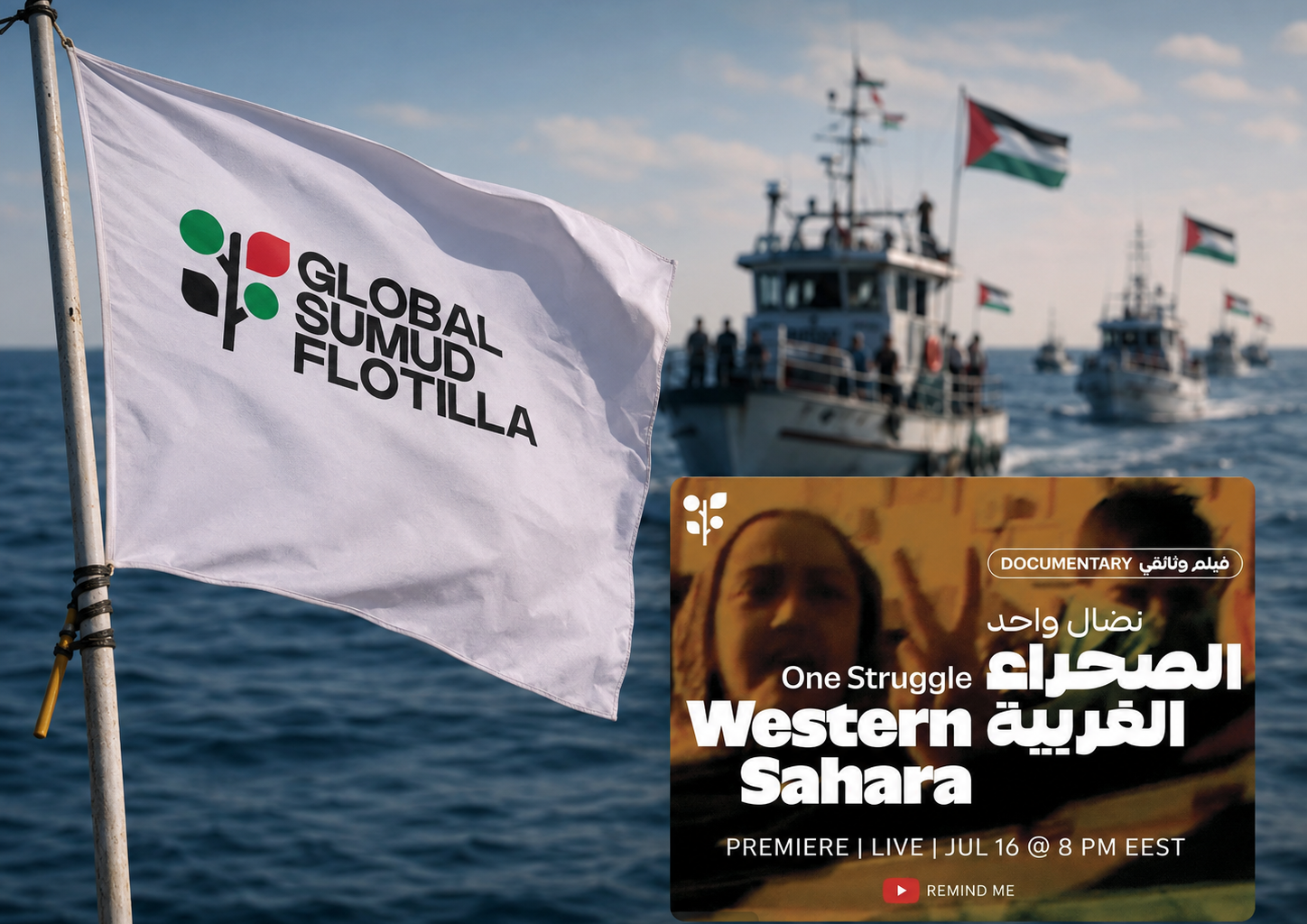
On July 14, the Global Sumud Flotilla announced that it would release a 14-minute documentary titled “One Struggle: Western Sahara” on July 16. The sprawling maritime coalition, which has spent the better part of a year sailing across the Mediterranean in the name of Palestinian solidarity, getting intercepted, getting detained, getting deported, and then sailing again to be intercepted once more, ultimately did not publish the film following strong pressure from Moroccans.
In the documentary, it formally and publicly endorsed the Polisario Front, described it as a “Sahrawi liberation movement,” falsely claimed that the International Court of Justice (ICJ) had rejected Moroccan sovereignty over the territory, and announced that this film was merely the first episode in a new series exploring what it called “the interconnection of resistance and liberation movements around the world.” The mask, in other words, didn’t slip – it was removed deliberately, folded neatly, and placed on the table for everyone to see.
For those of us who watched the Sumud Flotilla’s emergence with a suspicion that its humanitarian mission was never quite as pure as its organizers insisted, the documentary was less a revelation than a confirmation.
It was the moment when an initiative that had always traded on the emotional currency of Gaza’s suffering finally admitted that its ambitions extended well beyond the besieged strip and into the contested ideological terrain of Cold War-era liberation politics, where every conflict is the same conflict, every state is a colonizer, and every armed separatist group is a noble resistance movement deserving of unconditional solidarity.
The comparison the flotilla is attempting to draw – between Palestine and Western Sahara, between Israel’s military occupation of Gaza and Morocco’s sovereignty over its southern provinces – is not merely historically illiterate; it is politically obscene. The Polisario Front is not Hamas, and Morocco is not Israel.
The Western Sahara question, whatever one’s position on it, is a territorial dispute governed by a UN-led political process and adjudicated through Security Council resolutions – most recently Resolution 2797, which endorsed precisely the kind of negotiated political solution that Morocco has proposed through its autonomy plan.
To flatten this complexity into a slogan – “one struggle” – is to engage in the laziest, most intellectually dishonest form of transnational activism, the kind that substitutes bumper-sticker solidarity for the difficult, unglamorous work of actually understanding the conflicts it claims to care about.
And this is where the deeper fraud reveals itself, because the Sumud Flotilla, for all its theatrical grandeur – the 100+ boats, the celebrity passengers, the departure ceremonies broadcast live from Barcelona – has never actually delivered a single kilogram of aid to Gaza. Not one.
The 2025 mission was intercepted by Israeli forces in early October, with over 400 activists detained. The 2026 spring mission was intercepted twice – once off Crete in April, again off Cyprus in May – with hundreds more detained and deported. The boats sail, the cameras roll, the activists return home with stories of courage and confrontation, and the people of Gaza remain exactly as hungry, as bombed, as besieged as they were before the first vessel left port.
The flotilla is not a humanitarian operation; it is a performance – an elaborate, expensive, self-congratulatory spectacle designed to make its participants feel like they have done something meaningful while accomplishing nothing that changes the material reality of a single Palestinian life.
Compare this – and the comparison is not subtle, because it does not need to be – with what Morocco has actually done. On royal instructions from King Mohammed VI, Chairman of the Al-Quds Committee, Morocco delivered nearly 280 tonnes of humanitarian and medical aid to Gaza in 2025 alone, including 180 tonnes in July and another 100 tonnes in August, transported through an unprecedented overland corridor that Morocco was the only country to negotiate and operationalize.
The aid – food, baby formula, medicine, surgical equipment, blankets, tents – arrived. It was distributed. It reached Palestinian civilians. This is what Foreign Minister Nasser Bourita meant when he spoke, at the signing of Morocco’s International Stabilization Force (ISF) agreement on July 16, of “concrete solutions, with tangible and pragmatic contributions” – the kind of contributions that do not generate viral social media content or celebrity photo opportunities but that have the inconvenient virtue of actually existing.
And Morocco’s commitment does not end at the loading dock. On June 18, Moroccan military officers arrived at the ISF headquarters in southern Israel – making Morocco the first Arab country not merely to pledge troops to the ISF but to actually deploy them, alongside a planned military field hospital and a deradicalization program drawn from Rabat’s own counterterrorism model.
That Morocco is trusted to play this role is not an accident of geopolitics; it is the inheritance of decades of quiet, patient mediation that stretches back to King Hassan II’s secret channels between Arab capitals and Israeli leaders long before Oslo existed as a word in the diplomatic vocabulary. What distinguishes Morocco’s posture – and what infuriates the flotilla’s ideological fellow travelers – is that Rabat refuses to outsource Palestinian representation to Iranian proxies, to Hezbollah’s axis of resistance, or to any of the armed non-state actors that the global activist left has romanticized into liberators.
Morocco deals with Palestinians as Palestinians, not as instruments of Tehran’s regional ambitions, and it insists – radically, in a landscape dominated by performative militancy – that the path to Palestinian dignity runs through negotiation, institution-building, and stabilization, not through the endless recycling of armed struggle as an aesthetic.
The Bayt Mal Al-Quds Agency (BMAQ) – the operational arm of the Al-Quds Committee – builds schools, rehabilitates hospitals, funds scholarships for Palestinian students, supports orphans, and finances income-generating activities for families in East Jerusalem. Morocco, as Bourita noted, was the first country to sign an agreement with the Peace Council for Gaza formalizing its participation in the ISF. None of this happens on camera. None of it trends on social media. None of it earns the participants the intoxicating thrill of being arrested at sea and calling it resistance.
What the Sumud Flotilla has now done, by linking its brand to the Polisario Front’s separatist project, is reveal the ideological architecture that was always underneath the humanitarian veneer: a 1970s liberation theology in which the world is divided into colonizers and colonized, oppressors and resisters, and in which every sovereign state that does not conform to the fantasies of the global activist left is simply another Israel in need of dismantling.
The self-styled “Sahrawi Arab Democratic Republic (SADR)” – a paper state without territory, without a functioning government, without a population that is not confined to Algerian-administered refugee camps – has for decades modeled its entire symbolic apparatus on the Palestinian cause, right down to its flag, which follows the pan-Arab colors and is, as vexillologists have long noted, deliberately modeled on the PLO flag, with only the addition of a crescent and star on the white stripe to distinguish it.
The borrowing is not accidental; it is strategic – an attempt to import the moral authority of the Palestinian struggle into a completely different geopolitical context and to cast Morocco, a country with 12 centuries of continuous statehood, as a settler-colonial enterprise.
It is worth noting that 2 bills are currently before the US Congress seeking to designate the Polisario Front as a terrorist organization – H.R. 4119, introduced in the House in June 2025 by Republican Joe Wilson with bipartisan support, and a Senate companion introduced in March 2026 by Ted Cruz, Tom Cotton, and Rick Scott – citing the militia’s documented operational ties to Iran and Hezbollah.
But the intellectual bankruptcy runs deeper still, because the doctrine that the flotilla is now propagating – that self-determination is an unconditional, universal entitlement that overrides sovereignty, territorial integrity, and historical reality whenever a sufficiently motivated group demands it – is not a principle at all; it is a recipe for civilizational disintegration.
Follow this logic to its conclusion, and the map of the world dissolves into thousands of micro-states, each one carved from the body of an existing nation by whichever ethnic group, tribal confederation, or ideological faction manages to attract enough sympathetic documentarians and leftist European parliamentarians to its cause.
It is the geopolitics of adolescence – a worldview in which complexity is oppression, sovereignty is colonialism, and the only moral act is to break things apart, never to build them together. The serious world – the world of functioning states, of institutions that deliver water and electricity and justice, of borders that enable governance rather than obstruct liberation fantasies – operates on a different principle entirely: consolidation.
More states do not mean more freedom; they mean more borders, more disputes, more failed experiments in governance, more populations trapped in the amber of someone else’s revolutionary nostalgia. The Western Sahara question will be resolved, if it is resolved at all, through the kind of pragmatic, negotiated autonomy that Morocco has proposed and that the UN Security Council has repeatedly endorsed – not through the theatrical solidarity of activists who will sail home to Barcelona and forget about the Sahara the moment a more photogenic cause presents itself.
Morocco’s Justice and Development Party (PJD) – itself an Islamist opposition party with deep sympathies for the Palestinian cause – condemned the documentary in terms that left no ambiguity, calling it “a serious mistake and a dangerous deviation” that risked costing the flotilla whatever credibility it had built among Moroccans who had supported it in good faith.
The PJD’s statement noted that Moroccan activists had joined the flotilla to challenge Israel’s blockade of Gaza, not to have their participation instrumentalized for a separatist agenda that contradicts the national consensus on Morocco’s territorial integrity. The party accused the flotilla’s organizers of having been “infiltrated” by actors hostile to Morocco – a polite way of saying what many Moroccans were already thinking: that the entire enterprise had been compromised from the start.
The deeper lesson here is not about the Sumud Flotilla, which will sail again and be intercepted again and accomplish nothing again. The deeper lesson is about the fundamental distinction between activism that performs solidarity and diplomacy that delivers it – between the politics of spectacle and the politics of results.
Morocco, imperfect and complicated and navigating one of the most delicate diplomatic balancing acts in the region, has chosen the latter. It has chosen to build corridors, not sail into blockades. It has chosen to deliver tonnes of aid, not produce documentaries. It has chosen to sign stabilization agreements, not collect arrest records. And now, the flotilla that claimed to share Morocco’s concern for Palestinian lives has revealed that its true concern lies elsewhere entirely – in the dusty camps of Tindouf, in the failed separatist project of a Cold War relic, in the ideological fantasy that every border is a crime and every state is an occupation.
Gaza deserves better than this. Morocco already knew that.