
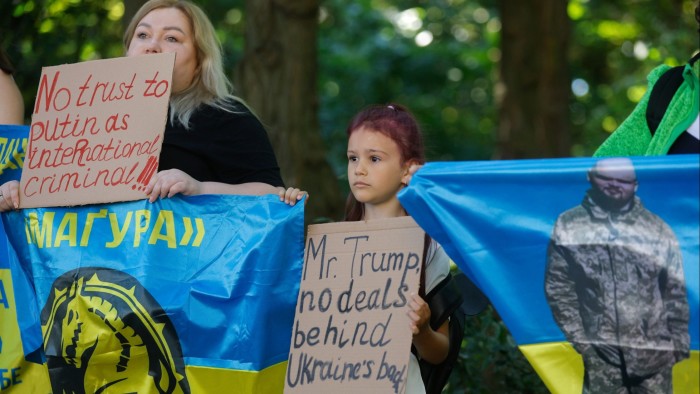
Donald Trump told Volodymyr Zelenskyy in a call on Wednesday that he would press Vladimir Putin over the war in Ukraine.
But by Saturday, after rolling out the red carpet for Putin at a high-stakes summit in Alaska, the US president appeared instead to have aligned himself with the Russian leader, echoing the Kremlin’s position and rhetoric.
The shift drew a sharp response from Ukrainian officials, soldiers and civil society, who reacted with frustration and accused Trump of undermining their efforts to bring Russia’s war to a just end.
In a post on Truth Social, Trump said he wanted to “go directly to a Peace Agreement, which would end the war and not a mere Ceasefire agreement, which often times do not hold up”.
He also suggested the US would not follow through with threats of new sanctions against Russia, signalling a move away from efforts to constrain the Kremlin’s war strategy.
In recent weeks Trump had publicly expressed great frustration with Putin over his intransigence and relentless bombing of civilians. His change of tone caused alarm and a sense of betrayal in Kyiv on Saturday that deepened as details of the meeting emerged.
Putin demanded Ukraine withdraw from the Donetsk and Luhansk regions as a condition for ending Russia’s war but told Trump he could freeze the rest of the frontline if his core demands were met, four people familiar with the matter told the Financial Times.
“This is a stab in the back,” a senior Ukrainian official told the FT, describing Trump’s shift.
“He just wants a quick deal,” another senior Ukrainian official said.
Oleksandr Merezhko, chair of the Ukrainian parliament’s foreign affairs committee, summed up the outcome of the Trump-Putin summit for his country in one word: “awful”.
“It looks like Trump has aligned with Putin and they both might be starting to force us to accept a peace treaty, which means in reality capitulation of Ukraine,” he said.
“The whole idea of the summit, as we were explained by Trump and Rubio, was to present Putin with a demand for an immediate ceasefire. And if he rejects this proposal there would be severe consequences for him,” Merezhko said. “Putin has rejected that by offering instead a ceasefire as peace treaty, and we don’t see from Trump any reaction, let alone severe consequences.”
Zelenskyy has now been invited by Trump to return to Washington for talks in the Oval Office on Monday — the same setting where, six months ago, he was ambushed by the US president and his vice-president JD Vance over Kyiv’s reluctance to commit to a US-brokered peace deal on terms that were favourable to Moscow at the time.
 Trump and Zelenskyy’s encounter in the Oval Office six months ago was explosive © AP
Ukrainian officials said that Zelenskyy would not agree to hand over Donetsk and Luhansk — a long-standing Kyiv red line — but that he would be open to discussing the issue of territory with Trump on Monday and in a future trilateral meeting with Trump and Putin.
Any handover of territory would raise concerns in Ukraine over its sovereignty. In addition, Kyiv worries that giving up its heavily fortified string of cities in the Ukrainian-controlled part of the Donetsk region would amount to offering Russia a springboard for future offensives.
Ivanna Klympush-Tsintsadze, a Ukrainian MP and former deputy prime minister, pondered how “feeding [Putin’s] ambitions and goals” could bring the war to an end and dissuade the Russian president from regrouping and launching fresh invasions later. “How is that going to ensure that no new attack is waged?” she asked.
The prospect of ceding vast, populated swaths of territory that the Russian military never managed to seize would trigger “a lot of tension in society” according to Olga Aivazovska, head of the board at OPORA, a Ukrainian civil society watchdog.
“It will also open the question of why we’ve been defending ourselves all these years,” she said.
Roksolana Pidlasa, an MP in Zelenskyy’s ruling party, said that Putin had demanded Donetsk and Luhansk “precisely because it’s unacceptable for Ukraine”.
“His goal isn’t peace,” she said. “It’s lifting sanctions and trapping Ukraine in a development limbo.”
“This summit was a huge mistake and a huge win for Putin,” said Alexander Khara, an analyst at the Kyiv-based Centre for Defence Strategies think-tank and former Ukrainian diplomat.
If talks were to fail, Trump could pin the blame squarely on Zelenskyy, he warned.
“Since 2014, the Russians have considered any Ukrainian government to be illegitimate, so they won’t consider Zelenskyy a capable interlocutor, especially when they have resources and they believe they can achieve their goals through military means,” he said.
 Ukrainian troops on the front line. Kyiv fears a fresh Russian offensive in the coming days © REUTERS
The talks unfolded as a stretched Ukrainian military struggles to push back Russia’s summer offensive.
Last weekend the Russian military made a 10-kilometer advance near the coal-mining town of Dobropillia, but it was halted this week, Ukraine’s general staff and Volodymyr Zelenskyy have said. Battle-hardened units such as the Azov first corps and the 79th air assault brigade were rushed to that part of the frontline to prevent the advance from turning into a breakthrough.
Ukraine’s president praised the “successes in some extremely difficult areas of the Donetsk region” but said Russia would press its offensive in the coming days “in order to create more favourable political circumstances for talks with global actors”.
Recommended

Near Pokrovsk, a once strategic town and logistics hub that the Russian military is now close to encircling, the commander of a small strike drone unit said any lull in the fighting was unlikely.
“The reality is that negotiations are negotiations, meanwhile the fighting keeps going and if we do not deal with it, no negotiations will save us,” Oleksandr Solonko wrote on Telegram.
In the Ukrainian capital, the week of frenzied diplomatic exchanges that culminated in the Alaska meeting did have one tangible effect: an eerie silence, as Russian kamikaze drones stopped targeting Kyiv while preparations for the meeting were under way — even as they kept hitting cities closer to the frontline.
But an air raid alarm blared briefly across Kyiv on Saturday afternoon, triggering fresh anxiety that Russian drones loaded with explosives as well as ballistic missiles would soon be racing once more towards the capital.