

A few weeks ago, I walked into a second-hand bookstore and bought a novel by Antonio Tabucchi, the Italian writer whose devotion to Fernando Pessoa and Lisbon had recently drawn me into his work. Only later did I open the first page and notice a dedication, written by Tabucchi himself, dated 1998 and signed in Tel Aviv. He had given the book to the library of the Italian Cultural Institute there. Somehow, over nearly three decades, it had left the library and traveled through other shelves before reaching mine.
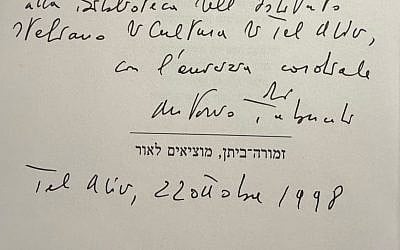
A Dedication from Another Europe. Antonio Tabucchi’s inscription to the library of the Italian Cultural Institute in Tel Aviv, October 1998 (Tel Aviv, 2026. Photo by Sharon Pardo)
Tabucchi would probably have appreciated the coincidence. His fiction is filled with displaced objects and people who discover that history has been waiting quietly for them. He understood that one learns a great deal about a society by watching whom it places at the center and whom it moves toward the margins. His migrants, Roma, and political exiles are never simply figures in a landscape. They reveal who belongs, who must explain their presence, and who is quietly moved outside the story a nation tells about itself.
That question of who belongs at the center and who is moved toward the margins is worth asking about Europe and its Jews.
In the decades after World War II, Europe symbolically relocated its Jews. The people who had been expelled, stripped of citizenship, and murdered were placed at the moral center of the postwar European order. Jewish memory became European memory. Auschwitz became a negative foundation for European identity, and antisemitism became a warning sign of democratic collapse. Synagogues were restored, memorials built, and schoolchildren sent to visit camps. This transformation was real. The European Union helped institutionalize it through law, education, and commemoration.
But reading Tabucchi now raises an uncomfortable question: Where does Europe place its living Jews? The harder test is whether Europe can criticize Israeli power without treating individual Jews or Israelis as extensions of that power.
Since October 7, 2023, something has shifted in parts of European academic and cultural life. European Jews and Israeli scholars are not the same constituency, but they are increasingly treated as though they were. The identity markers Jewish, Israeli, and Zionist are not synonymous, yet they often blur into one political category. Some Jewish students are asked to clarify their position on Gaza before speaking simply as students. Some Israeli academics find that their affiliation requires justification. A project becomes “complicated.” An invitation fails to arrive.
None of this proves that Europe as a whole has become antisemitic, or that criticism of Israel is antisemitic. Certainly, the devastation in Gaza and the conduct of Israel’s government and military demand scrutiny. The problem begins when responsibility for a state’s actions is transferred to individuals: a Jewish student in Amsterdam is treated as a representative of the Israeli government; an Israeli scholar in Brussels is cast as its emissary, though she may oppose it; anger over a distant war spills into hostility toward Jewish institutions closer to home.
This is where I keep thinking of Pereira. In Pereira Maintains, Tabucchi gives us a journalist in Salazar’s Portugal who shelters in literature, translation, and obituaries, hoping to remain outside politics. Pereira is cultured, thoughtful, and decent; he simply prefers the safety of his intellectual world. History refuses him that privilege. Slowly, he learns that silence is also a position and that culture cannot forever hide from the world outside it.
Europe today is not Salazar’s Portugal. The analogy is narrower: Pereira’s temptation to mistake silence for neutrality remains recognizable. It often comes to mind while watching some European institutions since October 7. Universities that spoke eloquently about other crises turned reticent when Israeli scholars faced exclusion or partnerships with Israeli institutions came under pressure. Colleagues who privately said the massacre horrified them explained that saying so publicly had become too complicated.
Almost none of this exclusion arrives as a declaration. No letter announces that Jews or Israelis have been pushed to the edges of institutional life. A partnership is reconsidered. A proposed visit becomes awkward. An invitation disappears. Pereira would recognize the temptation to retreat into scholarship rather than ask what is happening to the person who used to sit at the table.
For decades, Europe found it easier to honor Jewish memory than to accommodate Jewish agency. The dead could be commemorated without being argued with. The living disagree. They vote across the spectrum; some are secular and some devout, some oppose Zionism, and others regard Israel as central to their identity. They are not symbols. They are people, and people are inconvenient in a way memory never is.
Israel sharpens that difficulty because it is the most visible institutional expression of modern Jewish sovereignty. It does not speak for all Jews, but it makes Jewish power impossible to encounter only as memory. It has an army, exercises power, and has governments whose decisions may deserve severe judgment. For a European imagination partly built around Jewish victimhood, a sovereign Jewish state can be an unsettling presence.
None of this absolves Israel of responsibility. Power demands scrutiny, and political agency carries consequences. Israel cannot claim the moral immunity of the powerless while insisting on its sovereign right to act. But responsibility belongs to governments, institutions, and decision-makers. It does not pass by association to a Jewish student in a seminar room or an Israeli scholar applying for a grant.
Europe’s real test is whether it can criticize Israeli power without making Jewish belonging conditional on distance from that power. Can its universities protect academic freedom when the threatened researcher is Israeli? Can its cultural institutions engage with living Jews whose politics are inconvenient, rather than only with the dead whose politics can no longer trouble anyone?
I keep returning to the book. In 1998, Tabucchi signed it in Tel Aviv and gave it to the library of the Italian Cultural Institute. Decades later, it reached a second-hand bookstore and then my desk. He taught readers to look toward the margins, where societies place the people who complicate the stories they prefer to tell about themselves.
For decades, the test for Europe was whether it could mourn the Jews it had lost. The test now is whether it can make room for the argumentative, contradictory, and inconvenient Jews who are still here.
Professor Sharon Pardo is a Senior Fellow at the Jewish People Policy Institute (JPPI) and a professor of European studies and international relations in the Department of Politics and Government at Ben-Gurion University of the Negev (BGU).