
Debt Management Deile ‘Han Eun Ma Tong’ Accumulated Loan of 114 Trillion Amid Expansion Fiscal Stances…the greatest ever
![A panoramic view of the headquarters of the Bank of Korea in Jung-gu, Seoul. [Yonhap News]](https://www.newsbeep.com/wp-content/uploads/2025/08/news-p.v1.20250817.9164ba8e91b64e5096740441a63e04df_P1.jpg) 사진 확대 A panoramic view of the headquarters of the Bank of Korea in Jung-gu, Seoul. [Yonhap News]
사진 확대 A panoramic view of the headquarters of the Bank of Korea in Jung-gu, Seoul. [Yonhap News]
As the government’s expansionary fiscal stance becomes clear, national debt management is emerging as a key task. Unlike the Moon Jae In government, which used to be breathless due to excess tax revenue in the past, now has no choice but to rely on the issuance of deficit government bonds for increased spending due to slowing potential growth and worsening tax conditions. The authorities plan to create a virtuous cycle of economic recovery and tax revenue expansion through active spending, but the faster national debt growth is expected to put a heavy burden on fiscal management.
According to the National Assembly Budget Office and the financial information portal Open Finance on the 17th, the government’s interest expense on government bonds (based on settlement) increased by about 10 trillion won (51.4%) over the past four years from 18.6 trillion won in 2020 to 28.2 trillion won last year. The average annual growth rate reaches 13%. The interest burden on government bonds has increased in earnest as spending has increased sharply in the process of responding to COVID-19. It exceeded 20 trillion won by recording 19.2 trillion won in 2021 and 21 trillion won in 2022, and expanded to 24.6 trillion won last year.
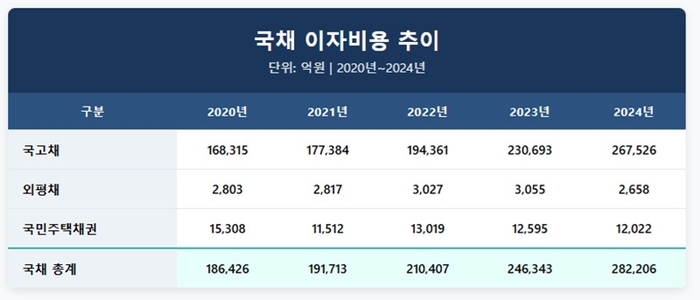 사진 확대
사진 확대
Among government bonds, interest costs on treasury bonds have soared. It increased from 16.8 trillion won in 2020 to 26.8 trillion won last year. This year, about 30 trillion won was set aside for interest repayment on treasury bonds alone, and 660 billion won was set aside in the name of external debt interest, which is expected to exceed 30 trillion won.
The share of interest expenses on government bonds in total expenditure is also on the rise. It stabilized at 3.4% in 2020, 3.2% in 2021, and 3.1% in 2022, but jumped to 4.0% in 2023 and 4.4% last year. Although large-scale spending to respond to COVID-19 has temporarily lowered its weight, it has recently soared to the mid-4% range, increasing the structural burden.
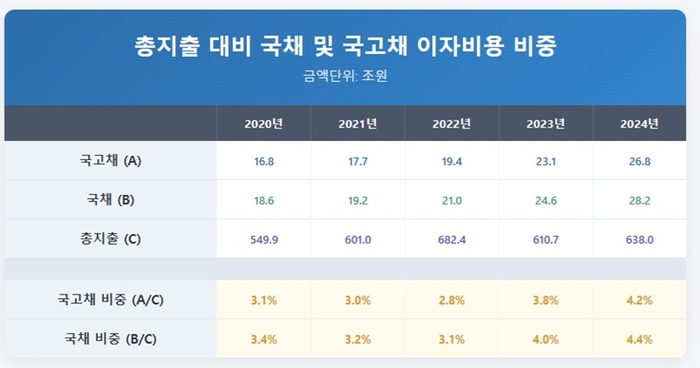 사진 확대
사진 확대
The volume of government bonds due to maturity is also a burden. As of the end of last year, the amount of treasury bonds due by year reached 94 trillion won this year and 98 trillion won next year. It decreased to 74 trillion won in 2027 and then to 50 trillion won in 2028, but large-scale refinance issuance is inevitable in a short period of time. The creation of two additional supplementary budgets is also a variable that increases the burden of volume on the bond market. If the amount of money issued is poured out, pressure to raise interest rates will increase, which will soon lead to the government’s increased interest costs.
The amount of funds borrowed from the Bank of Korea to fill the discrepancy between revenue and expenditure is also the highest ever. Between January and July this year, the government borrowed 113.9 trillion won from the Bank of Korea, exceeding 8.4% from the same period last year (105.1 trillion won). It exceeds both 2020 (90.5 trillion won) during the COVID-19 period and 2023 (10.8 trillion won), when tax revenue deficits were large. However, as the government repaid 43 trillion won in July, the balance was reduced to 200 billion won as of the end of July.