
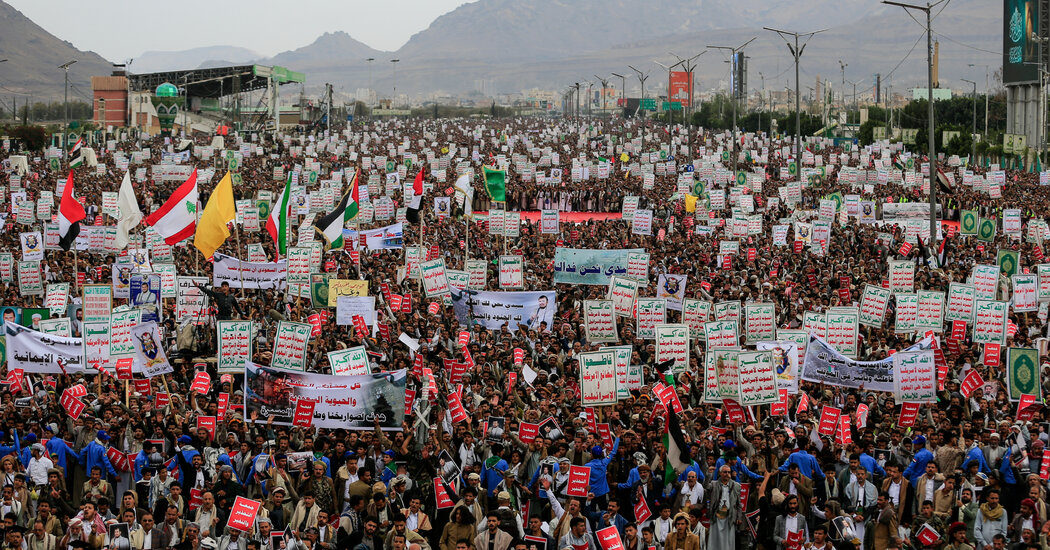
As the U.S. war with Iran spilled across the Middle East over the past five months, Yemen largely stayed on the sidelines.
That was until Monday, when the Iranian-backed Houthi militia, which controls a significant part of Yemen, declared a maritime blockade on Saudi Arabia, a U.S. ally. The move threatened to open a new front in the regional war and further disrupt global energy supplies.
Here’s what to know about the rising tensions in Yemen.
Will the Houthis enter the U.S.-Iran war?
The Houthis, a rebel group from Yemen’s northern highlands, seized control of the capital, Sanaa, more than a decade ago with the help of Iran. Saudi Arabia, which borders Yemen to the north, then led a failed military intervention in 2015 to oust the Houthis and restore the internationally recognized government. The intervention set off a devastating civil war that dragged on for years.
The war largely settled into a fragile stalemate since a cease-fire in 2022. But last week, the Houthis accused Saudi Arabia of striking Yemen’s main international airport in Sanaa in a dispute over an Iranian plane that tried to land there.
Yemen’s Saudi-backed government claimed responsibility for the attack. However, the Yemeni government does not have a functional air force and relies heavily on military support from Saudi Arabia.
The sudden rise in tensions raised questions of whether the Houthis would enter a war that, for the most part, they have stayed out of until now.
Analysts say Iran may be urging the Houthis to disrupt shipping in the Red Sea, which would cause further upheaval in the global energy markets. Oil prices have shot up in the past months as a result of dueling Iranian and American blockades of the Strait of Hormuz, another critical waterway for global shipping and energy supplies.
With the Strait of Hormuz effectively closed for months, the Red Sea has become a vital alternative export route for the transportation of Saudi oil and gas.
What led to the latest crisis?
In early July, a Houthi delegation attended the funeral in Tehran for Iran’s slain supreme leader, Ayatollah Ali Khamenei, who was killed in the opening salvos of the U.S.-Israeli war on Iran. When the Houthi delegation returned, Yemen’s government tried to block their Iranian flight from landing in Sanaa, prompting the Houthis to accuse Saudi Arabia of bombing the runway.
One senior Yemeni official said that they believed the plane was “carrying personnel and military dual-use equipment” from Iran.
The Houthis retaliated by attacking the Abha airport in southern Saudi Arabia, the first direct Houthi strike on Saudi soil since early 2022.
How could this escalate?
Days before the Houthis announced a naval blockade on Saudi ships, their leader, Abdul Malik al-Houthi, warned that all Saudi oil and energy facilities would become targets if the kingdom escalated militarily.
Iran sees the Houthi threat to the Red Sea as potential leverage in its war with the United States, said Ahmed Nagi, a Yemen analyst at the International Crisis Group. The group controls the part of Yemen that hugs the Bab al-Mandab, a narrow strait at the southern entrance to the Red Sea.
“I think the message from Iran is: Don’t assume our leverage is limited to the Strait of Hormuz. We also have an ally that can threaten the Bab al-Mandab if needed,” he said.
The Saudi-led coalition will respond to all Houthi threats against transiting vessels “swiftly and firmly,” Turki al-Malki, the coalition spokesman, said in a statement posted on social media on Monday.
Late on Monday, Yemen’s defense minister, Taher al-Aqili, said the army of the internationally recognized Yemeni government would be ready “to end the Houthi coup.” Rashad al-Alimi, Yemen’s exiled president, called on people living in Houthi-controlled areas to “align themselves around the state.”
How have the Houthis disrupted shipping before?
The Houthis did not give any specifics about how they would enforce a maritime blockade of Saudi Arabia. But they have used their ability to disrupt shipping in the Red Sea as a weapon before.
During the two-year war in Gaza which began in late 2023, they attacked commercial shipping there with drones, missiles and hijacking, attempting to exert pressure on Israel and its allies.
They could use the Red Sea again to exert pressure on Saudi Arabia. The kingdom has relied on Red Sea routes in recent months to export more than 3.6 million barrels of oil and related fuels a day, most of it to Asia, according to the maritime data firm Kpler.
Yasir al-Rumayyan, the chairman of Saudi Arabia’s state oil giant, recently said the ability to bypass the blocked Strait of Hormuz and use Red Sea export terminals had been a “lifeline” for the kingdom’s economy.
A Houthi blockade could affect more than 3 percent of the global oil market.
“The Red Sea is always an easy way in which they can make the world bleed,” said Farea Al-Muslimi, a research fellow at Chatham House.
“The Houthis are banking on insurance costs going up and panic among the global shipping industry like what happened during the war in Gaza.”