
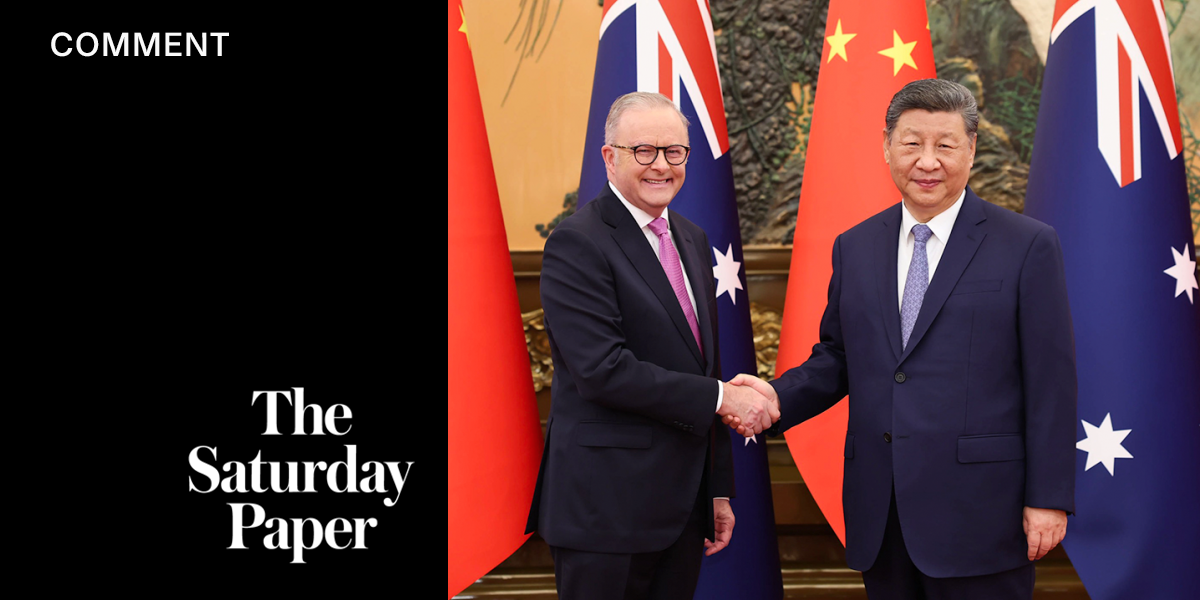
Anthony Albanese has returned from his week of top-level meetings and high-altitude tourism in the Middle Kingdom – the first Labor leader since Gough Whitlam to admire the Great Wall of China after sharing the love with Beijing’s No. 1, in this instance Xi Jinping.
The visit established Australia’s determination to forge its international relationships in its own national interest. In particular, it sent that message to Trump administration agitators in Washington.
No sooner had the prime minister arrived in Shanghai than a report appeared in the influential Financial Times referring to five informants who said that United States Under Secretary of Defense for Policy Elbridge Colby had in recent months repeatedly asked Australian and Japanese officials what their governments would contribute to the defence of Taiwan in support of any American intervention.
The story was a piece of cack-handed media strategy, seen as such by Australian government insiders, to disrupt the Albanese mission to China – the biggest strategic and economic competitor to a paranoid Washington.
If the story was intended to catch out Albanese, forcing him into a confrontational stance with his China hosts over a position that is completely hypothetical, it failed.
Helping Albanese in the task was a well-informed question from one of the media pack: “Prime minister, just briefly, would it be reasonable for the United States to demand any sort of assurances from Australia on a Taiwan contingency, given the United States itself maintains a policy of strategic ambiguity, at least in theory, on Taiwan?”
Albanese seized the opportunity with both hands, telling his inquisitor he had answered his own question. When asked to elaborate the prime minister said, “I think you can get it.”
In case anyone was still wondering, next morning on the ABC’s Insiders Minister for Defence Industry Pat Conroy explained that the sole power to commit Australia to war was with the government of the day and the Albanese government wouldn’t commit Australian troops to possible future conflicts in advance. When Patricia Karvelas pushed him further about private assurances, he said he wouldn’t engage in “hypotheticals”.
The Financial Times story coincided with a social media post from Colby saying “some among our allies might not welcome frank conversations”. He went on to say that many, led by NATO allies, were “seeing the urgent need to step up”.
Could he be suggesting Australia and Japan should do the main work in saving Taiwan?
Colby is seen as a China hawk who has blindsided his president on other decisions, according to Washington observers. They point to Colby advising his secretary of defence, Pete Hegseth, to withhold armaments to Ukraine as one example.
The spectacle of one of America’s oldest allies being feted in the Great Hall of the People by the highest levels of the Chinese government would not be missed in Washington. Yet what is America offering Australia? Tariffs that are, according to its own proffered template, unwarranted…?
In the case of Taiwan, he is well ahead of Trump, who has given no indication of any break with a policy of strategic ambiguity – recognising Taiwan as a part of China while at the same time supporting the status quo. This is the same policy Australia has adopted for almost five decades.
Not that anyone would know what Trump would do should China tempt fate by invading Taiwan. Strategic analyst Hugh White believes that if the US intervened directly against China the outcome would inevitably be a nuclear war. In that case, not only Australia but also the rest of the region, if not the world, would be embroiled.
Shadow defence minister Angus Taylor showed he had learnt little from the Morrison government’s sabre-rattling in China’s regard. There was nothing hypothetical about his call for a “joint commitment” with the US to defend the security of Taiwan through “strength and deterrence in the Taiwan Strait”.
Little wonder Xi, in his hour-long meeting with the prime minister, asserted China’s right to have war games in international waters off Australia as a counter to our own war preparations with the US and other regional navies in the disputed international waters of the strait.
Next time, the Chinese president, according to Albanese, would give more notice on live firing. The prime minister quoted Xi as saying, “China engaged in exercises just as Australia engages in exercises.”
Albanese’s deft handling of Colby was also apparent in the way he is now building on the first-term “stabilisation” of relations with our biggest trading partner. However, it is not lost on anyone in the government that the wolf warrior diplomacy adopted by Beijing five years ago, which led to coercive exploitation of tariffs every bit as blunt as Donald Trump’s, could re-emerge. It is just that, for now, Xi Jinping does not see this as being in China’s interests.
Channelling his predecessor John Curtin, Albanese is dealing with the world as it is. That means juggling the impact of Trump’s introduction of instability and uncertainty in traditional alliances, economic and strategic, with the offer of a pragmatic relationship with China, which promises to act more predictably in everyone’s interests, including ours.
Across the bank of flowers separating the two sides in the conference room of the Great Hall, Xi echoed Albanese’s own formula for making the relationship work. He said the most important thing they can learn from the disruptions of the near past is “that a commitment to equal treatment, to seeking common ground while sharing differences, pursuing mutually beneficial cooperation, serves the fundamental interests of our two countries”.
The spectacle of one of America’s oldest allies being feted in the Great Hall of the People by the highest levels of the Chinese government would not be missed in Washington. Yet what is America offering Australia? Tariffs that are, according to its own proffered template, unwarranted, and the clear message that we need to be in better shape to defend ourselves?
It was left to Chinese premier Li Qiang to almost directly address the elephant in the room. Without naming Donald Trump, he told the Australia–China CEO round table, attended by Albanese, the two nations needed to work together because “protectionist measures are on the rise in the world, and China and Australia are committed to advancing trade and investment liberalisation”.
Albanese’s China visit is in tune with public opinion at home and abroad. The latest Pew Research Center survey of public opinion in 24 countries found the global view of China has improved as Donald Trump hurt perceptions of the US.
The Washington-based centre found a majority of Australians – 53 per cent, up 14 points in four years – say it is more important to have strong economic ties with China than with the US. Of those surveyed, 42 per cent favoured the US, a 10-point drop in four years.
Opposition Leader Sussan Ley is struggling to bridge the divide on how we deal with Beijing between Taylor and the China hawks on her right and those more moderate pragmatists.
Ley says friendship with our giant trading partner is important, “but it can’t come at the cost of our national interest”. “Silence on things that matter to Australia can never be the price of a ticket to Australia,” she says.
Every Australian prime minister who has visited China since Gough Whitlam has faced similar calls about raising human rights issues with the People’s Republic.
Accusing Albanese of silence on this issue ignores the fact he did raise the fate of jailed Chinese-Australian writer and businessman Yang Hengjun but, the prime minister said, pre-empting further criticism from the Liberals, an immediate outcome could not be expected because that’s not the way things work.
The prime minister said “patient, calibrated advocacy” is what his government has done successfully in the past.
Ley will try to play the opposition more into the game when parliament resumes next week for the first time since the election. She says Albanese has questions to answer when he comes home about what plans he has to raise taxes in light of leaked Treasury advice.
She accuses the government of leaking some of its own advice to soften people up to the prospect of higher taxes in light of the “structurally weak budget” and to have any chance of meeting its target to build 1.2 million houses in five years.
This was no deliberate leak, however. In fact, Treasury tried to convince the ABC not to publish it because it was mistakenly included in a freedom of information response.
Treasurer Jim Chalmers is genuine in his claim that he is relaxed about it because, he says, he’s already “made it very clear that we will need to do more to make our economy more resilient”. The housing target was deliberately ambitious, he says, but with cooperation from the states and industry it is achievable.
Next month’s economic reform round table is clearly critical to achieving the sort of tax reform governments have been urged to address since the Howard years.
In its submission to the Productivity Commission, the Commonwealth Bank has broken ranks with many in the business lobby to urge the government to introduce wealth taxes and cap superannuation concessions, as well as look to cut income taxes and overhauling the goods and services tax.
That certainly looks like a dangerous political hypothetical, but surely a government with a near-record majority has the capital to spend on making it real.
This article was first published in the print edition of The Saturday Paper on
July 18, 2025 as “A middle power in the Middle Kingdom”.
For almost a decade, The Saturday Paper has published Australia’s leading writers and thinkers.
We have pursued stories that are ignored elsewhere, covering them with sensitivity and depth.
We have done this on refugee policy, on government integrity, on robo-debt, on aged care,
on climate change, on the pandemic.
All our journalism is fiercely independent. It relies on the support of readers.
By subscribing to The Saturday Paper, you are ensuring that we can continue to produce essential,
issue-defining coverage, to dig out stories that take time, to doggedly hold to account
politicians and the political class.
There are very few titles that have the freedom and the space to produce journalism like this.
In a country with a concentration of media ownership unlike anything else in the world,
it is vitally important. Your subscription helps make it possible.
Send this article to a friend for free.
Share this subscriber exclusive article with a friend or family member using share credits.

Used 1 of … credits
use share credits to share this article with friend or family.
You’ve shared all of your credits for this month. They will refresh on August 1. If you would like to share more, you can buy a gift subscription for a friend.
SHARE WITH A FRIEND
? CREDITS REMAIN
SHARE WITH A SUBSCRIBER
UNLIMITED
Loading…