
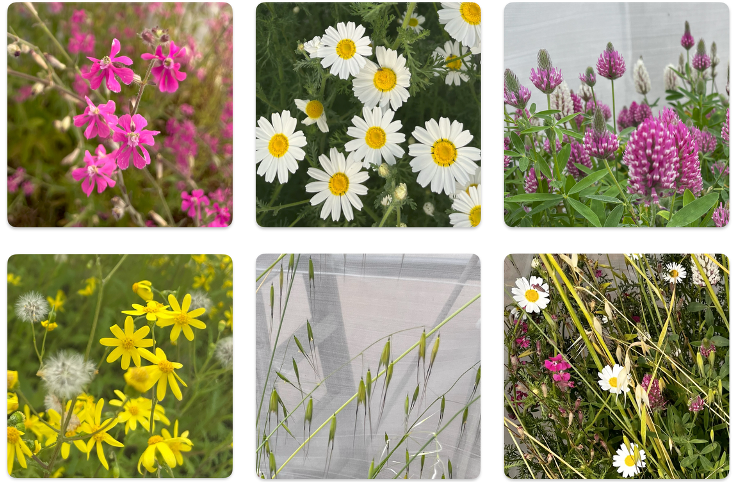
Hebrew University scientists have discovered that drought can shorten the amount of time that certain Israeli wildflowers will bloom — but instead of flowering closer together to make the most of the limited time and water, the species spread their flowering out.
An autumn drought delayed flowering, while a spring drought brought it to an earlier end. When five species were grown together, each bloomed for a shorter period and at a slightly different time.
“Each species used the available water at a slightly different stage,” explained PhD student Barel Tsafon.
Tsafon said the discovery was made through a long-running greenhouse experiment, which will enter its fifth year this fall. Noting that nature is far more complex than greenhouse conditions, he explained that further repetitions of the experiment will yield more information on the impact of drought on the population size of each species.
The research, whose findings should help scientists who follow the effects of climate change on ecosystems, was published Monday in Ecology Letters.
Get The Times of Israel’s Daily Edition
by email and never miss our top stories
By signing up, you agree to the terms
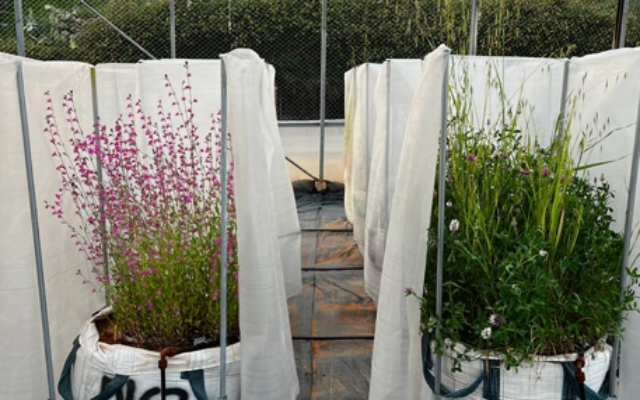
Two experimental plant communities used in the study. Right: A mixed-species community containing all five experimental species. Left: A monoculture of Palestine catchfly /Silene palaestina. (Barel Tsafon)
Tsafon said the next step is a long-term project to gather worldwide data via the citizen science organization, iNaturalist.
The database has already been built, and Tsafon and fellow PhD student Or Gross will shortly formulate questions about flowering times of multiple species in nature in Israel and overseas.
While the influence of temperature on blooming times has attracted significant research worldwide, it has largely focused on tropical plants, where temperatures change but water is available year-round, Tsafon said.
“We wanted to see what happened when water is limited [at different times],” he went on. “When water availability is researched, people usually look at the length of the drought, not the timing.”
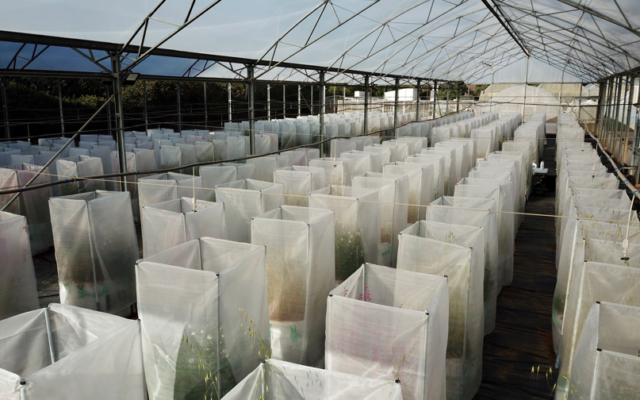
Experimental greenhouse containing the plant communities used in the study. (Barel Tsafon)
Tsafon and Gross, working under the guidance of the Agriculture Faculty’s Prof. Niv DeMalach, grew thousands of plants from five common Mediterranean species in greenhouse conditions. The plants experienced identical reductions in water, but the “droughts” occurred either at the beginning, middle, or end of the rainy season. Some plants were grown alone, while others were grown together to examine how neighboring species influence one another.
“We expected that a drought in the middle of the winter would be the main influence [on flowering],” Tsafon said, “and that at the start and end of the flowering period, they would overlap more to exploit the [shortened flowering] window. We never thought that with a narrower window within which to flower, they would separate more.”
Droughts in the middle of winter had no detectable effect on flowering.
Tsafon said the team did not check for altered behavior among pollinators because of the reduced flowering time available due to drought conditions.
We can’t do this work alone.

The war with Iran has been draining for all of us in Israel. But when I heard about a high casualty incident – ballistic missile impacts in Arad and Dimona that left nearly 200 people wounded – I drank a cup of coffee, packed a bag, and headed south.
There, I spoke with Shilgit, the head of an after-school program for underprivileged youth. Standing outside her destroyed center, Shilgit said it was a miracle that no children were hurt and spoke about the community coming together in the hours since.
As a Times of Israel reporter, I’m committed to telling stories of resilience like Shilgit’s. But my colleagues and I can’t do this alone. If you value work like this, please consider joining our reader support group, The Times of Israel Community. Your financial support is essential to keep real human reporting like this going.
— Stav Levaton, military reporter
Already a member? Sign in to stop seeing this
You’re a dedicated reader

That’s why we started the Times of Israel – to provide discerning readers like you with must-read coverage of Israel and the Jewish world.
So now we have a request. Unlike other news outlets, we haven’t put up a paywall. But as the journalism we do is costly, we invite readers for whom The Times of Israel has become important to help support our work by joining The Times of Israel Community.
For as little as $6 a month you can help support our quality journalism while enjoying The Times of Israel AD-FREE, as well as accessing exclusive content available only to Times of Israel Community members.
Thank you,
David Horovitz, Founding Editor of The Times of Israel