
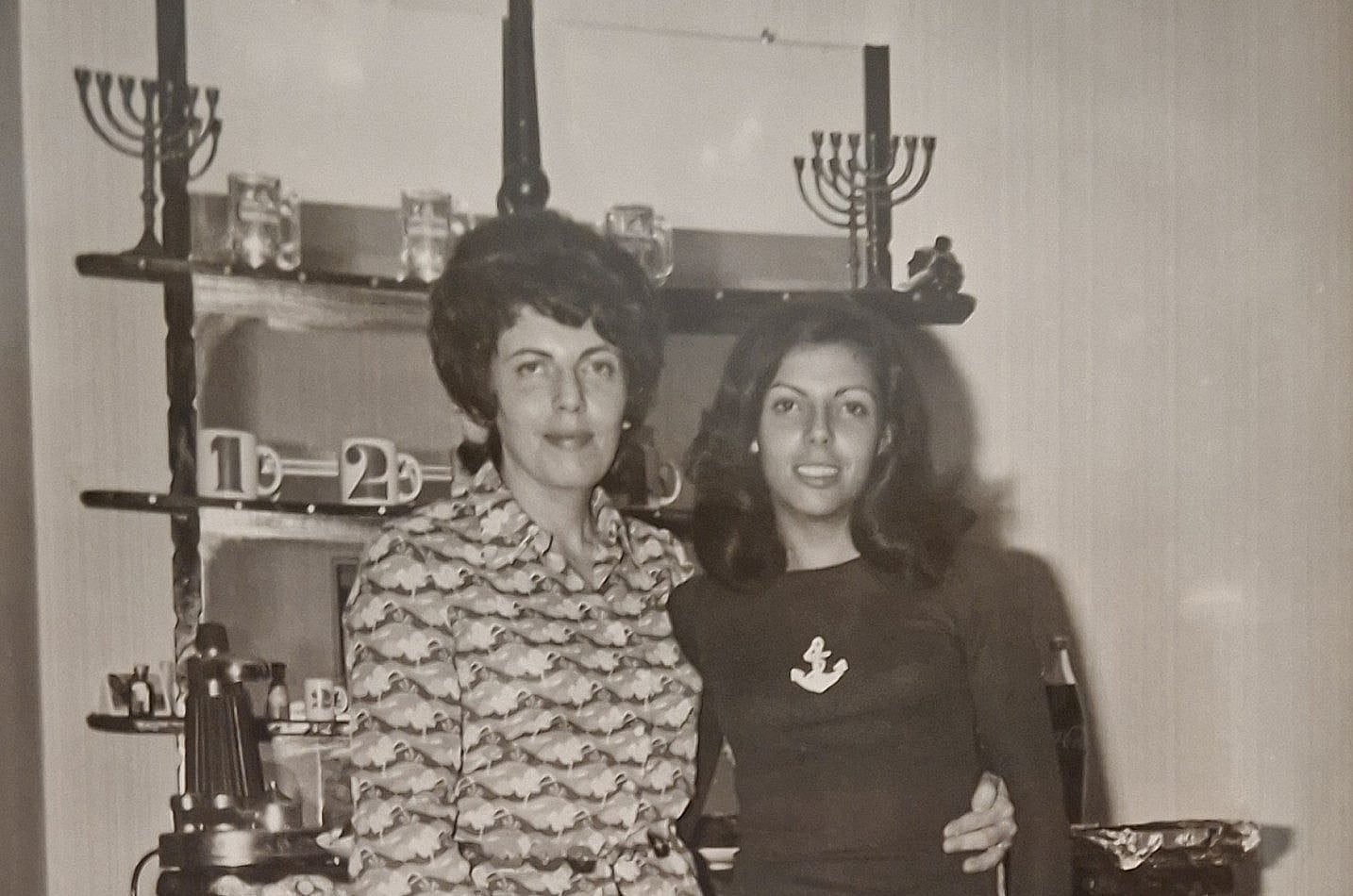
I have been thinking about my mother during the Nine Days leading to Tisha Be’Av.
Perhaps that is not a coincidence.
Tisha Be’Av belongs to the collective Jewish calendar. It is a period of mourning shared by Jews in Israel and throughout the Diaspora, a moment when we remember destruction, displacement and the long history of rebuilding somewhere else. It is also a reminder that Jewish history rarely remains in one country, one language or one form for very long. Families settle, languages are learned and partly forgotten, and customs are preserved, altered or abandoned. A few generations later, the same family may be living somewhere entirely different.
My mother died two months ago.
Her death did not suddenly reveal to me who she had been. I understood many of her choices before she died, even when I disagreed with them. But losing her changed my position inside the family story. It made me look at the generations behind me and the ones ahead of me differently.
My mother was the last person in our immediate family still living in France.
After we buried her, the apartment was emptied completely. Its furniture, clothes, papers and the countless objects accumulated over decades were gone. Then we closed the door.
There was no family home left in France.
My grandparents had rebuilt their lives there after the Shoah. My parents had lived and died there. My sister and I now live in Israel. Our children are growing up here.
The family had moved again.
But this is not only a story about movement from Poland to France and then from France to Israel. It is also a story about transmission: what each generation carried forward, what it could not carry, what it deliberately left behind, and what the next generation chose to search for again.
I was not raised by my mother and father alone. My grandmother was also one of the central parents of my childhood. I grew up between two generations, not simply after them.
That matters.
My grandmother and my mother did not transmit the same Jewish world to me.
My grandmother’s first language was Yiddish. The Jewish life surrounding her was not something she had discovered as an adult or chosen as an identity project. It was the atmosphere from which she came, shaped by Poland, migration, loss and the effort to rebuild.
Her presence gave me access to a generation that might otherwise have felt more distant. I did not only hear stories about my grandparents. I heard them directly from my grandmother. Her language, memories and way of being Jewish entered my childhood without needing to be formally explained.
My work alias, YiddishFeminist, is my tribute to her. -> my work alias
The name is not only a reference to a language. It is about what remains after rupture. The words that survive. The habits that outlive the people who practiced them. The objects nobody quite knows what to do with, but cannot throw away. The fragments a later generation receives and turns into something new.
People who know my work may know the name without necessarily knowing how personal it is. It began with my grandmother, but it also became a description of much of my adult life: looking for what survived, identifying what disappeared, and trying to understand what can still be transmitted.
My mother’s relationship to that inheritance was much more painful.
She would scream when she heard her parents speaking Yiddish.
For my grandmother, Yiddish had been a living language. For my mother, it seems to have carried the unbearable weight of everything that had been lost. She belonged to the first generation born after the Shoah, raised by parents whose world had been destroyed and whose family members had been stolen and murdered. Their survival entered every room, even when it was never spoken about.
I once asked to learn Yiddish. My mother refused outright. Her reaction was immediate and intense, so much so that it left a deep impression on both my sister and me. At the time, it felt like a door being firmly and unjustly shut. Years later, I understood that the language did not mean the same thing to her as it did to me.
For me, Yiddish represented a connection I wanted to recover.
For her, it may have sounded like fear and grief.
This is one of the central tensions of transmission. The same inheritance can feel like a treasure to one generation and an open wound to another.
My mother did not transmit formal Jewish practice. She did not build an even slightly observant home. She did not pass on Yiddish, and she did not reproduce the visible Jewish environment in which she had grown up. These were not omissions born of a lack of Jewish identity. They were the consequence of the Jewish world into which she herself had been born.
But at her funeral, I thanked her for giving me the gift of being Jewish.
That was what she transmitted with certainty.
She made sure being Jewish was something to be proud of, even if she never seemed to feel safe enough to pass on much more than that.
Before meeting my father, my mother had imagined marrying a non-Jewish French man, and she eventually married one. She told me that she wanted her future children to have a non-Jewish French surname in case antisemitism returned.
It was not a plan to abandon Judaism, but an attempt to protect the next generation.
She wanted Jewish children who might be less easily identified as Jewish.
This kind of calculation is difficult to understand outside the history that produced it. Raised by survivors, she inherited not only identity and pride, but the knowledge that visibility could become dangerous very quickly.
She had also spent time in Israel when she was young. She had been connected to Hashomer Hatzair and had experienced life on a kibbutz.
Yet when I wanted to move here, she was deeply afraid.
My decision frustrated her in a way that went beyond the ordinary fear of a mother whose child is moving abroad. I would not call it a betrayal, but there was something close to that feeling in her reaction. She had tried, in her own way, to create a safer and more securely French future for her children. Then one child moved to Israel.
My sister eventually followed.
The future my mother had tried to design moved in almost the opposite direction. Both her children built openly Jewish lives in Israel, and her grandchildren were born Israeli.
I do not think she ever stopped worrying about that. But her fear and her pride existed together even if it was not the future she would have chosen for us.
This, too, is transmission.
A parent passes something on, and the child does not preserve it exactly as it was given. The child may reject part of it, enlarge another part, or answer the same historical fear differently.
My mother answered Jewish history by trying to give her children pride without too much visibility.
I answered it by moving to Israel.
Yet even after seventeen years here, I remain, at my core, a Diaspora Jew.
That may sound contradictory, but it does not feel contradictory to me.
Israel is my home. It is where I live, work and raise my children. But my Jewish instincts were formed through a Diaspora family history. I think through languages, migrations, cultural memory and the ways Jewish life changes from one country to another. I understand Jewish continuity not only through sovereignty and place, but through adaptation, fragments, family stories and things recovered after they were nearly lost.
My husband’s relationship to being Jewish and Israeli is very different.
We are both Ashkenazi, but that shared label does not mean we inherited the same Jewish experience. His family has been born in Israel for several generations. He grew up inside an Israeli Jewish reality that did not need to be reconstructed from refugee papers, photographs and memories of another country.
For him, Jewishness and Israeliness are intertwined from the beginning.
For me, they met later.
Our children inherit both.
They are growing up with a father shaped by several generations of Israeli life and with a parent whose centre of Jewish memory remains deeply connected to the Diaspora, even after nearly two decades here.
What we transmit to them will therefore not be a pure continuation of either family line.
It will be a mixture.
They will inherit Hebrew as their first language, while learning that their family once spoke Yiddish and French. They will grow up in a Jewish life centered in Israel, with one parent for whom Israel was inherited, and another for whom it was a migration, a decision and a transformation.
This may be what every generation does, even when it believes it is simply preserving tradition.
It creates a new version.
My children will eventually decide which parts of this inheritance matter to them. I cannot control what they retain. I can only make sure they receive enough of the story to make a choice.
That responsibility became much more concrete when we emptied my mother’s apartment.
We did not only sort through the belongings of a woman who had died. We were closing the last physical home of our family in France.
My mother was buried there beside my father and her parents. The generations before us remained in French ground, while the living branches of the family were now elsewhere.
When the apartment was emptied, nothing of our daily family life remained there.
But I did not return to Israel empty-handed.
I brought back the family documents that had survived from my grandparents ‘generation and those before them. There were family photographs, some with Yiddish writing on the back. There were papers identifying my grandfather’s family as stateless refugees before they received French citizenship.
There were letters my great-grandmother had written to my grandmother from Drancy before she was sent to Auschwitz.
There was also the star she had once been forced to wear on her clothing.
These objects are now here, in Israel.
The family members they belonged to are buried in Europe. The languages written on them are no longer spoken fluently by anyone in the family. The countries listed on the documents do not correspond neatly to where their descendants live now.
Yet the papers survived.
Someone kept them.
Then someone else kept them.
Now they are with me.
I am reconstructing the family tree, searching archives and tracing branches that became separated or disappeared. I am identifying names, dates, relationships and places, and learning what can still be recovered and what may remain permanently unknown.
This work is not separate from grief.
It is one of the forms my grief has taken.
Tisha Be’Av led me back to the specific loss of my mother and to the realization that her death had changed my role.
I am now the oldest generation.
There is no longer a parent above me holding the family story in the same way. There are fewer people left to ask. The documents, memories and unanswered questions have moved downward.
They are now on my shoulders.
That does not mean my mother failed to transmit.
She transmitted what she believed was essential and what she felt capable of giving. She gave me Jewish pride. She made sure I never understood Jewishness as something shameful. She gave me that certainty even when she was frightened of what visible belonging could cost.
My grandmother gave me something else. Because she helped raise me, I received parts of her generation directly: the emotional presence of Yiddish, the memory of displacement, the particular texture of a Jewish life rebuilt in France.
I inherited both what they transmitted and what they could not.
I also inherited the gaps between them.
My work, my research and much of the Jewish life I have built have emerged from those gaps.
I chose to look for what was missing and to recover parts of an inheritance that my mother had experienced as too painful or dangerous to carry forward. I made Yiddish visible in my work, though I was not raised speaking it.
These choices are not corrections of her life.
They are my generation’s answer to the same history.
My children will answer differently again.
Perhaps that is one of the most recognizable patterns in Jewish family history. Every few generations, the place changes. The language changes. The relationship to visibility changes. Something once ordinary becomes symbolic. Something once rejected is rediscovered. Something carefully preserved loses its meaning. A new generation decides what deserves to remain.
Tisha Be’Av remembers the destruction of a shared Jewish center and the centuries of Jewish life that unfolded afterward across many lands.
My family’s history is only one tiny line inside that much larger story.
Poland was one chapter. France was another. Israel is the chapter we are living now. But every move carried more than people. It carried fear, pride, language, silence, documents, memories and, ultimately, the freedom of each generation to decide what to do with them.
My mother’s burial and the emptying of her apartment closed the French chapter of our immediate family’s life.
But it did not end the story.
Now I must decide what becomes memory, what becomes art, what becomes family knowledge and what reaches my children.
One day, they may look at the photographs and ask who the people are. They may ask why the writing on the back is in a language they do not understand. They may ask why their great-great-grandparents were stateless, why a letter was sent from Drancy, or why the family moved first to France and later to Israel.
I hope I will be able to answer.
Not perfectly. Not completely.
But enough for them to know that the story did not begin with us, and that it will not end with us either.