
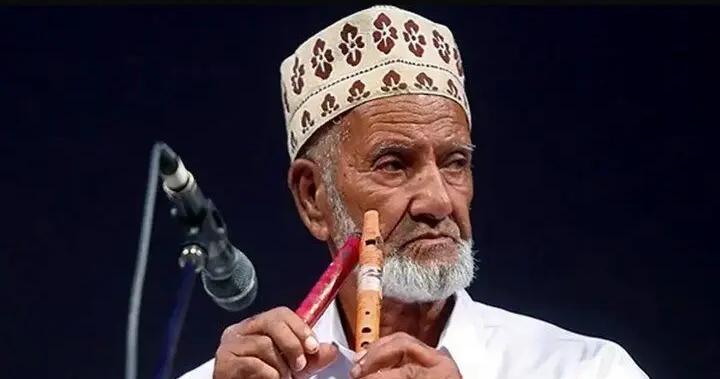
Shir-Mohammad Espandar, the renowned master of Baluchi regional music and one of the most prominent virtuosos of the donali, a double-reed flute, passed away on Wednesday evening, July 22, at the age of 98.
The cause of death of the artist, who hailed from Bampur in Sistan and Baluchestan Province, was cited as old age.
Born in 1931 in Bampur, Espandar was among the most celebrated figures in Iranian folk and regional music. As a teenager, he traveled to Karachi, Pakistan, to master his craft. He returned to Iran in 1958, launching a professional career dedicated to the native musical traditions of Baluchestan.
Until 1983, Espandar performed on both the single-reed flute (tak-ney) and the donali. He frequently recounted that he had learned to play the donali without formal training, simply by watching the hand movements of a master player. Beyond his virtuosity as a performer, he was also a skilled artisan who crafted his own instruments.
The donali, a signature instrument of Baluchi music, consists of two flutes played simultaneously, requiring exceptional breath control and technical mastery. Through his performances at national and international festivals, Espandar played a pivotal role in introducing Baluchi music and Iranian folk traditions to global audiences.
An album featuring his works, titled Music of Baluchestan: Shir-Mohammad Espandar, was published by the Mahoor Institute of Culture and Art. Among his accolades, he received an honorary doctorate in traditional music from France, as well as an Iranian diploma of honor in performance. A sculpture of Espandar and his very first donali are preserved in a museum in Tehran.
Iranian media described Espandar as the nation’s last great master of the donali. According to Espandar himself, only one student in Sistan and Baluchestan had learned the instrument under his mentorship; tragically, that student died in a road accident in 2011.
In his final years, Espandar lost his sight due to cataracts. Nevertheless, his name endures as one of the most lasting figures in Iranian folk music and as a vital reviver of Baluchi cultural heritage.