
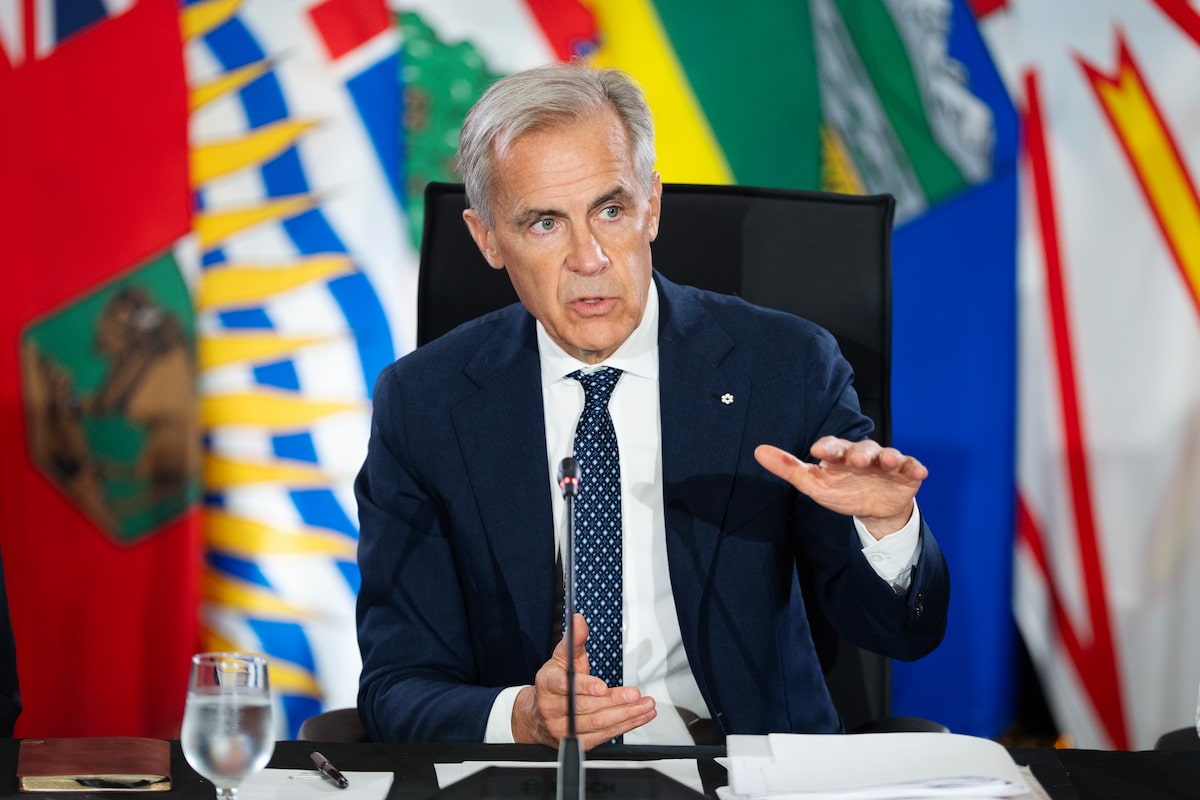
Prime Minister Mark Carney speaks during a gathering of premiers in Charlottetown on Thursday. The Trump administration’s latest tariff threats have put pressure on Mr. Carney to deliver a plan on Canada’s response.Darren Calabrese/The Canadian Press
Canada will do whatever it takes to defend and support workers and families in the face of unwarranted trade actions from the United States, Prime Minister Mark Carney said Thursday as he met with the country’s premiers.
Mr. Carney stressed the importance of unity in his opening remarks at the premiers’ meeting in Charlottetown, in the wake of threats from U.S. President Donald Trump to impose 50-per-cent tariffs on a range of Canadian products next month.
The Prime Minister has been under pressure from premiers to provide a plan for the country if Mr. Trump goes ahead with the new tariffs on Aug. 19, with some calling for retaliation and others stressing diplomacy.
Ontario Premier Doug Ford has said this week that he wants Canada to hit back at Mr. Trump if the U.S. President goes ahead with the tariffs, saying Canada can’t continue to roll over to a bully.
Analysis: Trump’s latest tariff threats open new front in trade negotiations
In his opening remarks, Mr. Carney referenced the Fathers of Confederation.
“What they suspected then is what we know in our bones today: that our unity is our greatest strength, and that our destiny is in our hands,” Mr. Carney said as he sat alongside the provincial and territorial leaders.
“As everyone knows, on Monday, the U.S. administration announced its intention to impose the latest in a series of unilateral, unwarranted trade actions. And we’re clear: Canadian governments around this table will do whatever it takes to defend and support our families, our workers, and our businesses.”
Prime Minister Mark Carney said unity is Canada’s greatest strength as he and the premiers huddled to prepare a response to fresh tariff threats from the U.S.
The Canadian Press
Mr. Carney said Canada’s position has improved since the trade war started 18 months ago, citing diversification efforts.
“We’re in a stronger position because of the determination of Canadians themselves, and I will say this, because of the focus of the premiers around this table,” he said.
The Prime Minister said he has met with the premiers 14 times since last March, including five times in person. He also held a virtual meeting with them earlier this week, to co-ordinate a “Team Canada” approach, including “how we can make the most of our expanding trade network around the world.”
“Because Canada has what the world wants, including being a reliable partner in a world that’s anything but,” Mr. Carney said.
Opinion: Premiers, tear down these internal trade walls
Mr. Carney was joined at the meeting by Canada-U.S. Trade Minister Dominic LeBlanc, the government’s point-person on U.S. relations.
The Prime Minister also faced calls to provide premiers with more information about talks with the U.S.
In a video, Quebec Premier Christine Fréchette said she planned to make three requests of Mr. Carney during a private meeting that took place Thursday morning, including that the provinces have access to the federal government’s negotiation plan.
“The decisions that will be made by the Canadian government will have significant impacts on our economy. So I am asking that Quebec be fully informed and involved in the Canadian strategy,” she said.
Ms. Fréchette added that she wants Quebec’s interests to be “fully taken into account” during the negotiations, especially regarding supply management of the dairy industry and respect for the province’s unique culture.
The Quebec Premier said she would also ask Mr. Carney to ensure Ottawa is ready to roll out relief measures for businesses and workers hit by any new tariffs.
Prior to the meeting on Thursday, Prince Edward Island Premier Rob Lantz, who chairs the premiers’ group, said he hopes the Prime Minister takes an “aggressive” approach to strike a comprehensive deal with the United States.
He later told the room that he and his counterparts held “thoughtful discussions” about the country’s challenges but also its economic opportunities.
Mr. Trump’s top trade official, Jamieson Greer, said Wednesday that he’s aiming to negotiate interim deals with Canada and Mexico by the end of the year, while discussions about more fundamental changes to continental trade rules are expected to stretch into 2027.
While some premiers said they were hopeful a deal with the U.S. can be struck by next month, others weren’t so sure.
“I’m bullish, but I’m not entirely confident we’ll get there,” Saskatchewan Premier Scott Moe told reporters at a press conference alongside his counterparts Wednesday.
Mr. Carney and the premiers are set to hold a news conference later on Thursday.
The Prime Minister also spoke about the forest fires that have ravaged parts of Canada this summer, calling the recent weeks “one of the worst wildfire seasons in our history.”
He offered recognition to the firefighters, emergency crews and members of the Canadian Armed Forces who are working “relentlessly” to battle the fires.
With a report from Maura Forrest in Montreal