
LONDON — When rumors spread in 1987 that Margaret Thatcher intended to appoint her chancellor of the Exchequer, Nigel Lawson, as foreign secretary, some Tory MPs quietly grumbled that the prime minister couldn’t appoint a Jew as Britain’s chief diplomat.
Four decades on, amid a grim backdrop of near-historic levels of antisemitic incidents in Britain, there is perhaps one glimmer of light. New UK Prime Minister Andy Burnham’s choice of Ed Miliband, the country’s most senior Jewish politician, as foreign secretary this week evoked no such reaction.
Ironically, however, Miliband — who led the Labour Party in opposition between 2010 and 2015 — has had a long and, at times, uneasy relationship with Britain’s Jewish community. Indeed, his record as Labour leader suggests that will be mirrored in what is likely to be a tense relationship with Israel.
Here’s what to know about Miliband’s rise to the Foreign Office.
In the beginning
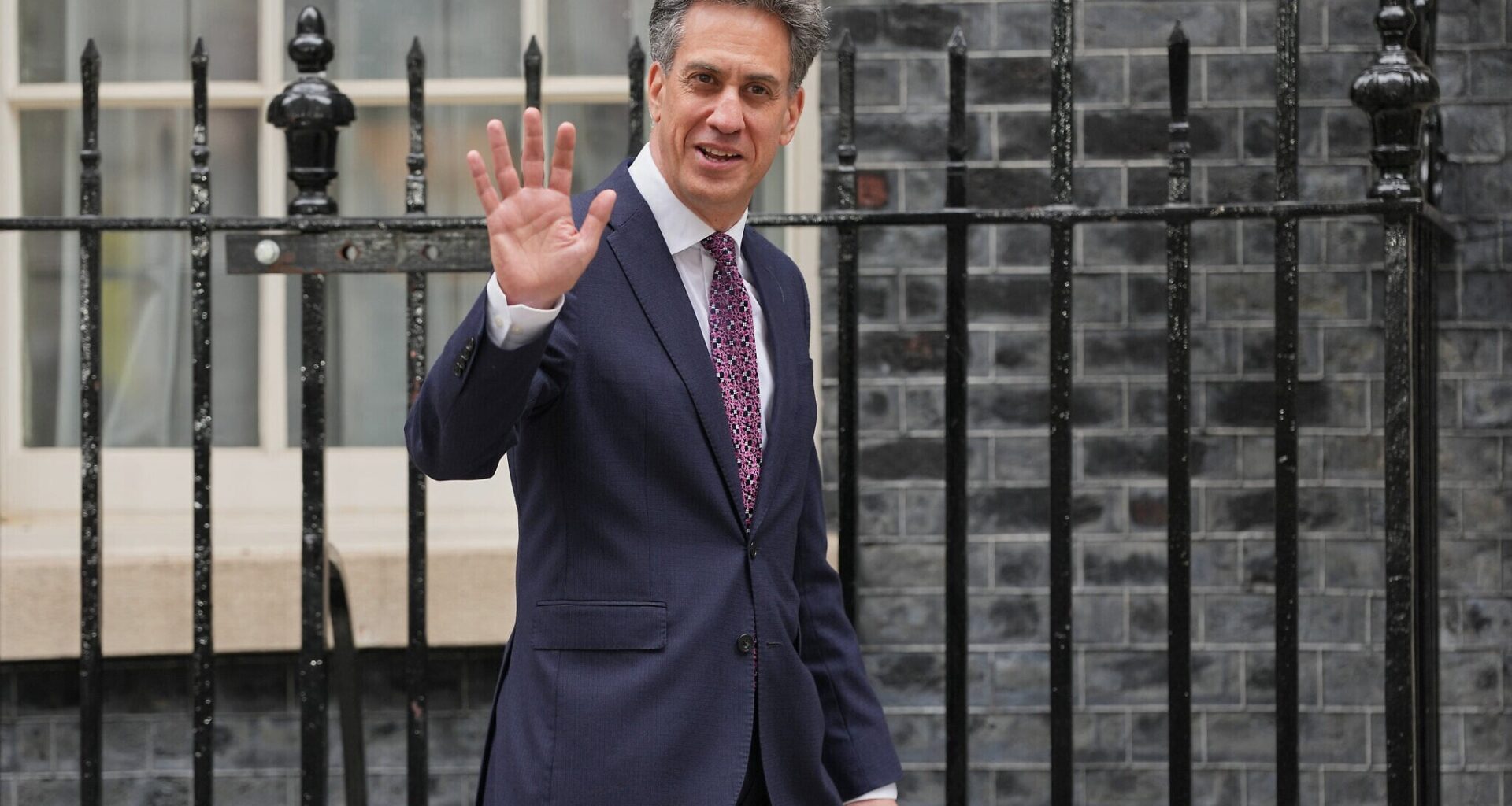
After he emerged from Downing Street following Burnham’s decision to send him to the Foreign Office, Miliband immediately referenced his Jewish heritage.
Get The Times of Israel’s Daily Edition
by email and never miss our top stories
By signing up, you agree to the terms
“My parents came to Britain as Jewish refugees from the Nazis,” he stated. “To them, Britain was both a sanctuary and a beacon of hope in the global fight against fascism. I will carry my parents’ faith in that spirit of Britain to my role representing our country.”
Miliband’s family history is a painful one. As he later recalled, when he was seven, he was taken to visit his grandmother in Tel Aviv. Pointing to a black-and-white photograph in her home, the young boy demanded to know who was “that man in the picture.” He was quickly taken from the room and quietly told that the man — David, his grandfather — had died in Poland many years before he was born. Only some years later did Miliband realize that his mother’s father had been murdered by the Nazis for being Jewish.
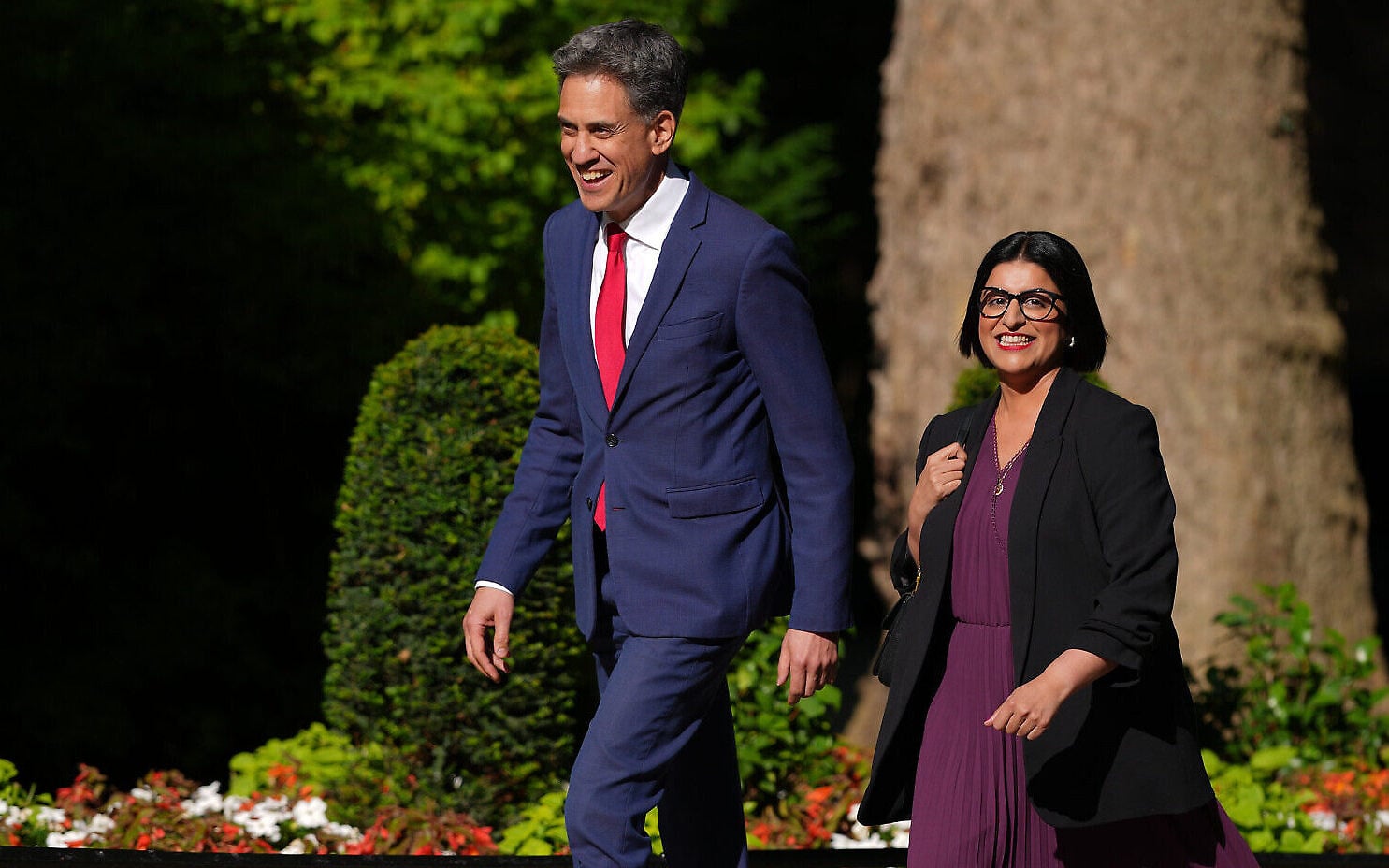
Ed Miliband and Shabana Mahmood arrive for a cabinet meeting in London, July 20, 2026. (AP/ Kirsty Wigglesworth)
Miliband’s parents, however, escaped the gas chambers. Fleeing Belgium as the German armies overran it in 1940, his 16-year-old father, who later adopted the name Ralph, caught the last boat from Ostend to Britain. In Poland, his mother, together with her sister and mother, was sheltered throughout the war, initially by nuns. Marion Kozak made it to Britain seven years after her future husband.
Miliband and his brother David were not brought up as part of the Jewish community. As he wrote in a 2012 essay, Marion and Ralph, a renowned Marxist academic, “defined themselves not by their Jewishness but by their politics.”
Politics ran in both ferociously bright boys’ blood. David became a youthful aide to Tony Blair in opposition, headed the Downing Street Policy Unit during Labour’s first term in office after its 1997 landslide, and himself became an MP in 2001 and a minister swiftly thereafter. Ed attached himself to the other architect of the centrist New Labour project, Gordon Brown. When Brown became chancellor in 1997, he became a senior adviser in the Treasury, before following his brother into parliament in 2005.
‘The era of New Labour has passed’
On Brown’s arrival in Downing Street as prime minister in 2007, he appointed both David and Ed to his Cabinet. David went to the Foreign Office, while Ed became energy secretary. Ed, the younger and more left-leaning of the brothers, was, politically, the more junior. But, when Brown resigned following Labour’s defeat in the 2010 general election, he confounded expectations by running against and narrowly beating his brother to attain the party leadership.
Miliband immediately announced a rupture with the government in which he had loyally served just months earlier, boldly declaring: “The era of New Labour has passed.” In his first speech as Labour leader, he denounced the Iraq War Blair had joined in 2003. Also in 2010, he signaled that he would abandon the staunchly pro-Israel line that had been a hallmark of New Labour. “The Gaza blockade must be lifted, and we must strain every sinew to work to make that happen,” Miliband stated.
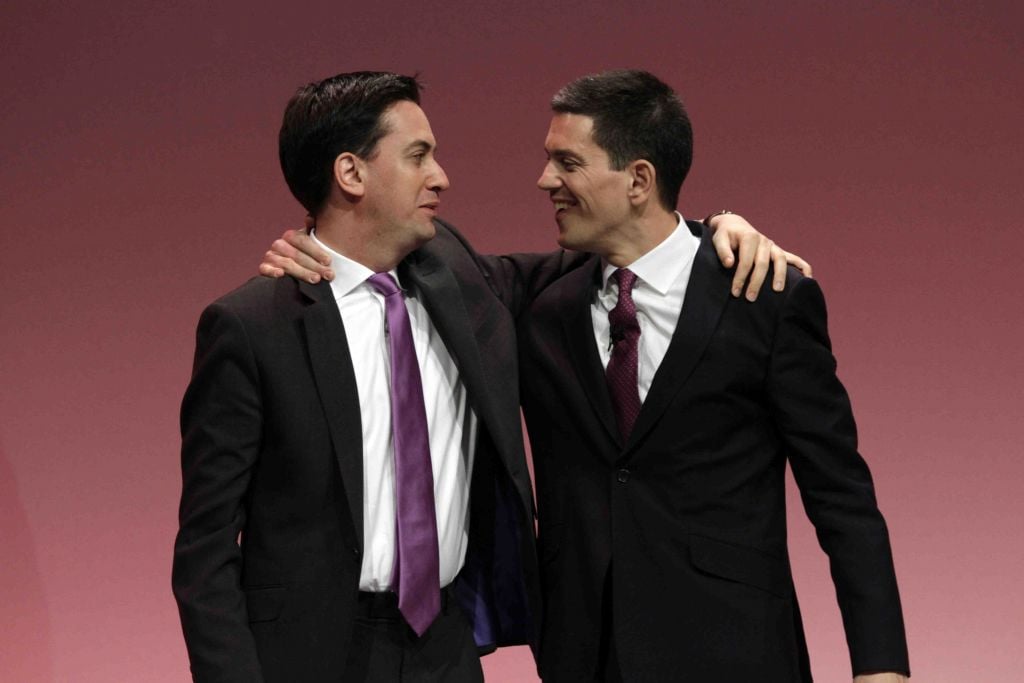
Ed Miliband, left, the then newly elected leader of Britain’s opposition Labour Party, embraces his brother David Miliband, right, following David’s speech on foreign policy during the party’s annual conference in Manchester, England, September 27, 2010. (AP/Lefteris Pitarakis)
The significance of his words on Gaza was underlined by the fact that he made no mention of Hamas or the rocket attacks on Israeli border communities that had led to the blockade. Moreover, Miliband’s 6,000-word address did not touch on any other foreign policy issues beyond Israel and Iraq — a country in which British troops had been serving for the past seven years.
The lessons of Iraq
The most controversial moment in Miliband’s tenure as Labour leader came in late August 2013 when parliamentarians were called to session during a recess following Bashar al-Assad’s sarin nerve gas attack on the suburbs of Damascus in which at least 1,400 civilians died.
The prime minister, David Cameron, wanted authorization for the UK to join planned US strikes to stop the Syrian dictator from repeating the war crime. Citing the intelligence failures in the run-up to the Iraq war, Miliband demanded “compelling evidence” that Assad was behind the attacks. In reality, Assad’s guilt — he committed further chemical weapons attacks over the next five years — was never in doubt. But Miliband stuck to his line, whipped his MPs to oppose UK military action and, thanks to a revolt on the government benches, succeeded in inflicting a humiliating defeat on Cameron.
The impact was immediate and far-reaching. Breaking his own famed “red line” against the use of chemical weapons in Syria, then-US president Barack Obama responded to Britain’s change of stance by halting his own plans for US strikes. Critics suggest the West’s resultant inaction emboldened Assad’s ally, Vladimir Putin, triggering his decision to attack Ukraine in 2014 — itself the prelude to the full-scale invasion of 2022. But Miliband has shown no regrets about his stance, boasting in the 2015 general election that he had stood up “to the leader of the free world” by refusing to support the bombing of Syria.
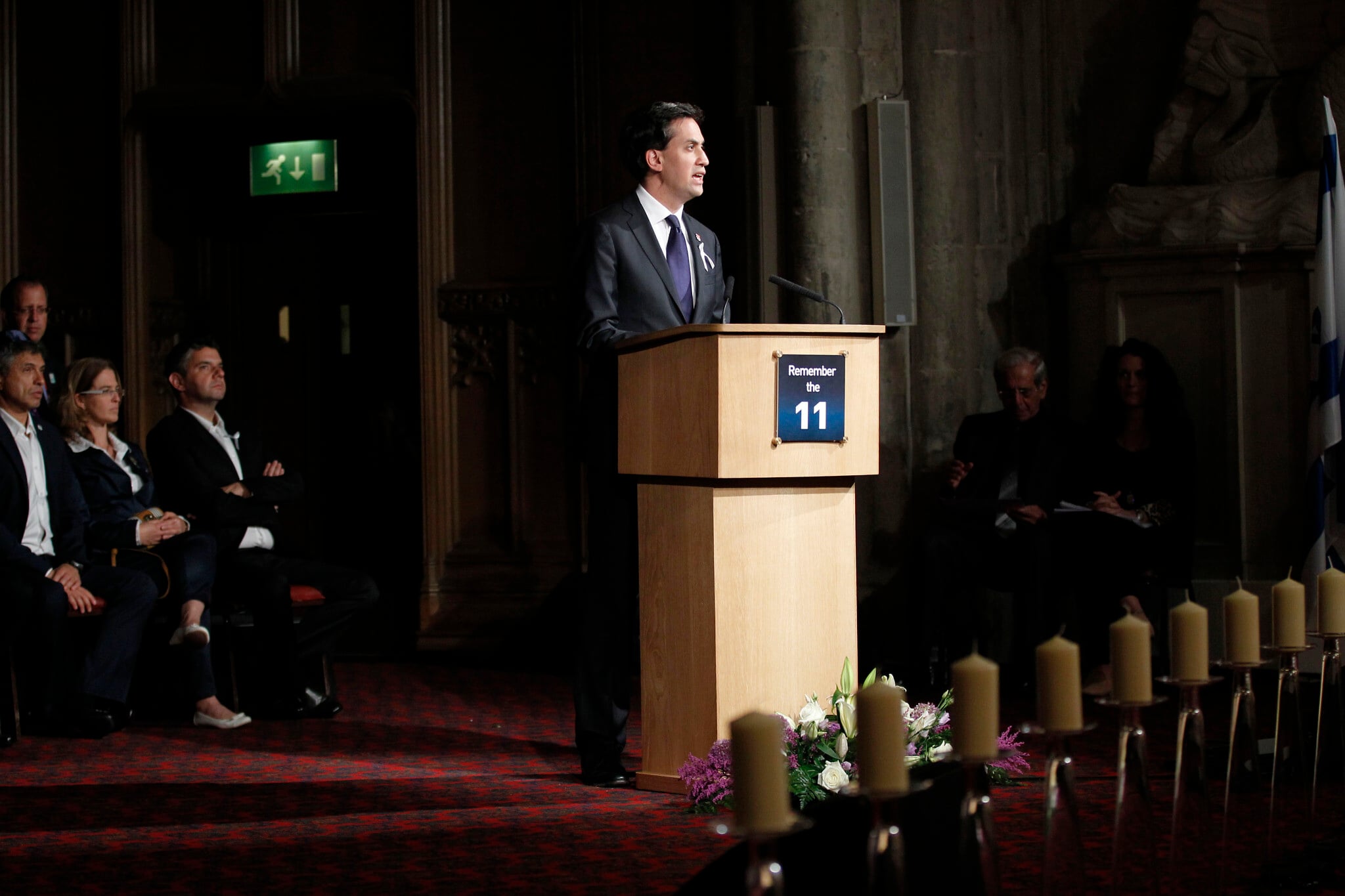
Then-Labour leader Ed Miliband addresses guests at a memorial in London to commemorate the 40th anniversary of the terrorist attack at the 1972 Munich Olympic Games, where 11 members of the Israeli Olympic team were killed, August 6, 2012. (AP/Sang Tan)
Israel: ‘Part of my family history’
Ten months later, Miliband traveled to Israel — a rare foreign foray for the Labour leader. He met with Prime Minister Benjamin Netanyahu, then-opposition leader Isaac Herzog and PA president Mahmoud Abbas, striking a far more nuanced and warmer tone than he imparted during his 2010 conference speech. Visiting the southern city of Sderot, long a target for Hamas rocket fire, for instance, he conceded: “I understand the reasons why Israel feels so concerned about its security, and I think that’s very much a part of understanding how you can get solutions.”
And while he warned that settlement-building risked damaging the Obama administration’s fragile peace process, he denounced the Boycott, Divestment and Sanctions movement, and said he wanted to bring his two young sons to the “homeland for the Jewish people” because it was “so much a part of my family history.” As if to underscore the point, Miliband’s office released images of him being greeted by his great-aunt as he arrived to spend a Shabbat dinner with her at Kibbutz Nachshonim.
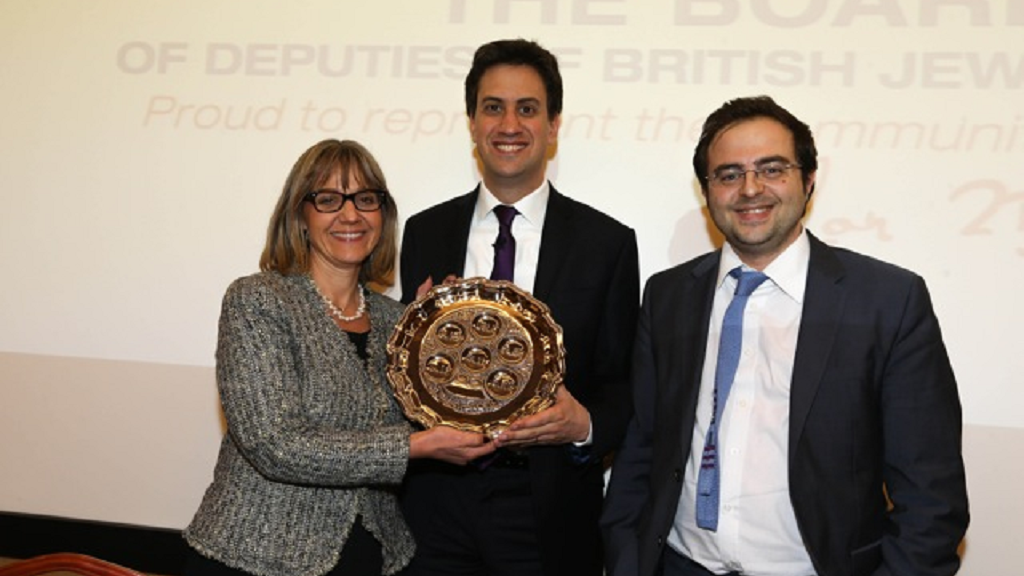
Labour leader David Miliband, flanked by Board of Deputies Vice President Laura Marks and Jewish News editor Richard Ferrer, shows off a seder plate he received. (Courtesy of Marc Morris)
‘A friend of Israel’
Perhaps the high point of Miliband’s relationship with the Jewish community came shortly after his return from Israel, when he addressed the Labour Friends of Israel 2014 annual lunch. With a general election less than a year away, Miliband pledged a strong relationship with Israel if he became prime minister and lavished praise on the Jewish state as “an amazing economic powerhouse.”
Declaring that “we must ensure Israel’s security and right to protect itself,” he denounced Iran and its terror proxies Hamas and Hezbollah. But the speech was also intensely personal.
“Israel has special meaning for me and a special place in my heart,” he said, recalling picking oranges during childhood visits and speaking movingly of being handed new information at Yad Vashem about his grandfather’s death. Visiting the Holocaust museum and memorial reminded him of how “Israel became a miraculous affirmation of life in the face of death.”
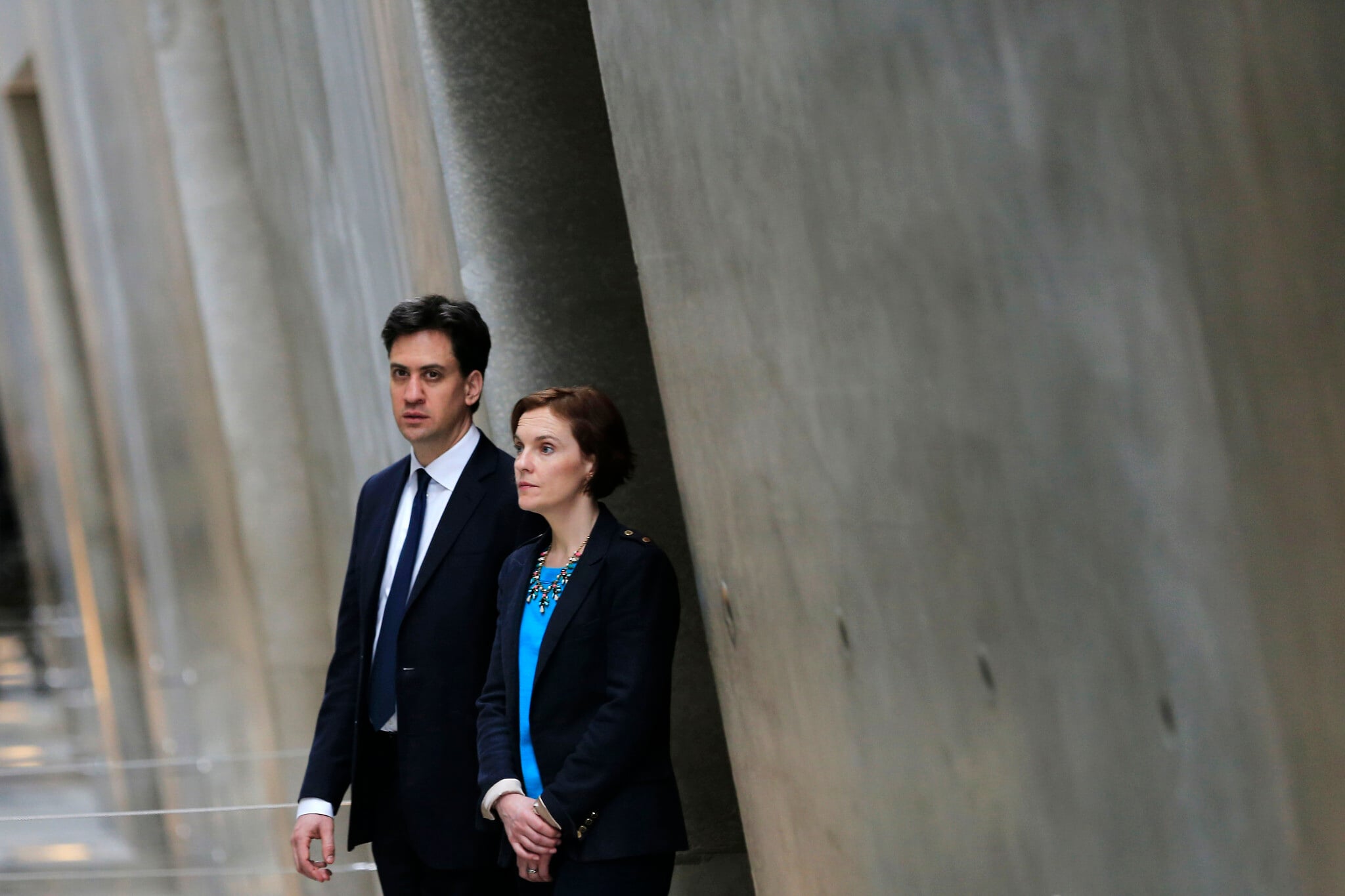
Then-Labour party leader Ed Miliband and his wife Justine visit the Yad Vashem Holocaust memorial in Jerusalem, April 10, 2014. (AP/Tsafrir Abayov)
Gaza again
Miliband’s LFI speech had begun with words of concern for the fate of Naftali Frenkel, Gilad Shaar, and Eyal Yifrach, the three kidnapped Israeli teenagers who were later found to have been murdered by Hamas, triggering the 50-day 2014 Gaza war. But the Labour leader’s tone during the conflict was fiery, condemnatory and a marked departure from that of Blair, who, during the 2006 Lebanon War, had steadfastly refused to call for a ceasefire.
By contrast, Miliband assailed Cameron’s “silence on the killing of hundreds of innocent Palestinian civilians” as “inexplicable” and branded the Jewish state’s actions “unacceptable and unjustifiable.”
In response, the two major Jewish communal organizations, the Board of Deputies and Jewish Leadership Council, said the Labour leadership “regrettably ignores the ideology of Hamas, the psychology of Hamas, the actions of Hamas and thus the reality faced by Israel.”
For many in the community, Labour’s four-month silence as antisemitic incidents in the UK doubled in the wake of the conflict proved an even greater source of anger and confusion.
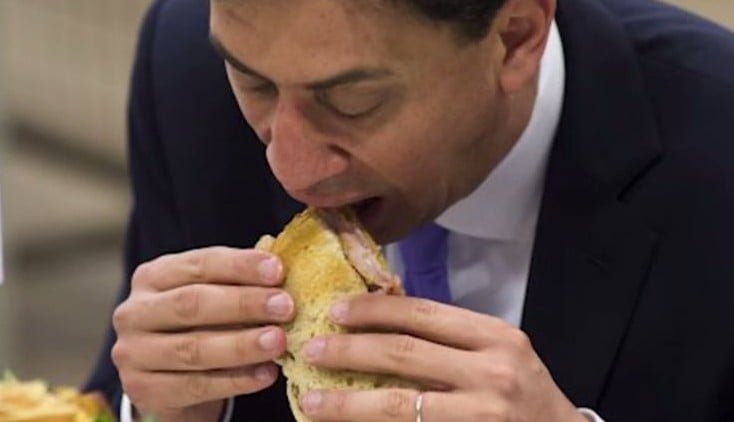
Then-Labour leader Ed Miliband grapples with a bacon sandwich in May 2014 (YouTube screenshot)
Just when you thought it couldn’t get worse
The rift between Miliband and the Jewish community deepened still further in the autumn of 2014, when Labour announced that it would support the unilateral recognition of a Palestinian state. Abandoning 13 years of carefully calibrated policy — under Blair and Brown, the party supported a negotiated two-state solution, with recognition following, not preceding, an agreement between Israel and the Palestinians — Miliband took the rare step of whipping his MPs to back a motion proposed by a backbench MP, Grahame Morris.
That backbencher was a leading voice in Labour Friends of Palestine and the Middle East who just weeks before had compared the IDF to the Islamic State terror group. In response to what she termed “this ludicrous piece of propaganda,” popular Jewish actor Maureen Lipman delivered a searing public attack on Miliband that concluded with her declaring that, for the first time, she wouldn’t be voting for Labour in the imminent general election.
Rejection and defeat
Lipman was far from the only British Jew who decided that Labour was effectively forcing them to choose between their support for the party and their support for Israel. It was a contest in which Labour came off worse. A poll for the Jewish Chronicle on the eve of the 2015 election showed that 73 percent of Jews said a party’s attitude towards Israel and the Middle East was a “very” or “quite” important factor in how they would vote. Moreover, by a massive 55-point gap, those surveyed judged that Cameron’s approach was better than that of Miliband.
The result was a collapse in Jewish support for Labour under Miliband. In 2010, Jews voted in roughly equal numbers for the party and the Conservatives. Five years later, the Tories captured the votes of 67% of Jews, with Labour winning only 15%. When the polls closed on election night, a string of north London marginal seats with large Jewish electorates remained firmly in Cameron’s column. The next day, the defeated Miliband resigned as Labour leader.
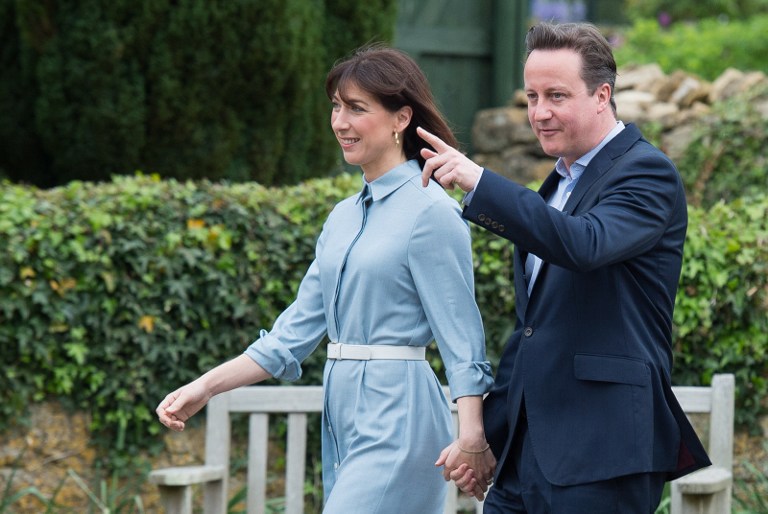
British Prime Minister and leader of the Conservative Party David Cameron arrives with his wife Samantha to vote at a polling station in Spelsbury on May 7, 2015, as Britain holds a general election. (AFP / Leon Neal)
A period of silence
Critics argue that changes driven through by Miliband as to how Labour elects its leader, and his decision to elevate hard-left figures sidelined under Blair and Brown, helped pave the way for Jeremy Corbyn’s upset victory in the 2015 contest.
With the veteran pro-Palestinian activist now at the helm, antisemitism surged within the party. While a number of senior Jewish and non-Jewish Labour MPs repeatedly challenged Corbyn’s handling of the issue, Miliband was largely silent — although he did push back against attempts by the left to stop the party from adopting the International Holocaust Remembrance Definition of Antisemitism in full. Miliband’s apparent desire to stay out of the battle contrasted sharply with his predecessors. Reflecting their strong stance on the issue in government, Blair labeled antisemitism in the party “prejudice and poison,” while Brown termed the issue “a running sore.”
Back in the limelight
With Starmer’s election as Labour leader following the party’s landslide defeat at the 2019 general election, Miliband returned to frontline politics. As Energy and Climate Secretary after Labour took office in July 2024, he enjoyed widespread popularity among party members. Inside the government, he was one of the leading ministers believed to have pushed a reluctant Starmer to formally recognize a Palestinian state last summer.
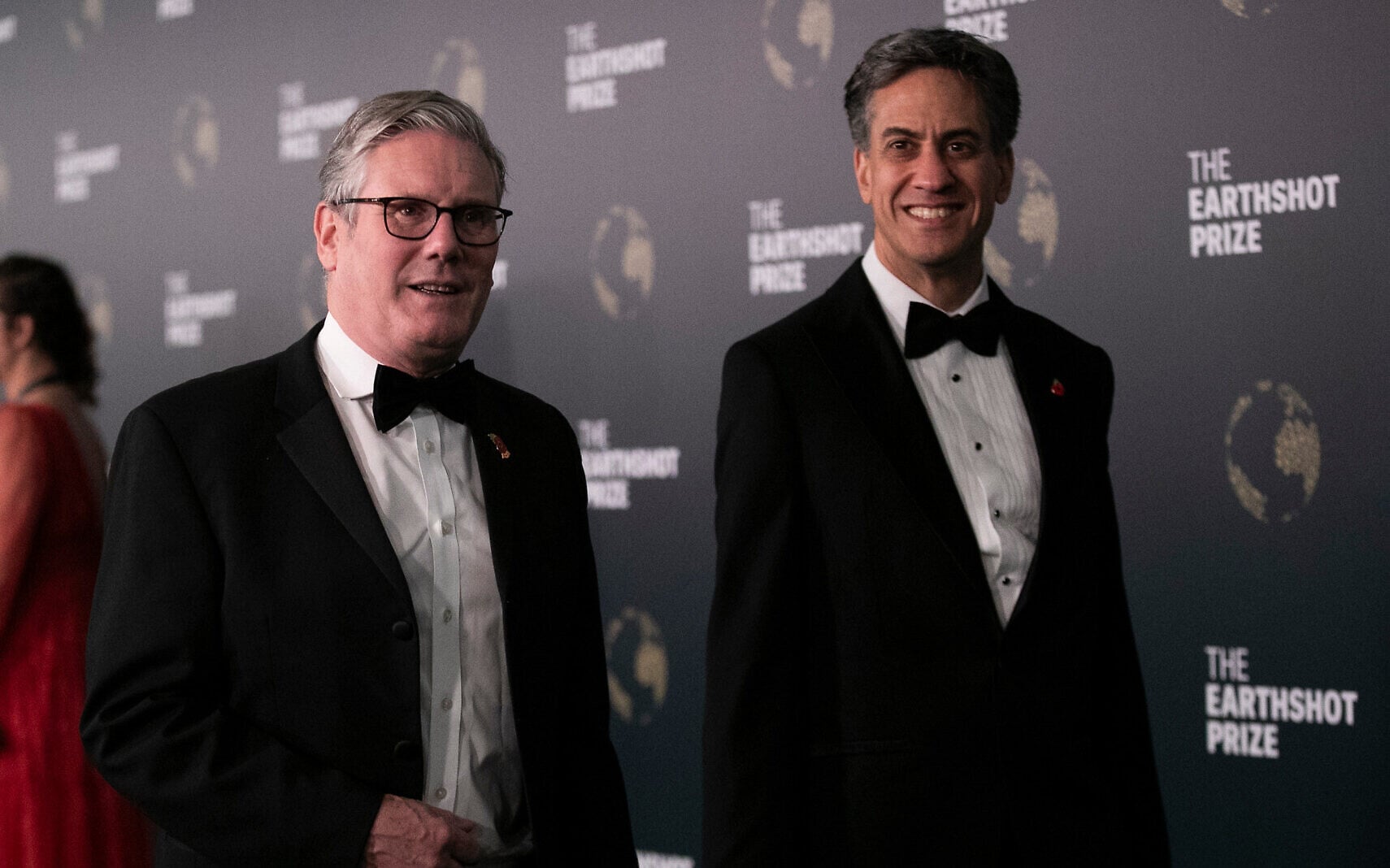
Then-UK prime minister Keir Starmer, left, and Energy, Security and Net Zero Secretary Ed Miliband walk on the green carpet before the Earthshot Prize award ceremony at the Museum of Tomorrow in Rio de Janeiro, November 5, 2025. (AP/Bruna Prado)
Miliband’s decision to turn against the former prime minister is seen as having contributed to Starmer’s premature departure from power this month. Indeed, he was touted as a potential successor had Burnham not managed to return to the House of Commons in a special election. Despite helping to ease Burnham’s path to Downing Street, the new prime minister — fearing the stock markets taking fright — denied Miliband the job of chancellor he has long reportedly prized.
As foreign secretary, Miliband is expected to feel comfortable following the lead set by Burnham, who, on the eve of becoming prime minister, declared his belief that Starmer hadn’t been tough enough on Israel, saying the party was too slow to call for a ceasefire in Gaza. The first sign may come with further action on West Bank settlements, with the government confirming it is drawing up plans for a ban on imports and exports. Such a move, though, could further strain ties between London and Washington. So too could Miliband’s strong opposition to any UK involvement in US military action in Iran.
There may be few second acts in politics, but Miliband — rejected by the voters in his bid to become prime minister 11 years ago and denied a stint at the Treasury this week — still finds himself holding one of Britain’s top “great offices of state.”