
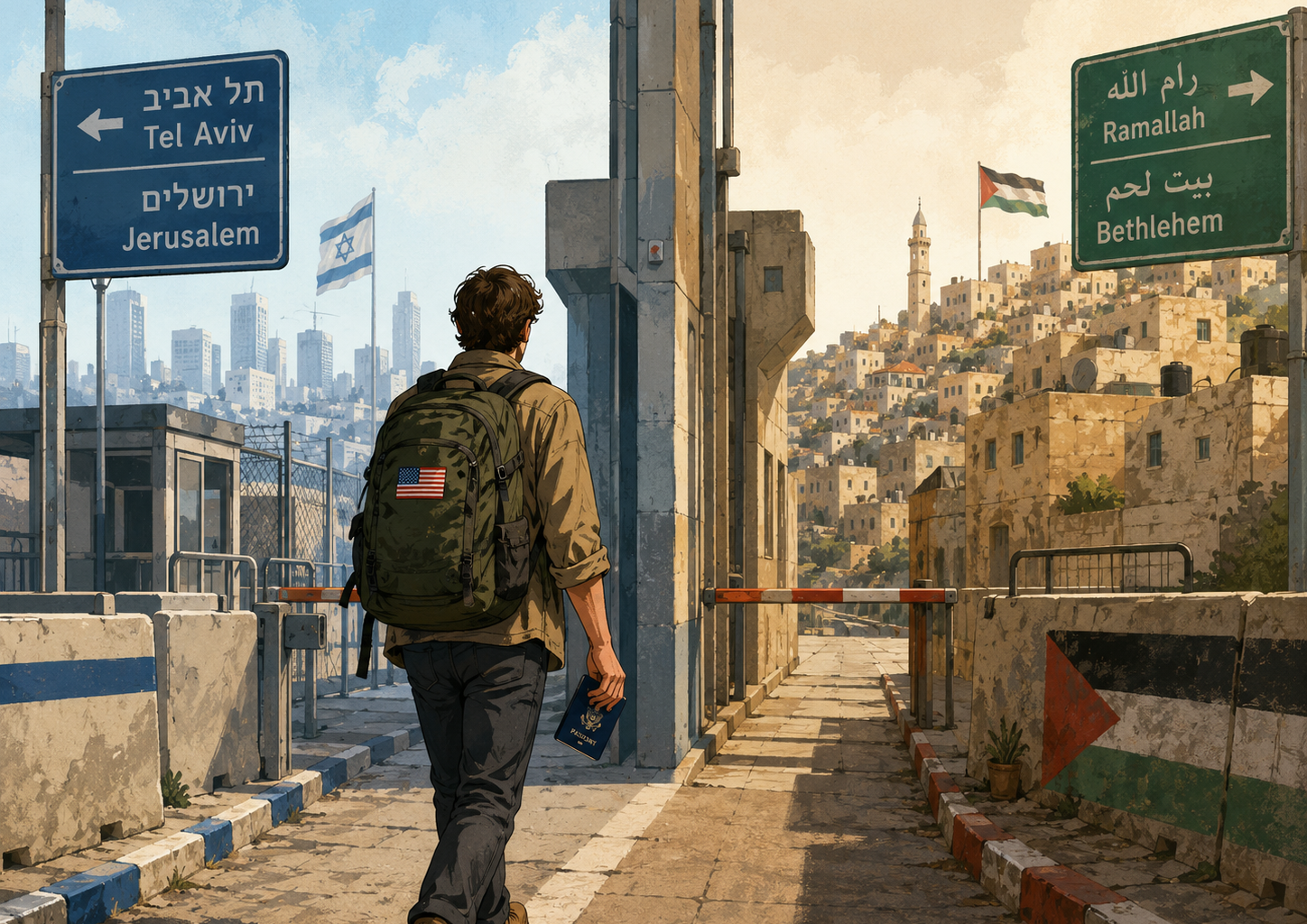
I have spent more hours than I care to admit watching travel vlogs from Israel and Palestine – those breezy, handheld, parasocially intimate videos in which a 20-something with a backpack and a foreign passport lands at Ben Gurion, eats hummus in Tel Aviv, takes a sherut to Jerusalem, and walks through the Old City’s four quarters.
They then catch a bus to Bethlehem through Checkpoint 300 with nothing more than a passport flash and a nod, wander into Ramallah for coffee, drive through the Jordan Valley past settlements and Bedouin encampments and military watchtowers, and return to the coast for sunset – narrating the whole journey as though Israel and Palestine were a single, continuous, traversable space, which, for them and only for them, it is.
This is the detail that never quite gets said aloud, the one that sits underneath every checkpoint documentary and every UN mobility report but that nobody frames in its full absurdity: in the territory between the Jordan River and the Mediterranean Sea, the only people who can move freely across the entire landscape – who can experience it as one place rather than as a patchwork of jurisdictions, permits, walls, and prohibitions – are the people who have no claim to it whatsoever.
The architecture of this paradox is worth understanding, because it reveals something about the nature of the Israeli occupation that no amount of diplomatic abstraction can capture. The West Bank, under the Oslo Accords, is divided into 3 zones: Area A, comprising the major Palestinian cities – Ramallah, Nablus, Jenin, Jericho, Bethlehem, Hebron – under nominal Palestinian Authority civil and security control; Area B, Palestinian villages under shared jurisdiction; and Area C, constituting roughly 60% of the West Bank’s total territory, under full Israeli military and civil control, where most of the approximately 520,000 settlers live and where Palestinians are systematically denied building permits, water access, and freedom of movement.
Israeli authorities formally prohibit their own citizens from entering Area A – red signs at the entrances warn, in Hebrew, Arabic, and English, that entry is forbidden, dangerous, and against Israeli law. Palestinians, meanwhile, cannot enter Israel without permits issued through a bureaucracy that B’Tselem describes as opaque, arbitrary, and one of the principal tools through which Israel controls Palestinian movement.
They cannot use Ben Gurion Airport. They cannot drive on settler-only bypass roads. They cannot access roughly 10% of the West Bank that falls within settlement municipal boundaries, or the 20% designated as military firing zones. Since October 2023, the restrictions have tightened to the point where the UN documented an average of 38 access incidents per week across the West Bank in 2025, including mobile checkpoints, extended closures, and shootings at Palestinians attempting to reach workplaces.
Into this landscape of mutual exclusion walks the foreigner – the British backpacker, the American student, the Japanese travel vlogger, the German volunteer – and discovers, with the cheerful obliviousness of someone who has never had to think about jurisdictional identity, that none of these restrictions apply to them.
They cross from Israel into Area A without prohibition. They return to Israel without a permit. They visit settlements and Palestinian refugee camps in the same afternoon. They film themselves eating knafeh in Nablus and shawarma in Haifa and posting it as a single day’s itinerary, stitching together a territorial continuity that neither Israelis nor Palestinians are permitted to experience. They can do this because their passport assigns them to no side of the conflict, which means, in the perverse logic of occupation, that they are assigned to all of them.
What the vlogger captures without realizing it – the seamless passage from one world to another, the casual crossing of boundaries that for millions of people represent the outer limit of their entire existence – is the most devastating possible indictment of the system, precisely because it is delivered without commentary.
The camera does not editorialize. It simply shows a person walking through a landscape that its inhabitants cannot walk through, filming a country that its people cannot see whole. The foreigner experiences the homeland as a single place. The Palestinian experiences it as a cage. The Israeli experiences it as a fortress. And the checkpoint, which exists to separate the native from the native, waves the outsider through without a second glance.
There is a term for this in the academic literature – Clio Chaveneau, in a 2024 study, calls it “mobility privilege,” and Matthew Griffiths has written about Israel’s “international mobilities regime” – but the academic language, precise as it is, misses the gut-level strangeness of the thing itself.
The strangeness is not that foreigners are privileged; privilege follows the passport everywhere on earth. The strangeness is that in this particular place, on this particular land, over which two peoples have fought for more than a century, the person with the greatest freedom to know the whole of it is the person with the least stake in its future – and that this condition is not an accident of bureaucracy but the logical, inevitable product of a system designed to ensure that neither of its native populations ever sees the full picture of what they are fighting over.
The land is whole. Its people are not allowed to know that.
A Moroccan journalist with a Master’s degree in Media Studies from Qatar. I contribute about the Western Sahara dispute, Morocco-Israeli relations, and Jewish-Muslim coexistence in a country that was once home to around 250,000 Jews—the largest Jewish community in the region. I also run the Instagram account @murakuc.officiel, which now has over 300,000 followers and focuses on old photographs and archives of Morocco, including its deep Jewish roots that the country officially recognizes in its 2011 constitution as the Hebraic component.