
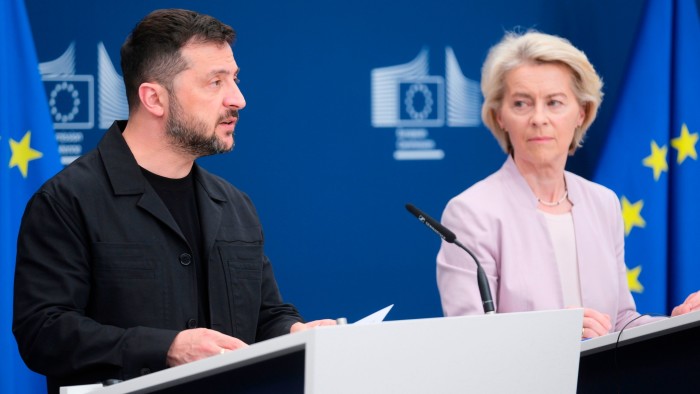
Volodymyr Zelenskyy will ask Donald Trump to increase pressure on Russia for a ceasefire in the Ukraine war and spell out what security guarantees he is willing to offer at a White House meeting on Monday in the face of US demands that Kyiv make additional concessions to stop the fighting.
The US president agreed at a meeting with Russian President Vladimir Putin on Friday to push directly for a peace agreement without an initial pause in the fighting.
Trump’s shift in position shocked Ukraine and European leaders, who fear the move would allow the Russian army to maintain pressure on Ukrainian front lines to bolster Putin’s claims to territory not yet occupied.
“Putin has many demands, but we do not know all of them,” said the Ukrainian president at a press conference in Brussels on Sunday, adding that “it will take time to go through them all”.
“It’s impossible to do this under the pressure of weapons,” Zelenskyy said. “So it’s necessary to cease fire and work quickly on a final deal”, he added, with positions frozen on the current front line.
Zelenskyy said he would raise it in Washington, where European leaders will join him in a show of support, and that he expected a “positive meeting”.
In a post on X he welcomed the willingness of the US to discuss security guarantees for Ukraine, which he said “must really be very practical, delivering protection on land, in the air and at sea, and must be developed with Europe’s participation”.
European Commission president Ursula von der Leyen, German Chancellor Friedrich Merz, UK Prime Minister Sir Keir Starmer, French President Emmanuel Macron, Italian premier Giorgia Meloni, Finnish President Alexander Stubb and Nato secretary-general Mark Rutte confirmed they would attend the talks.
Von der Leyen, speaking alongside Zelenskyy, was more conciliatory towards Trump, saying “the effect must be stop the killing . . . whether we call it a ceasefire or it’s a peace deal”.
She called for a trilateral meeting between Zelenskyy, Putin and Trump soon.
Marco Rubio, the US secretary of state, told CBS on Sunday: “In order to have a deal here, both sides are going to have to make concessions.” It had become clear that neither Moscow nor Kyiv were “on the verge of surrender”, he said.
On Friday, Putin told Trump that Ukraine must pull troops out of the Donetsk and Luhansk regions in the eastern part of the country as a condition for peace. He said he could freeze the rest of the frontline in return.
Trump passed on the message to Zelenskyy and European leaders in a call on Saturday, but it was unclear if he backed the demand.
When asked about territorial swaps on Sunday, Rubio said Russia might have to give up territory it holds but Ukraine would have to consider withdrawing from some areas too.
“Ultimately, what they’re willing to live with is what they’ll have to decide on. Maybe the answer [is] they’re not willing to live with any of this. We don’t know. But that’s what we need to explore,” Rubio said in a separate appearance on ABC.
Zelenskyy also said he would ask for more details of what security guarantees would be offered by the “Coalition of the Willing” countries during a video call to discuss European military support in the event of a peace deal.
The Coalition of the Willing includes Merz, Macron and Starmer. France and the UK have led the push to establish a European-led “reassurance” force for a post-peace Ukraine, establishing a headquarters in Paris.
“There are no details how it will work and what America’s role will be, what Europe’s role be,” Zelenskyy said.
Some things “can be provided only by the US” including air defence systems, he added.
Steve Witkoff, the US special envoy, told CNN on Sunday that Putin agreed in his meeting with Trump to allow the US and allies to give Ukraine a security guarantee similar to Nato’s collective defence mandate.
“We were able to win the following concession: that the United States could offer Article 5-like protection, which is one of the real reasons why Ukraine wants to be in Nato,” he said.
But Rubio suggested that Moscow still had to come on board.
“[The Ukrainians] don’t want to be back here again. They want to be able to go on to rebuild their country and live their lives. That’s a very reasonable request. That’s something we’re working on. And that’s something the Russian side has to understand, obviously,” Rubio said.
“As a sovereign country, Ukraine has a right, like every sovereign country, to enter into security alliances and agreements with other countries,” he added.
 Vladimir Putin and Donald Trump hold a press conference after their summit in Alaska on Friday © Jeenah Moon/Reuters
Rubio blamed a “stupid media narrative” for the idea that the Europeans were coming to Washington on Monday to stop Zelenskyy being bullied by Trump into an unfavourable deal for Ukraine. “We’ve been working with these people for weeks,” he said.
However, Zelenskyy’s last White House meeting in February ended with him leaving early after a humiliating argument in the Oval Office during which Trump told him “you don’t have the cards” to win the war with Russia and that he should be more grateful for US support.
Putin told Trump he still wished to resolve what he claims are the “root causes” of the conflict, which would essentially end Ukraine’s statehood in its current form and roll back Nato’s eastward expansion.
European leaders said that Russia should not have a veto on Ukraine joining Nato or be allowed to impose limitations on its armed forces.
Recommended

Zelenskyy repeated that he could not agree to hand over Donetsk and Luhansk but he was prepared to discuss the “territorial issue” at a meeting with Putin and Trump.
A German government official said Zelenskyy would meet Trump alone, then be joined by the others for a working lunch, followed by talks.
They would discuss the financing of Ukraine’s armed forces as well as security guarantees, territorial issues and sanctions, the official said.
Additional reporting by Richard Milne in Oslo, Leila Abboud in Paris and Anne-Sylvaine Chassany in Berlin