

A history of pioneering research and space exploration at Jodrell Bank Observatory could end in just 20 months unless new funding for the iconic landmark is urgently secured.
The Manchester Evening News has launched a campaign to help save the future of the Lovell Telescope, where all scientific observations could cease after financial backing for the e-Merlin telescope network was scrapped.
One outraged MP has slammed the decision to reallocate funding – claiming scientific excellence has been ‘stripped’ from the north for decades in favour of the ‘golden triangle’ cluster of elite universities of the south and London.
SIGN THE MANCHESTER EVENING NEWS CAMPAIGN HERE
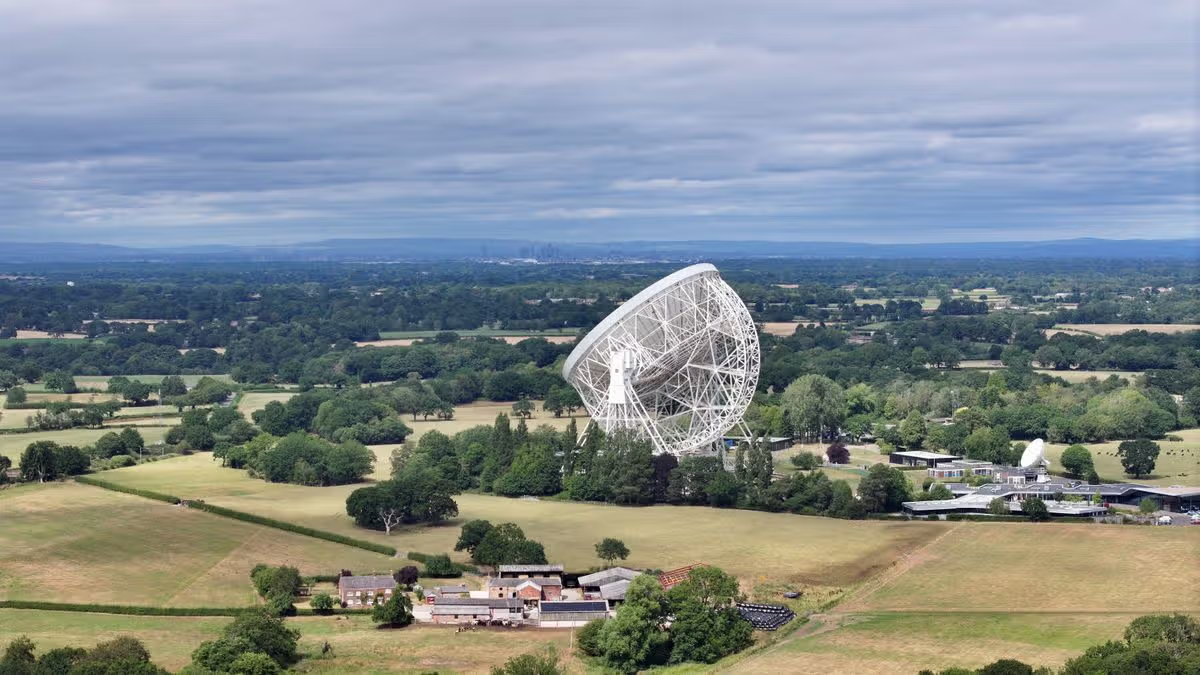
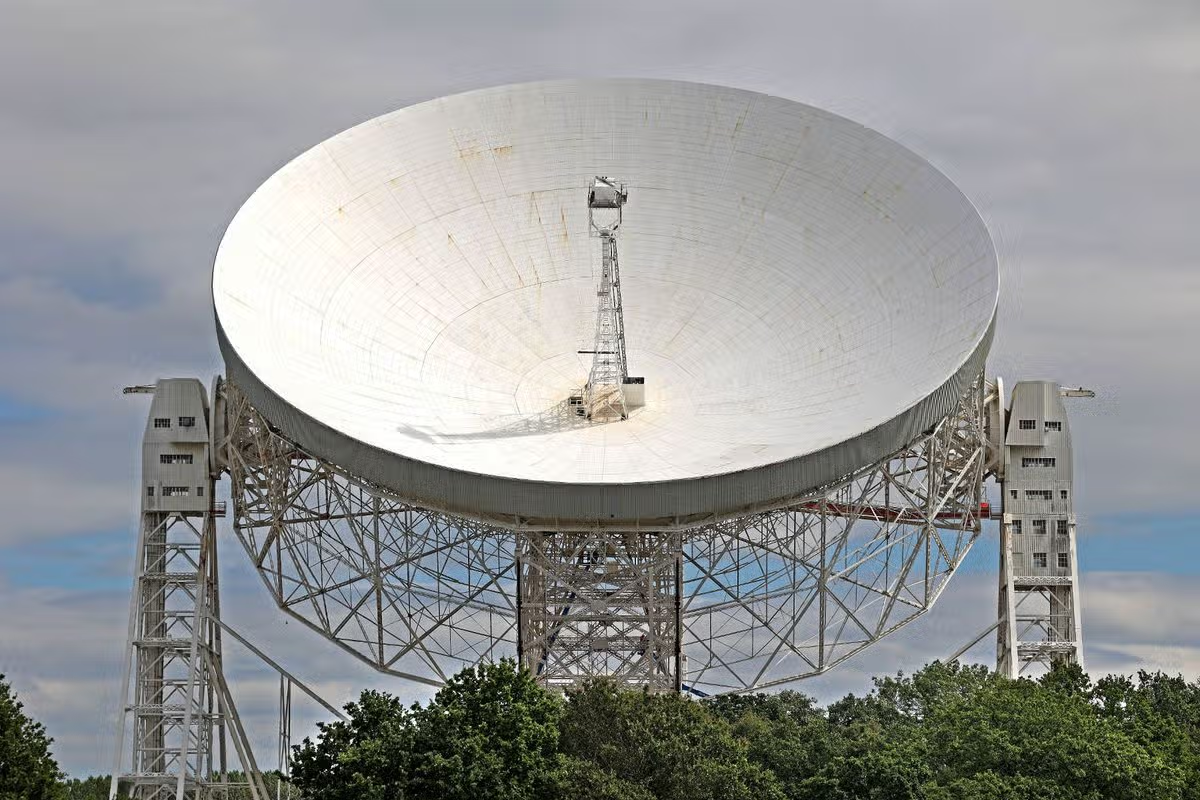
Standing since 1957, the iconic north west landmark is the world’s third largest steerable radio telescope and in 1966 intercepted and printed the first-ever pictures from the Moon’s surface. It went on to play a key covert role in the Cold War.
For five years at the height of the tensions, Jodrell Bank was relied upon to give a four-minute warning of an impending nuclear attack.
Now, all scientific observations at Jodrell are expected to end on April 1, 2028, unless alternative funding can be found.
Prime Minister Andy Burnham has been challenged to prove his commitment to the north by stepping in to reverse budget cuts for the world-renowned scientific facility worth millions of pounds. One outraged Greater Manchester MP said it would be the ‘first test’ of the PM’s vow to ‘rebalance’ the country with No 10 North.
Another MP, however, said alternative funding options and ‘new opportunities’ were ‘being explored’.
Jodrell Bank(Image: Getty Images)
The observatory – a regional landmark loved by millions that earned Unesco World Heritage status in 2019 due to its significance to astrology – is home to the iconic Grade I-listed Lovell Telescope. The telescope, built almost 70 years ago and the largest in the UK, stands proud on the Greater Manchester skyline as a beacon for astrophysics and engineering.
In the decades since the Cold War, Jodrell Bank’s scientists, through the telescope, have studied distant galaxies, black holes and dark matter. More recently, the Lovell Telescope has been the lead in a collection of seven others spanning more than 135 miles across Great Britain in a research project known as e-Merlin, first launched in the early 2000s.
Connected by a high-speed optical fibre network, they join forces as one giant telescope to give clear pictures of space rivalled only by the Hubble telescope in the US. The telescopes are designed to detect the faint natural radio emissions from stars and galaxies – and act as key radar research.
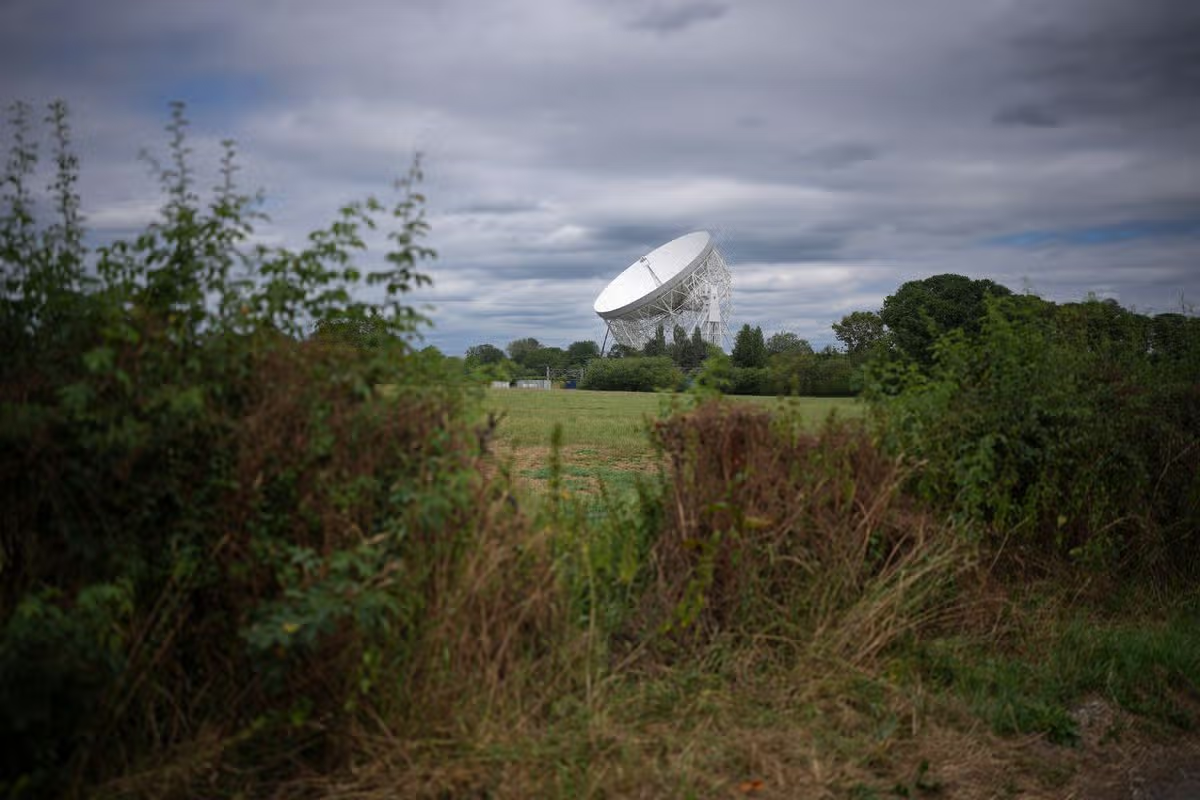
But UK Research and Innovation (UKRI), which funds the science at Jodrell Bank, announced on Monday funding for e-Merlin – worth around £2.8m per year – is to end.
The funding cuts were announced on Monday(Image: Getty Images)
Bosses at the University of Manchester, which manages the observatory, said the funding cut would mean the end of the Lovell Telescope as an ‘active scientific instrument for radio astronomy’ by March 2028 and the loss of 28 jobs employed by the e-Merlin grant.
The Macclesfield observatory’s Jodrell Bank Centre for Engagement – hugely popular for educational school trips – is not affected and would remain open. It’s the science that would be lost, unless new money can be found.
It’s estimated that around 3,000 scientists could be affected in total in a knock-on effect.
The Science and Technology Facilities Council, part of UK Research and Innovation, said the network of radio telescopes is ‘not prioritised for further funding’.
Greater Manchester MP Graham Stringer, who sat on the Government’s Science and Technology Select Committee for 15 years, told the Manchester Evening News he was ‘outraged’ by the decision.
The Labour MP for Blackley and Middleton South said he believes funding for ‘curiosity-driven research’, which he said leads directly into the science that results in specific scientific projects, is being subjected to wholesale cuts.
Mr Stringer said: “This was a mistaken policy from Keir Starmer’s regime. I would expect Andy Burnham to reverse this decision. To lose Jodrell Bank, which is a symbol of science excellence in the north of the country, would undermine his policy to rebalance up the United Kingdom.”
Mr Stringer said the Daresbury Laboratory – a scientific research lab near Daresbury in Cheshire – would also be adversely impacted.
“Jodrell Bank has to be saved,” he said. “It has to be saveable if No 10 in the North and rebalancing the country – Andy Burnham’s projects – are to survive. It’s the first test of his promise – it’s absolutely critical for his future and the north of England that he changes this.

Jodrell Bank Observatory(Image: Jason Roberts /Manchester Evening News)
“It was a part of the last Labour regime – Sir Keir Starmer’s regime – that there has been a stripping of scientific excellence out of the north and a pushing of it into the golden triangle between Oxford, Cambridge and London.”
Professor Sarah Sharples, Vice President and Dean of Science and Engineering at the University of Manchester, said the much-loved and used visitor centre popular with children and adults alike was a ‘separate organisation’ within the Jodrell Bank site.
“Then you have the iconic Lovell Telescope – the dish you see in all the incredible images,” Prof Sharples told the M.E.N. “It was built by Bernard Lovell and his team in the 1950s.
“The impact of the ending of the e-Merlin funding means that unless we find alternative funding, then from the end of March 2028, we will not be able to maintain the Lovell Telescope as a working radio facility.
“The thing that has been removed as funding is the funding of maintenance of the Lovell Telescope as an active scientific instrument for radio astronomy. There are 28 people who are employed by the e-Merlin grant and the e-Merlin grant funds an array of telescopes. The Lovell Telescope is the lead.
The iconic telescope is almost 70 years old(Image: Jason Roberts /Manchester Evening News)
“The reason there is an array of telescopes is that when you have more than one telescope receiving those very weak, but very significant, radio waves that enable us to use radio telescopes to make those observations in space, then if you have more than one, that enables you to get much more accuracy – you can get centremetre level accuracy.”
Prof Sharples said the educational visitor centre alone generates £4.7m a year in economic impact.
The university, she added, was working to ‘find alternative sources of funding from government, from industry, from charities, from philanthropy.
“We are very keen to work with local MPs to identify resources of funding,” she said. “It’s an incredible, iconic facility of cultural importance as well as scientific importance. The University of Manchester is an extremely proud host of the Lovell Telescope and Jodrell Bank and is keen to do everything that we possibly can to ensure that it remains an active scientific instrument for many years to come.”
Macclesfield MP Tim Roca, whose constituency hosts the observatory, acknowledged people would be ‘concerned’.
He said he was in ‘active discussions’ with the funding body and the university to ‘fully understand the implications’ and to ‘make the case for protecting this world-leading scientific institution’. “It is important to stress that Jodrell Bank is not closing and scientific work at the site will continue,” the MP said in a statement.
“Current funding for e-Merlin astronomy is in place until 2028, and alternative funding options and new opportunities are being explored.

Jodrell Bank(Image: Getty Images)
“The Science and Technology Facilities Council has also confirmed that its investment in the Square Kilometre Array Observatory at Jodrell Bank remains one of its highest priorities and will continue.
“However, there are funding decisions affecting astronomy research at the site that I am continuing to work through with Government and the organisations involved. I will continue pressing for clarity and the best possible outcome for Jodrell Bank, its staff and the wider scientific community.”
The Science and Technology Facilities Council said it had set out a ‘prioritisation programme’ affecting research projects in particle physics, astronomy and nuclear physics – known as PPAN. “Due to increased costs forecast in the future, the research council has conducted a prioritisation exercise for future projects to focus investment where it will deliver the greatest long-term impact and ensure STFC reaches a sustainable financial position,” it said.
Although no exact monetary figures have been announced, the council said the budget for the three areas of science would be cut by 2.7 per cent over four years.
The council said its costs were ‘forecast to increase significantly’ and cited increased energy costs; ‘unfavourable’ foreign exchange fluctuations; higher staffing costs and an expanded portfolio of activities.
Professor Michele Dougherty, executive chair of STFC, said: “After listening to our community we have protected core discovery research within PPAN, through a more focused portfolio that safeguards postdoctoral researchers, protects PhD opportunities and maintains the UK’s international leadership.
“However, the situation does require some tough, but necessary, decisions which we have outlined today. These are never easy choices, but we have made what we feel are the right decisions to bring STFC to a sustainable financial position by 2029/30.
“The strength of feeling and depth of engagement we have seen reflect the passion people have for the research STFC enables. While this has involved challenging conversations, it has shaped a plan offering the best available way forward and we are grateful for everyone’s input.”
A spokesperson for the University of Manchester said: “While these cuts to e-Merlin’s funding are significant, Jodrell Bank remains a major scientific, cultural and economic centre nationally and for the local area. We will be looking at the implications of this news carefully and working with our partners to secure the future of the Lovell telescope and e-Merlin.”
A spokesperson for the UKRI said: “STFC has undertaken a rigorous prioritisation process to focus investment on the areas that will deliver the greatest long-term scientific capability, impact and value for the UK, while maintaining a sustainable PPAN portfolio.
“The decision to withdraw funding from e-MERLIN at the end of its current funding agreement is the result of a comprehensive, evidence-based prioritisation process. As part of this, STFC is focusing investment on the areas that will deliver the greatest long-term scientific capability and value, including the next generation of world-leading radio astronomy facilities
“STFC continues to invest in Jodrell Bank’s future through its support for the UK’s hosting of the SKAO headquarters, which is already delivering significant benefits to the University of Manchester and the North West. The current e-MERLIN funding agreement runs until March 2028, providing time to explore alternative funding arrangements.”