
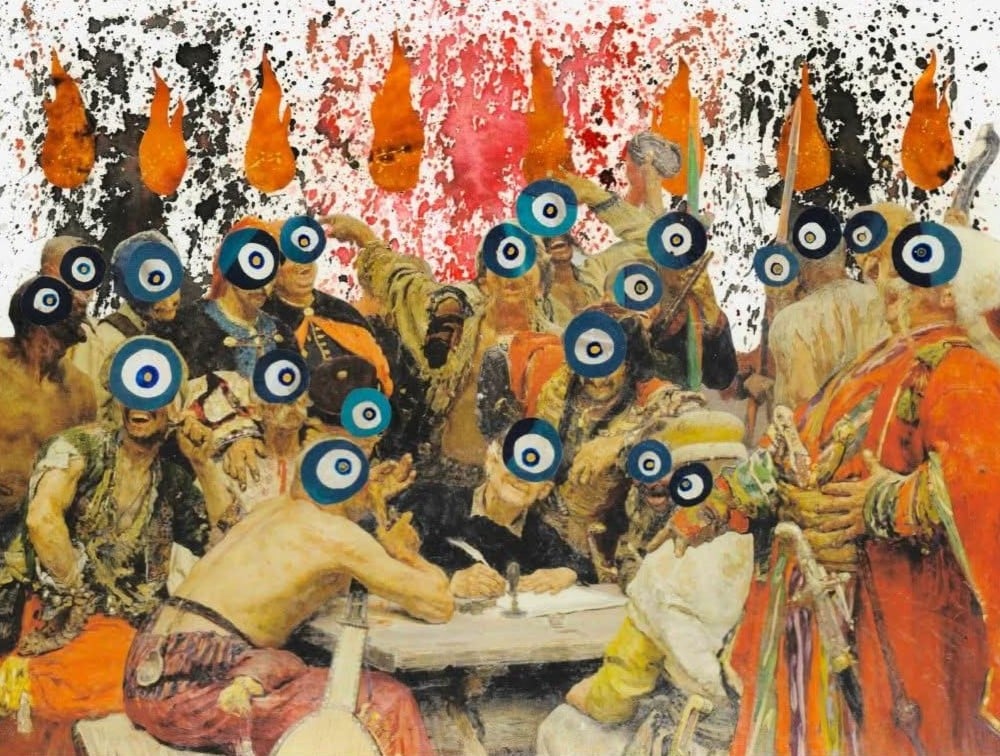
Propaganda is a means of war aimed at the civilians. Despite the distinctions between war, armed conflict and a “special military operation” becoming blurred, propaganda continues to portray a common existential enemy that is both pitiful and all-powerful. In this context, the anti-Ukrainian and anti-Israeli narratives disseminated by the Putin regime’s propaganda in Russia and abroad bear a striking resemblance to “The Protocols of the Elders of Zion”, as well as Soviet and Nazi propaganda.
In this conversation, Jewish artist and educator Moshe Shamah discusses how propaganda has changed throughout recent history, why contradictory images of Nazis and Jews coexist in the mass consciousness, and how to combat propaganda of hatred, which endangers not only individuals, but also democracy and civil society in Israel ahead of the Knesset elections in October.
On 29 July, Moshe Shamah will address these topics as part of his lecture “From Soviet Propaganda to Putin’s Russia” at the Museum of the Jewish People (ANU). Event partners: Embassy of Ukraine in the State of Israel, Israeli Friends of Ukraine, Israel Shelanu.
The 20th century and many contemporary examples have made politics an integral part of our everyday lives, meaning that, in one way or another, art inevitably becomes involved in the debate. Would you say that your artistic practice responds to a particular form of propaganda, or does it oppose the very propaganda as a phenomenon?
Moshe: It was the remarkable sense of urgency and the clear effect that said propaganda has had on society since Russia’s full-scale military invasion of Ukraine that made me act. In some sense, it became less of a choice, and more of a deep sense of responsibility, which is why I decided to pursue this subject in my educational work – just as I have been creating endless art series to fundraise for Ukraine as of 2022.
Academically speaking, I took a course on propaganda over the centuries, titled “The Arts of Power”, in either my sophomore or junior year, which was taught by Dr Alastair Bellamy, which had a profound impact on my interests within an art historical context – one could make the case that this was the first “domino” which led me to this point today.
On a more personal level, however, as an artist, I have been swarmed by an unending tidal wave of anti-Israel, and frankly antisemitic propaganda in the international art world. The type of regurgitated slogans and visual narratives that I and other Israeli or Jewish artists are subjected to, truly make us feel as if we are being haunted by the spectre of Soviet “Anti-Zionist” propaganda – and they have severely impacted my ability to work and exhibit internationally. In this sense, my fight against propaganda is not only for the sake of Ukraine or Israel, but also a deeply personal battle, with my own future and livelihood on the line.
Furthermore, that fight has been a great bridge to building cross-cultural solidarity, with Ukrainians, Kurds, Persians, Taiwanese people, and beyond – and it’s for this that I decided to go in-person to attend the Conference “Ukraine in the World” in Lviv at the Ukrainian Catholic University earlier this month, where I was invited to present a shorter version of the talk that will be held at the ANU Museum on 29 June.
How do you think the phenomenon of propaganda has changed over the last half-century? Personally, I’m concerned by the trend whereby propaganda is spreading beyond the state control, taking the form of memes, stickers and graffiti, for example, and beginning to circulate freely and without regulation.
Moshe: I would say that the general format and content of modern propaganda remains overarchingly the same over recent history, from Post-WWII, and especially the 1960-1970s to now. However, the deployment mechanism has changed dramatically, becoming increasingly multifaceted over time.
Previously, propaganda relied heavily on creating a visual feedback loop via magazines, posters and other publications, coupled with radio and mainstream television. The obvious answer as to how this has changed is social media and AI. You don’t need to commission (or force) an artist to create a poster, print and distribute them, and place them on street signs and workplaces, when you can generate a thousand images in minutes, and have them disseminated to millions of people before lunchtime. The content remains the same, but the range and efficacy have increased.
However, in the case of Putin’s Russia, it seems that the image of the enemy, whether a Ukrainian or a Jew, has been inherited from the all-encompassing yet clumsy and absurd Soviet propaganda machine.
Moshe: The propaganda narratives which run parallel between the Soviet Union and Russia today, do so for a variety of reasons. Firstly, the institutions largely remained intact in Russia – simply with leadership changes and swapped out placards and names. These narratives continue to be utilised because the state apparatus has yet to “accomplish” any of its decade-long tasks, the demoralisation and destruction of Western society as an international model, and the creation of a “multipolar” world.
Both then and now, the various groups which have been fixated on, for our purposes – Ukrainians and Jews/Israelis, remain the same, because the goals remain the same – and we from their perspective, we are merely the foremost “satellites” of that crusade against the West.
It’s hard to imagine that Putin, a former KGB agent whose tasks included encouraging Neo-Nazi violence in East Berlin, designed the Russian political system we see today unthinkingly. Is it pathetic? Sure, from a knowledgeable or even outside perspective, but it is also extremely calculated and extremely intentional.
However, propaganda seems to undermine civic participation, despite many people – including those who produce and benefit from it – believing it aims to mobilise society against a common enemy. Consequently, society becomes paralysed, as if being transported from a real, dynamic life into a one-dimensional propaganda poster.
Moshe: You’re absolutely right in regards to propaganda’s eventual endpoint as a passive mental framework which exists in a population – but I would think that most politicians are not on “auto-pilot” and are indeed using propaganda as an active tool to further their goals, whether positive or negative. At least, any skilled politician would be aware of this, as would their respective teams and staff.
In certain societies, propaganda has the overarching effect of societal apathy – such as Putin’s long-standing “gentleman’s agreement” with the Russian public, which ultimately boiled down to “Leave politics to me, and you worry about your paycheck” (an increasingly challenging lie for the Russian government enchant the population with, when oilfields and Wildberries warehouses are reduced to black clouds every day by the impressive work of the Ukrainian military).
In other societies, propaganda mobilises the masses by abusing their legitimate concerns to stoke fear and populism, and incubate a sense of isolation for the sake of political gain which may not even have any kind of grand strategy aside from individual profit via democratic erosion – a theme that is perhaps familiar to some of us.
I would like to ask specifically about the role of otherness in propaganda, a topic that many researchers of antisemitism have highlighted and continue to do so. How does the Putin regime’s propaganda combine such disparate images as Ukrainians, who are labelled as Nazis by Russian propagandists, and Jews? It’s simply absurd – to portray the other, anyone who differs from the “normal man”, as a threat to life itself and everything that “normal” people value.
Moshe: Russian propaganda in particular has a rather broad and pragmatic framework – throw everything at the wall and see what sticks. If that means portraying Jews and Ukrainians as part of a neo-Nazi Banderite plot today, then so be it. Tomorrow, they might frame Netanyahu as Trump’s puppeteer or Zelensky as a drug-addicted thief draining Western resources. They believe that we have reached a post-meaning point in civilisation where words no longer require consistency or explanation. They bombard any given population with everything at once in the hope that something will stick.
We can see this in the rhetoric used by anti-Israel voices in the West, who have a response for literally any counterargument, as if it were scripted. I’ll remind you of the rather relevant quote by Jean-Paul Sartre: “Never believe that antisemites are completely unaware of the absurdity of their replies. They know that their remarks are frivolous, open to challenge. But they are amusing themselves, for it is their adversary who is obliged to use words responsibly, since he believes in words.”
It is worth recalling another quote from the same seminal essay (“Antisemite and Jew”, 1946): “If the Jew did not exist, the Antisemite would invent him.” Propaganda invents false plots that people find convenient to believe for various reasons.
Naturally, if we are framed as conspirators in a neo-Nazi plot for world domination, working on the dime of the cynical American empire, then we are deemed the ultimate evil – and this doesn’t only justify what happens to our statues, it creates a mental framework in which by violence against any individuals belonging to those respective groups anywhere in the world is not only morally justified, but also an ethical obligation. In Russia’s framework, the conclusion is clear, “de-Nazification” is the only choice of anyone with a conscience. The goal is total social confusion, infighting and chaos – through which Russia and its allies will assert dominance.
In regards to the most absurd iterations of this – my immediate instinct is to name Lavrov’s pathetic quote in the first year of the war, in which he claimed that it is consistent to claim that Zelensky is a Nazi, because Hitler was also part-Jewish (an obvious falsehood, but an old conspiracy that has been revived), and that Israel is, by extension, a Neo-Nazi patron, because “some of the worst antisemites are Jews.”
In addition to this, Russian media has, on several occasions, claimed that Rebbe Nachman’s grave in Uman has become a “neo-Nazi drafting station” and thus, is a legitimate target for strikes. So far, they have not had any luck in this regard. Even more absurd is the fact that these absurdities are repeated as mantras of commitment and devotion by both the far left and the far right in Western societies, both of which are growing in popularity by the day.
Is there any way to counter this propaganda, which seems to have taken root in people’s minds based on my own observations?
Moshe: We need massive and expansive education campaigns, and not only for historical and visual literacy – but also for digital, media and AI literacy. We need to equip ourselves with the ability to discern fact from fiction and reality from (deep)fakes, and good faith from baiting bots.
In addition to this, we need to encourage our populations to support the kind of art and culture that we want to see as the remedy. A society with a healthy relationship with art, literature, journalism, and more can create a positive feedback loop of positive reinforcement and good-faith conversation, as well as broad-tent events where diverse opinions and lifestyles can coexist.
If we support our artists and poets, if our scholars and journalists engage with the people on the ground, and if we reframe the way we talk to each other – hostile propaganda, internal and external, won’t have the soil needed to take root. Yes, this won’t be easy. It won’t satisfy a dopamine addiction with a single click – it will take a lot of work, effort, and investment from all of us. However, cultural decay has given way to this crisis, and cultural renaissance is the remedy. I believe in us and truly believe that we can take the necessary steps to turn vision into reality.
It should be noted that we are both direct targets of hate propaganda. But what would you say to one of those odious propagandists if you were to come face-to-face with them?
Moshe: In regards to what I would tell those propagandists, from Solovyov to Hasan Piker, if I had the chance – I’d ask them to dig a bit deeper into the history they love to abuse, and tell me: What happened to Julius Streicher and Joseph Goebbels at the end of the Second World War? What fate did Mikhail Ryumin face, once he ceased to be useful to the Soviet system that had elevated him? Does a life of humiliation and disgrace like that of artists Leni Riefenstahl or Alensandr Gerasimov appeal to you?
Retribution will come, perhaps not today, but it is certain – because while you attempt to lull the people of the world into a sleepwalking march off a civilizational cliff, thousands of people like me are everywhere, and we will not stop counteracting you. Cracks will form, leaks will spread – democracy will crash in like a great wave. The Russian government has already laid the groundwork for the Ukrainian-Jewish solidarity needed to defeat you. Unlike you, I have faith in the intelligence and goodwill of my compatriots, and we will win.
My final question. How does propaganda from outside Israel, and sometimes even from within our own society, affect us Israelis? This is particularly important in the run-up to the Knesset elections, as many olim hadashim have been – and, in some cases, still are – exposed to propaganda from the countries they left.
Moshe: As my work focuses on the visual elements of propaganda, I have not yet collected sufficient analytical data on the upcoming elections to provide a definitive answer within my framework for now – but what I can tell you is that Russian state propaganda has already been working for quite some time to undermine Israeli society by capitalizing on a few different factors.
First and foremost, the propaganda in question aims to widen the divide between different groups within Israeli society and political camps, feeding into tensions wherever they may exist: Haredi draft laws, the war in Gaza (while they themselves host Hamas representatives in Red Square offices), the relationship between state and religion, etc. In addition to this, propaganda efforts are not only aimed at Israel and Ukraine, but at many states. These efforts deepen the gap between us and the rest of the world and heighten feelings of isolation and existential dread. Russia has even been caught commissioning “mercenaries” in Europe to carry out antisemitic vandalism and deepen the tension between local Jewish and Muslim communities.
A heightened sense of isolation leads to precisely the type of demoralisation which looks to poor decision-making, resulting in the fragmentation of alliances of normative democratic states and populations. Organisations such as the Jerusalem Institute for Intelligence and Security (INSS), as well as former and current heads of the Mossad have published statements and reports on the subject of Russian interference in Israeli politics and electoral processes.
At the same time, however, a society with well-established democratic traditions must also develop resilience to propaganda.
Moshe: I think that it’s self-evident that a population engaged in civic life will be significantly less susceptible to propaganda, whether visual or otherwise, from their own government or hostile foreign state agencies. One’s “level of intelligence” is far less important than active engagement with external ideas; propaganda has a wide reach. In brief, bearing in mind historical nuances and complexity, Hitler depended on the demoralised intelligentsia of Weimar Germany, while Lenin initially depended on the angry, starving working class. Today, all sectors of society are targets and are being fed their own respective echo chambers to serve XYZ goals.
When it comes to Russian-speaking olim, and perhaps this is particularly relevant for the older generations in question – I am quite assertive in my view that the Israeli government should immediately ban Russia Today and Channel One from mainstream cable television and radio, just as they did with Al Jazeera. This is not a question of freedom of the press; these “news channels” are a weaponised avenue of psychological warfare launched by malicious enemy state actors. There are plenty of legitimate Russian-language news sources, just as there are many legitimate Arabic-language news sources. This is just the first pre-emptive step that can be taken.
Broader measures to integrate olim from various countries of origin into Israeli cultural and sociopolitical fabric, whether that be via language, education, or social settings – will help them adjust to the broader body-politic of their current home, and slowly undo the programming of their countries of origin, namely states such as Russia and Belarus.
This is imperative not only for the well-being and future of the olim in question, but also for the security and democratic vitality of the state itself. I achieve this through my artwork, my educational work and by actively inviting and including olim from the “Post-Soviet space” into our community in Jerusalem. I urge other Israelis to do the same. Ultimately, any kind of “deprogramming” requires the active participation of the individual. All we can do is provide accessible education and visual literacy to help along the way, because the anti-democratic axis of states is moving in lockstep against us all while we squabble and trip over the cognitive traps they have laid for us.
Tel Aviv – Jerusalem
26 June 2026