

The Islamic regime publicly hanged two protesters arrested during the January demonstrations in Alikhani Square in Isfahan on Tuesday morning, sparking renewed public outrage, according to the country’s judicial media and footage of the event circulating online among dissident circles.
The two protesters were named by Mizan news agency as Amirhossein Safari and Abolfazl Sepahi, who were alleged to have attacked police officers “with machetes and knives, tying them to road signs, pulling them on the ground, dousing them with gasoline, and setting them on fire” on January 8, the same day that four members of Iran’s security forces were allegedly killed by protesters in the square.
Human rights groups estimate that more than 30,000 people were killed by the Islamic regime during the December and January protests. Tehran, however, has claimed that foreign-backed rioters were responsible for the deaths of 3,117 people, including 427 members of the security forces.
There are numerous reports that the Islamic Republic frequently conditioned the return of victims’ bodies for burial on bereaved families accepting the state’s narrative.
Families were allegedly forced to sign statements claiming that rioters had caused the deaths or that the deceased had been members of the Basij paramilitary.
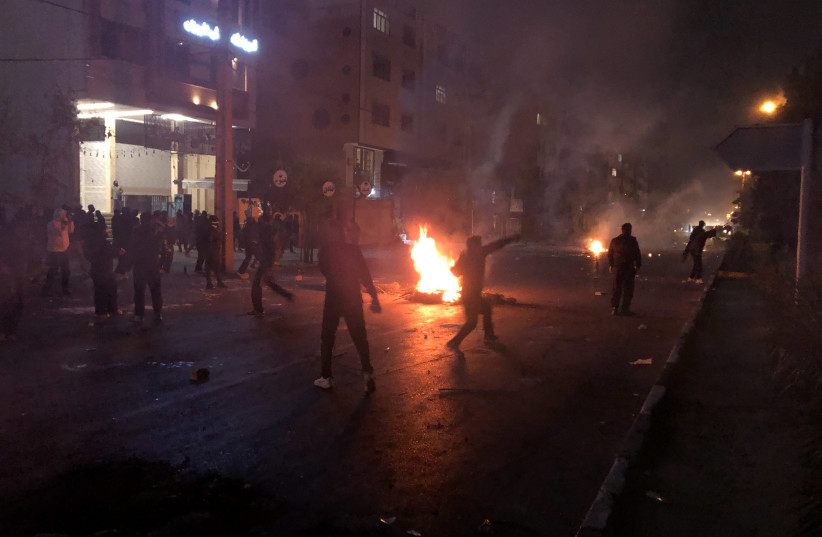
A total of 12 men were convicted for the alleged killings in the square, two of whom were executed on July 19 for their alleged role, despite the UN warning of serious misconduct during the judicial proceedings that led to their guilty verdict.
Safari and Sepathi were convicted under the charge of “moharebeh [waging war against God] by drawing weapons and creating fear and terror” and “corruption on earth for committing acts that severely disrupted public order and security in the country,” charges that have been used against numerous protesters.
The Islamic Republic of Iran Broadcasting released footage of the alleged attack, accusing the men of being “monarchist rioters.”
There were reports that Iran had planned the public execution when iron scaffolding appeared in the square overnight, and the area reportedly came under heavy police surveillance.
Beni Sabti, an Iranian expert on the Islamic Republic at INSS, told The Jerusalem Post that protests had already broken out in response to the executions, but it was clear that the regime’s boldness was intended as a message to the global community that it was no longer concerned with managing international perceptions by hiding its human rights violations.
During the protests, the regime shut down the internet to prevent the world from seeing the violent suppression of protests, and many executions were carried out without prior notice to the families in violation of Iranian law. Now, the regime is carrying out these acts in the street, he highlighted.
“It goes back to the self-confidence they’ve had since the end of the war. They believe they defeated Israel and the United States, and they also believe they ultimately crushed the protesters,” he said. “That has left them feeling extremely confident and powerful, to the point where they think they can do this. From the perspective of the Iranian regime’s logic and behavior, it’s actually a very logical step.”
A source close to Safari’s family told the diaspora site Iran International that relatives had been summoned to Isfahan Central Prison for a final visit.
The Special Rapporteur on the situation of human rights in the Islamic Republic of Iran, Dr. Mai Sato, said that the 12 protesters were subjected to a group trial in a closed-door proceeding that contravened the standards of fair trial procedures.
Since the beginning of 2026, at least 24 people have been executed in connection with the January protests, the experts noted, adding that the death penalty is being used as a means to “instill fear in society and suppress dissent.”
The UN experts warned that current laws in the Islamic Republic make it impossible to criticize the government without the risk of retaliation, harassment, and prosecution.
There are now immediate concerns for the well-being of Shervin Bagherian Jebeli, who turned 18 just days before his arrest.
Within a week, and before any trial, State television aired a video of him confessing to violence against security officers during interrogation, where he appeared unaware of the meaning of the capital charge of moharebeh, which the UN experts warned raised concerns as to whether he had access to any legal counsel of his own choosing.