
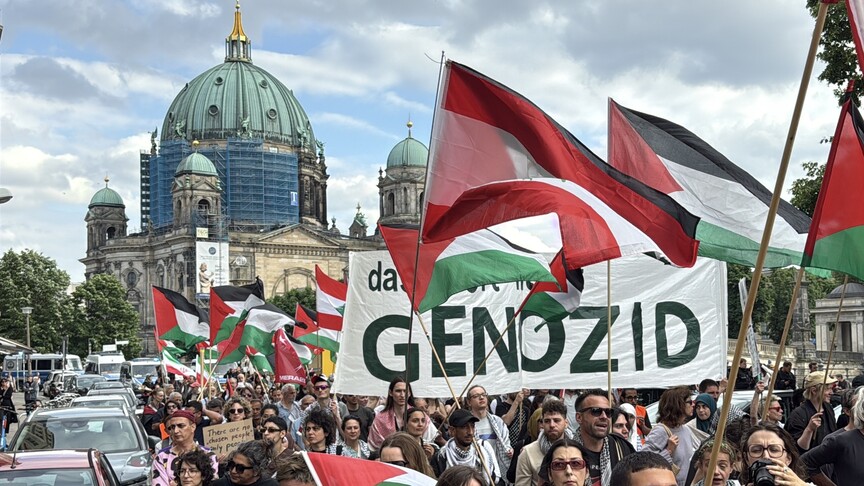
Also supplied 31% of Israel’s major arms imports in 2021-2025 period, according to SIPRI think tank
Germany’s diplomatic concern over Israeli military actions in Palestine stands in stark contrast to its arms policy, with nearly €800 million ($909 million) in defense sales to Israel approved in the first five months of 2026.
Berlin authorized licenses worth €799.3 million for Israel, making it the sixth-largest recipient of German military equipment during the period, according to preliminary figures released by the Federal Economic Affairs and Energy Ministry.
The figure forms part of a record €13.87 billion in German military export approvals between January and June. Of that amount, approximately €9.6 billion covered weapons of war and €4.3 billion other military equipment.
In Israel’s case, more than 60% of the value was linked to a major “maritime defense project.”
Almost another 20% concerned cooperation between German and Israeli companies “in the interest of the German Armed Forces,” while the remainder covered other military equipment classified as “non-war weapons.”
Germany has supplied Israel with Dolphin-class submarines manufactured by shipbuilder TKMS, according to a report by Al Jazeera.
The latest vessel, the INS Drakon, is said to have been handed over to the Israeli Navy in July after undergoing sea trials in the city of Kiel.
The submarine, estimated to be worth about €480 million, is considered capable of providing a sea-based second-strike capacity, allowing Israel to retaliate after suffering a nuclear attack.
Total approved export figures to Israel reached around €326 million in 2023, a tenfold increase from 2022, around €161 million in 2024, and at least €250 million in 2025, according to estimates.
Concern in words, approvals on paper
The scale of the approvals conflicts with Chancellor Friedrich Merz’s increasingly direct criticism of Israel’s war in Gaza and illegal operations in the occupied West Bank.
“I am deeply concerned about developments in the Palestinian territories,” Merz said in April, adding that he told Israeli Prime Minister Benjamin Netanyahu that “there must be no de facto annexation of the West Bank.”
A near identical readout was also issued after their conversation in mid-July.
On the ground, however, Israeli demolitions, military raids and settler attacks continue to intensify across the occupied territory.
Israeli authorities carried out 341 demolition operations in the first half of 2026, destroying 740 Palestinian structures and affecting 923 people, according to the Palestinian Wall and Settlement Resistance Commission.
The UN Office for the Coordination of Humanitarian Affairs said Israeli demolitions displaced more than 1,700 Palestinians in 2025.
This month, after clashes between Palestinians and Israeli occupiers, Netanyahu vowed to expand operations in the West Bank.
Merz in the past has been similarly critical of Israel’s military campaign in Gaza, which officially ended with a truce in October 2025 but violations have continued unabated.
In a televised May 2025 interview with German broadcaster WDR, he said the scale of civilian suffering could no longer be justified simply as part of Israel’s fight against Hamas.
“When boundaries are crossed, where humanitarian international law is really being violated, then Germany too, then the German chancellor too must say something about it,” he said.
“What the Israeli army is doing now in the Gaza Strip, frankly speaking, I no longer understand with what goal,” he said.
Arms freeze lasted just over 3 months
On Aug. 8, 2025, Merz announced Germany would stop approving weapons exports that could be used in Gaza “until further notice,” following an Israeli decision to intensify military operations in the enclave.
“The German government remains deeply concerned about the ongoing suffering of the civilian population in the Gaza Strip,” Merz said in a statement.
He said the planned escalation made it “increasingly unclear” how Israel’s stated objectives could be achieved and called for comprehensive humanitarian access.
The restriction received overwhelming public support. A survey conducted for German public broadcaster ZDF found that 83% of respondents supported halting weapons supplies that could potentially be used in Gaza.
The August 2025 poll also found that 62% wanted Berlin to exert greater political pressure on Israel to end its military campaign, while 60% supported German recognition of a Palestinian state.
The government’s partial freeze, however, was narrow and short-lived. It applied only to new approvals for equipment considered usable in Gaza, while previously authorized deliveries could continue.
Germany lifted the restriction in November, around three and a half months later, and returned to examining applications individually.
Amnesty International called the decision “reckless,” arguing that citing the ceasefire and stabilization in Gaza ignored continuing Israeli attacks, restrictions on humanitarian aid and mass displacement.
The Israeli army killed more than 73,000 people in its brutal two-year offensive in Gaza starting in October 2023. The campaign left the enclave in ruins that will take years to rebuild, with the UN estimating the cost of reconstruction at about $70 billion.
Israel’s second-largest supplier
The US accounted for 68% of Israel’s major arms imports in 2021-2025, while Germany supplied 31%, according to the Stockholm International Peace Research Institute (SIPRI), a think tank.
Together, the two countries provided almost all the major conventional weapons Israel imported during the period.
SIPRI ranked Israel as the world’s 14th-largest arms importer, with its imports rising 12% compared with 2016-2020.
The Campaign Against Arms Trade, citing industry and government data, said Germany’s supplies to Israel have included frigates, torpedoes and submarines. German-made transmission systems are also used in Israel’s Merkava 4 tanks, according to the organization.