
Growing up in apartheid South Africa, I knew what it felt like to live in a country becoming increasingly isolated from the world. Sporting boycotts, economic sanctions and diplomatic pressure were part of everyday life. Living in Israel today, I sometimes experience echoes of that atmosphere. University campuses, European capitals and international institutions increasingly portray Israel as uniquely illegitimate. Accusations of genocide, apartheid and colonialism—once confined largely to activist circles—are now repeated by politicians, amplified across social media and echoed by influential public figures. At the same time, Jewish communities across the world have experienced a disturbing rise in antisemitic attacks, leaving many Jews wondering where criticism of Israel ends, and hostility towards Jews begins.
Yet there is one profound difference. South Africa was condemned because of a political system. Israel increasingly finds itself challenged over the legitimacy of Jewish sovereignty itself.
It is into this moment that Parshat Eikev speaks.
The portion is often remembered for its repeated command to remember, but its message is much deeper. Moses is preparing the Jewish people to become a sovereign nation in their ancestral homeland. Before discussing military victory or national prosperity, he reminds them that the Land of Israel is neither a trophy of war nor a political achievement. It is the fulfillment of God’s covenant with Abraham, Isaac and Jacob.
Then Moses offers one of the Bible’s most beautiful descriptions of the Land:
“For the Lord your God is bringing you into a good land—a land with streams and springs and fountains… a land of wheat and barley, vines, fig trees and pomegranates; a land of olive oil and honey.” (Deuteronomy 8:7–8).
This is more than geography. It is a love song to the Land of Israel. The Seven Species symbolize abundance and blessing, reminding us that the Land is not merely somewhere to live; it is where the covenant is meant to be lived.
Long before Herzl and the modern Zionist movement, Moses laid the spiritual foundations of Jewish nationhood. In many respects, Eikev is the Torah’s blueprint for Zionism: a people returning home to build a society rooted in faith, justice and responsibility.
Yet covenant never comes without obligation.
Moses warns:
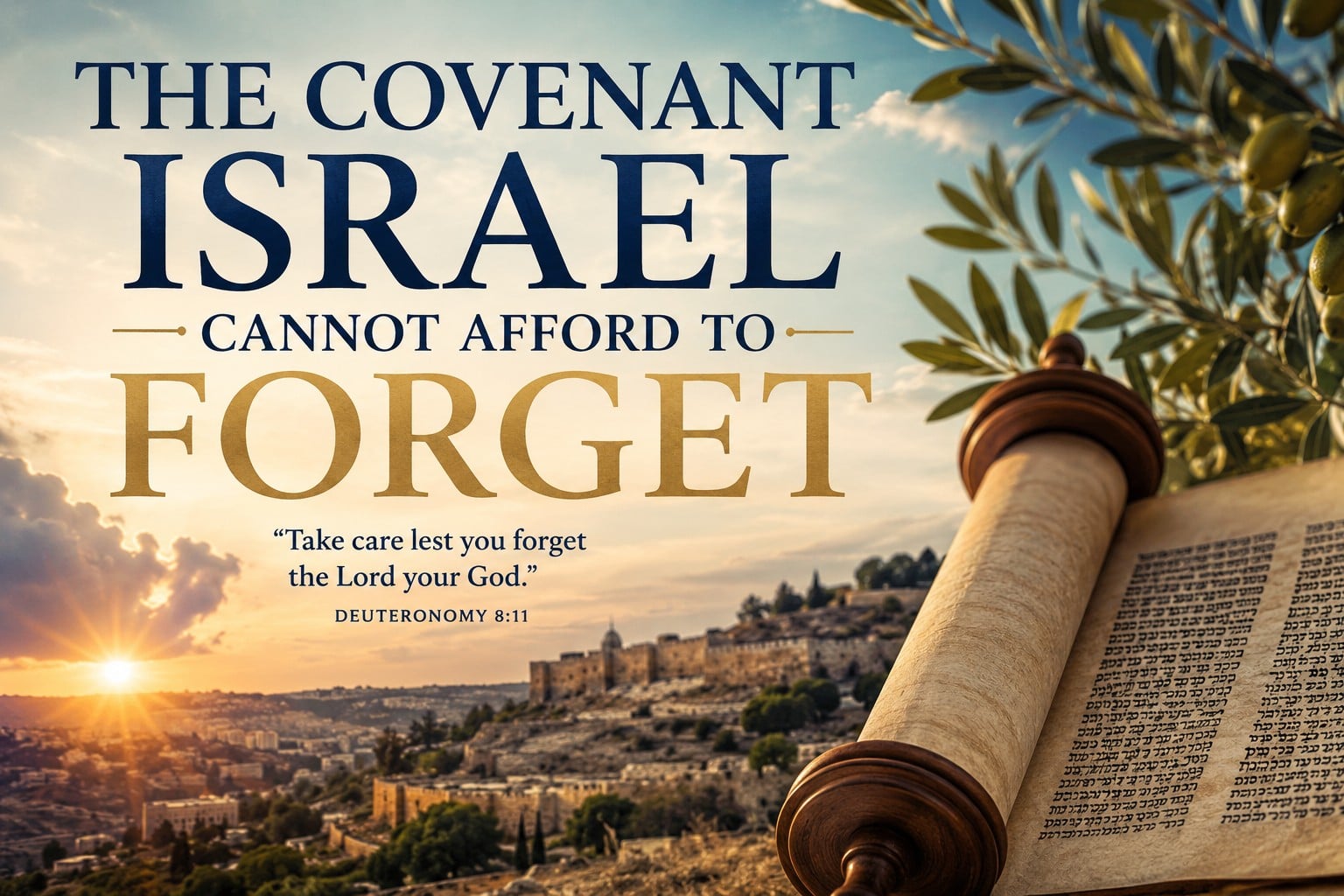
“Take care lest you forget the Lord your God.” (Deuteronomy 8:11).
And again:
“You may say in your heart, ‘My strength and the might of my hand have gained me this wealth.’ But remember the Lord your God, for it is He who gives you the power to prosper.” (Deuteronomy 8:17–18).
The greatest danger is not defeat.
It is success without humility.
Moses then confronts another uncomfortable truth:
“Do not think in your heart… ‘It is because of my righteousness that the Lord has brought me to possess this land.’ Rather, it is because of the wickedness of these nations… and in order to fulfil the oath that the Lord swore to your fathers, Abraham, Isaac and Jacob.” (Deuteronomy 9:4–5).
Immediately afterwards he adds:
“Know, then, that it is not because of your righteousness that the Lord your God is giving you this good land to possess, for you are a stiff-necked people.” (Deuteronomy 9:6).
These verses capture the remarkable balance at the heart of the Torah. The Jewish people’s claim to the Land rests on God’s covenant, not on moral perfection. At the same time, sovereignty is never presented as a licensce for arrogance. The covenant that establishes our inheritance also imposes our responsibilities.
Nor does Moses want the nation to live in fear.
As they prepare to cross the Jordan, he tells them:
“If you should say in your heart, ‘These nations are more numerous than I; how can I dispossess them?’ Do not fear them. Remember what the Lord your God did to Pharaoh and to all Egypt.” (Deuteronomy 7:17–18).
The command is striking. Israel is told to be courageous, not because of military superiority, but because of God’s faithfulness. Security requires strength, wisdom and vigilance, but it also requires confidence that the covenant did not end in the wilderness.
The events of October 7 reminded Israelis that evil is not merely a biblical concept. Hamas’s deliberate murder of civilians, the kidnapping of hostages and the celebration of those atrocities confronted the world with a brutality that cannot be explained away. Whatever one’s political views about the wider conflict, October 7 underscored why the Torah recognizes that wickedness is a reality that societies must confront rather than ignore.
This week’s parsha also invites us to remember another chapter of Jewish history.
On 18 Av 5689 (24 August 1929), sixty-seven Jews were murdered in Hebron. The survivors were evacuated because the British authorities concluded they could no longer guarantee their safety, bringing one of the world’s oldest continuous Jewish communities to an end. In practical terms, Hebron’s Jewish community had been driven from the city through violence.
History repeated itself in Iyar 5708 (May 1948) when the communities of Gush Etzion fell after months of determined defense. Many defenders were killed, others taken prisoner, and the surviving residents were expelled. Nineteen years later, after Israel’s victory in the defensive Six-Day War, families returned to rebuild what had been lost.
These events matter because history shapes narrative.
When the story begins in 1967, Jewish communities become “settlements.”
When it begins in 1948, they become communities returning after war.
When it begins in 1929, they become communities rebuilding after massacre and expulsion.
But when the story begins with the Bible, the Jewish relationship with the Land of Israel is no longer measured in decades or even centuries—it is measured in millennia.
Hebron is where Abraham and Sarah are buried.
Beit El is where Jacob dreamt of a ladder reaching heaven.
Shiloh is where the Mishkan stood.
Jerusalem is where David established his capital and Solomon built the Temple.
The covenant did not begin in 1967, 1948 or 1929.
It began with Abraham.
Rabbi Jonathan Sacks observed that Judaism became the civilization that remembers because memory shapes identity. We do not remember simply to preserve the past. We remember so that we understand who we are and what we are called to become.
That, ultimately, is the message of Parshat Eikev.
Against every expectation, the Jewish people have returned to their homeland. We have revived our ancient language, rebuilt our national life and restored Jewish sovereignty after nearly two thousand years of exile.
But return is only the beginning.
If we are to remain in this extraordinary land, we must love it, defend it without fear, pursue justice within it and never imagine that our strength alone secures our future. The covenant gives us confidence in our claim, but it also demands humility in how we exercise it.
When the story begins with today’s headlines, Israel appears to be a modern political dispute.
When the story begins with the Bible, Israel becomes the continuation of a covenant thousands of years old.
That is the covenant—and the memory—that Israel cannot afford to forget.
Jeffrey Levine is a CFO, writer, and grandfather living in Jerusalem. He writes regularly on Jewish identity, ethics, and resilience, blending personal reflection with historical insight. His blog series “The Soul of Israel” can be found on the Times of Israel, Substack, LinkedIn, and other platforms. He is also the founder of Upgrading ESG—Empower Society for Good, which explores how business, faith, and sustainability can align for a better world.
He is also the founder of PersoFi – Empowering AI Financial Automation for SMEs – www.persofi.com
To learn about me, here is a link to my personal website – www.jeffreylevine.blog