
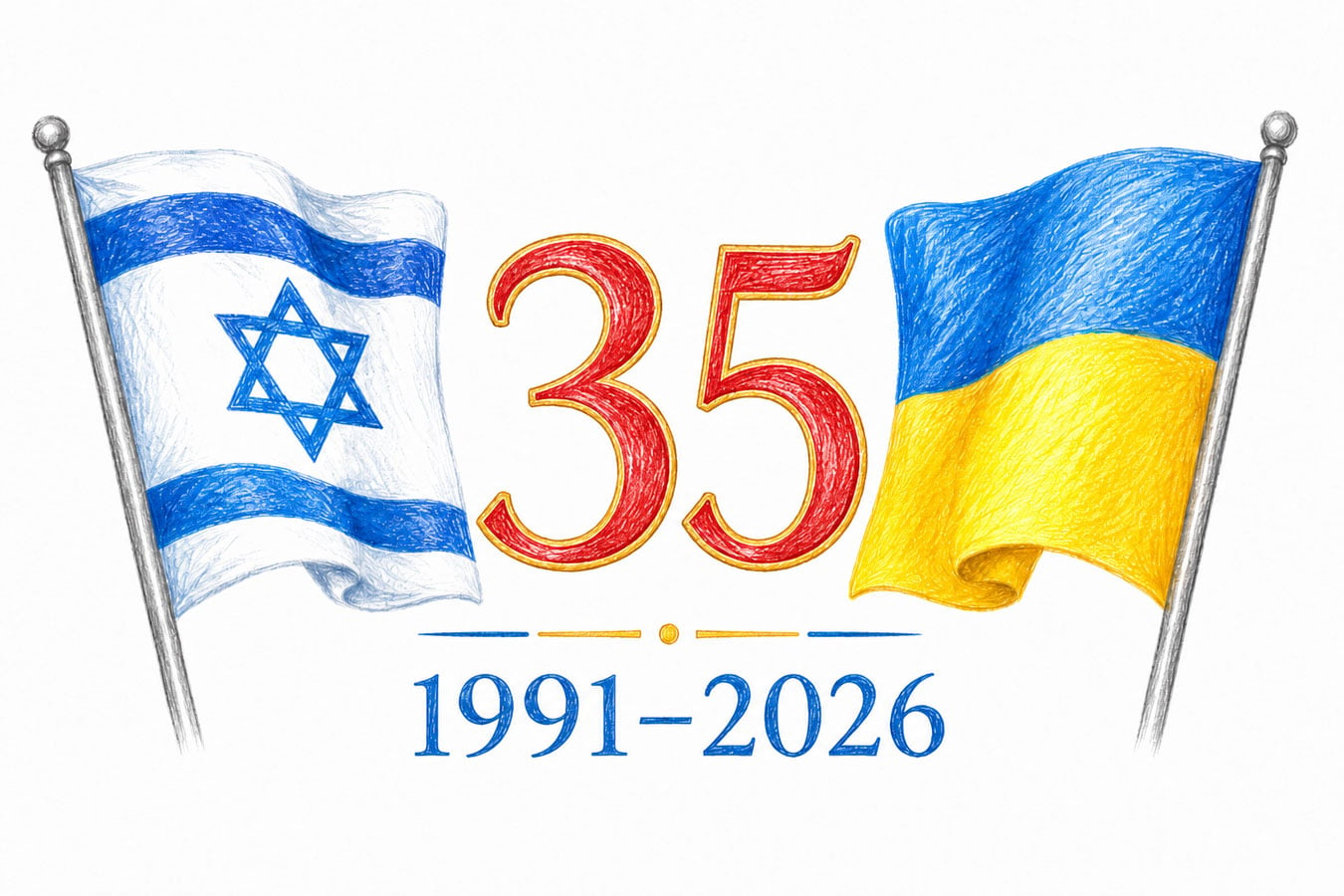
Israel and Ukraine are preparing to mark 35 years of diplomatic relations at a moment when the history connecting the two countries is becoming inseparable from their present-day security challenges.
During a telephone conversation on July 28, 2026, Israeli Foreign Minister Gideon Sa’ar invited Ukraine’s acting foreign minister, Andrii Sybiha, to visit Israel on the occasion of the anniversary. The following day, the Ukrainian side confirmed that Sybiha had accepted the invitation.
This was more than a routine diplomatic exchange.
Sa’ar described Israel and Ukraine as friends, expressed sorrow over the many Ukrainian victims of Russia’s war, and spoke about expanding Israeli-supported educational centers for children receiving long-term treatment in Ukrainian hospitals.
Sybiha added several issues of direct importance to Israelis. He informed Sa’ar about Russia’s escalating attacks on civilian vessels and freedom of navigation in the Black Sea, warning that the consequences extend far beyond Ukraine. Disruption of shipping routes and attacks on port infrastructure affect global food security, including Israel, which relies heavily on imported food and agricultural products.
The ministers also discussed preparations for the 85th anniversary of the Babyn Yar massacre and agreed to maintain high-level contacts and continue cooperation within international organizations.
That reference to Babyn Yar is not incidental. It brings the story of Israel–Ukraine relations back to where much of it began.
Before formal diplomatic recognition
On August 24, 1991, the Ukrainian parliament declared Ukraine’s independence from the Soviet Union. At the time, the country had only just appeared on the political map, and its future international position remained uncertain.
Yet one of the first major international commemorative events organized by the emerging Ukrainian state was dedicated to the Jews murdered by the Nazis at Babyn Yar.
On October 5, 1991, Ukrainian leaders, representatives of Israel, the World Jewish Congress, diplomats and public figures gathered in Kyiv to commemorate the victims. Israeli flags were displayed openly at Babyn Yar, something that would have been politically and symbolically impossible during much of the Soviet period.
The Israeli delegation was led by Education Minister Zevulun Hammer. Israel’s consul general in the Soviet Union, Arye Levin, read a message from President Chaim Herzog.
Leonid Kravchuk, who would soon become the first president of independent Ukraine, delivered an important speech about Ukrainian–Jewish history. He acknowledged that some Ukrainians had participated in Nazi crimes and called for a new era in relations between Ukrainians and Jews.
For a state that had not yet received full international recognition, this was a significant political statement. Ukraine was signaling that it intended to confront difficult chapters of history rather than continue the Soviet policy of erasing the specifically Jewish identity of many Holocaust victims.
On December 1, 1991, Ukrainians overwhelmingly confirmed independence in a national referendum. Kravchuk was elected president on the same day.
Personal communication between the leaders of Israel and Ukraine began almost immediately. President Herzog sent Kravchuk a congratulatory telegram following his election.
Israel formally recognized Ukraine’s independence on December 25, 1991. Diplomatic relations were established the next day, on December 26.
The 35th anniversary will therefore fall on December 26, 2026.
Building relations between two young diplomatic partners
Ukraine opened its embassy in Tel Aviv in October 1992. Its first ambassador to Israel was Yuri Shcherbak, a physician, writer, public intellectual and diplomat who represented Ukraine from October 1992 until 1994.
Israel opened its embassy in Kyiv in early 1993. Within little more than a year after establishing relations, both countries had created permanent diplomatic missions.
President Kravchuk visited Israel in January 1993. During his reception in Jerusalem, President Herzog recalled Kravchuk’s speech at Babyn Yar and emphasized the importance of his words for Ukrainian–Jewish relations.
That same year, Israel and Ukraine signed an agreement on cooperation in education and culture. From the beginning, the relationship was not based only on politics or trade. It was also built around historical memory, Jewish life in Ukraine, cultural exchange and the family connections of hundreds of thousands of Israelis whose roots lie in Ukrainian cities and towns.
High-level visits soon followed.
Israeli prime minister Yitzhak Rabin visited Ukraine in 1995. Ukrainian president Leonid Kuchma traveled to Israel in 1996. Benjamin Netanyahu first visited Ukraine as prime minister in 1999.
Netanyahu returned to Kyiv on August 19, 2019, where he met President Volodymyr Zelensky. The two leaders held negotiations and visited Babyn Yar together. During their discussions, Zelensky called on Israel to recognize the Holodomor of 1932–1933 as genocide against the Ukrainian people.
Israeli presidents Moshe Katsav, Shimon Peres and Isaac Herzog also visited Ukraine at different moments in the relationship.
In 2021, President Herzog traveled to Ukraine to participate in events marking the 80th anniversary of the Babyn Yar massacre. Once again, the history of the Holocaust became not a peripheral issue but one of the central pillars of the bilateral relationship.
From history to shared security challenges
Today, Israel and Ukraine are connected not only by memory.
Both countries face the consequences of cooperation between Russia and Iran. Iran has supplied military technology and weapons used by Russia against Ukrainian cities, while Israel sees the Iranian regime as one of the greatest threats to its national security.
During his conversation with Sybiha, Sa’ar specifically mentioned the Iranian threat. This reflects a growing understanding that the wars affecting Eastern Europe and the Middle East can no longer be treated as completely separate.
The same Iranian military technologies, networks and strategic partnerships can influence several theaters simultaneously.
Ukraine has accumulated extensive battlefield experience in detecting, tracking and intercepting Iranian-designed drones. Israel, in turn, possesses advanced defense technologies and experience in emergency medicine, civil resilience and rehabilitation.
There is a clear basis for deeper cooperation, even though political disagreements between the two countries have sometimes prevented the relationship from reaching its full potential.
Why the Black Sea matters to Israel
Sybiha’s emphasis on freedom of navigation in the Black Sea also deserves particular attention in Israel.
Russian attacks on Ukrainian ports, civilian vessels and export infrastructure are not only an attack on Ukraine’s economy. They threaten international shipping routes and the stability of food supplies to countries far from the battlefield.
Israel imports large quantities of grain, agricultural products and other goods. Any prolonged disruption in the Black Sea can lead to higher prices, shortages and increased dependence on alternative suppliers.
When Ukraine speaks about protecting its ports and maritime routes, it is therefore also speaking about the security of countries that depend on those routes.
This is why the bilateral conversation should not be reduced to symbolism surrounding an anniversary. The issues discussed by Sa’ar and Sybiha have practical consequences for Israeli households, businesses and national resilience.
Cooperation inside Ukrainian hospitals
One of the most concrete examples of Israeli assistance is the creation of educational spaces for children undergoing long-term hospital treatment in Ukraine.
These centers allow hospitalized children to continue studying, use libraries, participate in creative activities and receive emotional support. The model is based on Israeli experience and is being adapted to the conditions of Ukrainian hospitals operating during wartime.
This type of cooperation may not attract the same attention as military aid, but it has long-term significance.
A child receiving cancer treatment, recovering from an injury or living through repeated Russian attacks should not lose all connection with education and ordinary life. Israeli expertise can help preserve that connection.
Sa’ar’s decision to mention these centers in his public statement showed that the relationship is being supported not only through diplomatic declarations but also through projects affecting individual Ukrainian families.
Babyn Yar as a bridge between past and future
The decision to discuss the 85th anniversary of Babyn Yar during the same conversation is deeply symbolic.
In 1991, Babyn Yar became one of the places where independent Ukraine first presented itself to Israel and the wider Jewish world. Ukraine’s willingness to acknowledge Jewish suffering and confront uncomfortable historical questions helped create the moral foundation for diplomatic relations.
Thirty-five years later, Babyn Yar remains part of the conversation.
But the context has changed. Ukraine is now defending its own independence against a Russian war that has destroyed cities, killed civilians and displaced millions. Israel is facing continuing threats from Iran and its regional allies.
The two countries do not always see every international issue in the same way. There have been disagreements, missed opportunities and periods of mutual frustration.
Yet the relationship has survived because it is based on more than temporary political calculations. It rests on history, shared communities, cultural ties and increasingly interconnected security interests.
Sybiha’s expected visit to Israel could become an opportunity to move from general declarations toward a more structured partnership.
The agenda is already visible: Iranian military cooperation with Russia, Black Sea navigation, global food security, humanitarian and medical projects, work in international organizations and the preservation of Jewish and Ukrainian historical memory.
Israel recognized independent Ukraine on December 25, 1991. The following day, the two countries formally established diplomatic relations.
Thirty-five years later, the task is no longer simply to celebrate that decision.
It is to decide what Israel and Ukraine want the next 35 years of their relationship to become.