
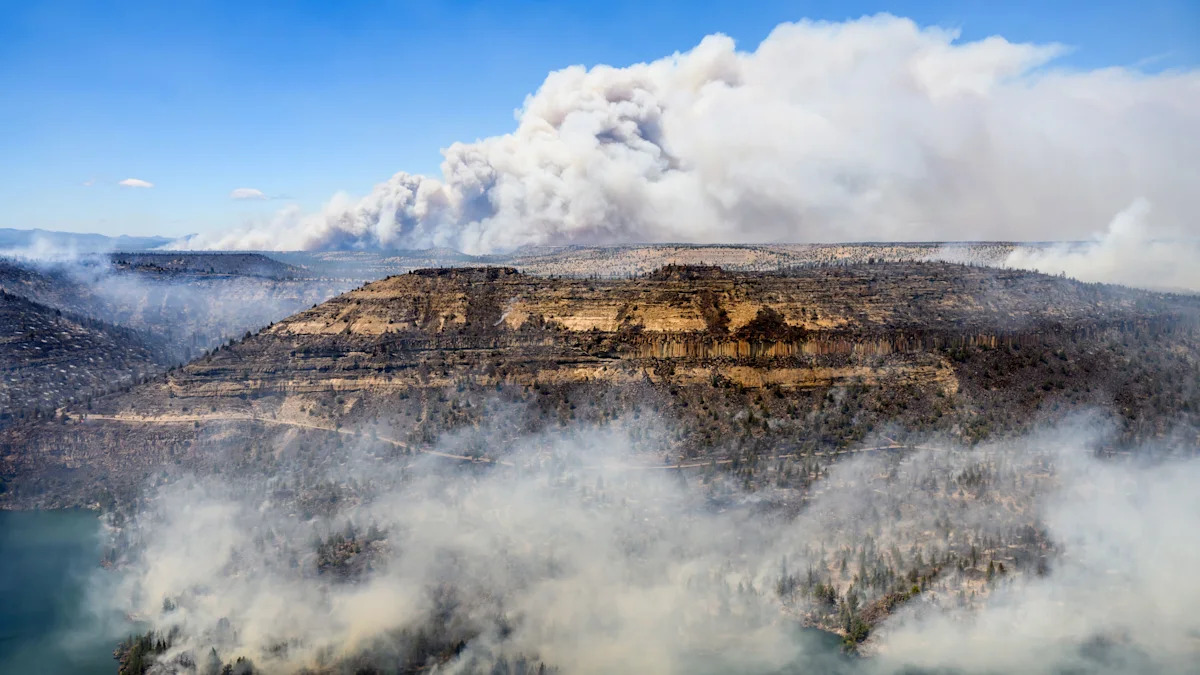
Smoke from fires burning in the Pacific Northwest continued to create hazy skies and unhealthy conditions on Wednesday for a large swath of the United States. Conditions have improved somewhat for areas of Oregon and Idaho, which had experienced very unhealthy concentrations of airborne particulates earlier in the week, but both states were still advising residents to avoid exposure to the smoke as much as possible.
The massive plume of smoke, which has spread as far as Florida, comes less than two weeks after the Midwest and Northeast endured record-setting levels of hazardous air pollution caused by Canadian wildfires.
As of Wednesday morning, there were 45 large uncontained fires burning in Oregon and Washington that, along with smaller fires in the area, had cumulatively burned more than 1.8 million acres of wildland. There were also more than 17 uncontrolled fires in British Columbia, just north of Washington.
The worst air quality in the country on Wednesday morning was near Boise, Idaho, where particulate matter concentrations in the air were at levels just below the threshold to be considered very unhealthy. Parts of eastern Oregon and southern Idaho were also experiencing generally unhealthy conditions. Both states have issued air quality advisories urging residents to limit their time outdoors to avoid potentially harmful levels of airborne particulates, which can cause a range of health problems, especially for sensitive groups.

Smoke forecast for noon PT on July 29, 2026, across the continental United States.
(NOAA)
The smoke is not as widespread or severe as the historically toxic air that affected the Midwest and Northeast earlier this month, which created concentrations of pollutants more than 10 times the level that is considered hazardous for everyone under the Environmental Protection Agency’s Air Quality Index.
Forecasters expect air quality in areas near the fires to reach very unhealthy levels at certain points over the course of the day. The smoke is also forecast to travel thousands of miles across the northern U.S. to the Midwest and then down through portions of the South. The latest forecasts show Montana, the Dakotas and parts of Minnesota also experiencing slightly improved air quality, though conditions may still be unhealthy for sensitive groups. Some of the smoke has traveled to Florida and other southern states; most of it is expected to remain high in the sky where it won’t meaningfully affect air quality.

A map showing Air Quality Index scores in the continental U.S. at 8 a.m. PT on July 29.
(EPA)Why has the smoke been so bad this year?
Lots of environmental factors affect the severity and frequency of wildfires — and just about all of them have been working against the U.S. and Canada this summer. For starters, last winter was historically warm, which meant forests got drier during months when they would normally replenish their moisture. The warm winter also resulted in less mountain snowpack, reducing the amount of water available to parched areas during the spring melt.
More recently, the U.S. and Canada have experienced severe and prolonged heat waves that have sapped even more moisture from the trees, bushes and grasses fueling the fires.
“The conspicuous overlap between record-breaking warmth, dryness, and/or low snowpack and these fires is simply not a coincidence,” climate scientist Daniel Swain wrote in a social media post on Sunday.

The Bench fire burns along the banks of the Deschutes River on Saturday, July 25, 2026, in Jefferson County, Ore.
(Noah Berger/AP)
As with all extreme weather events, pinpointing exactly how much climate change has affected an individual fire or set of fires is impossible. But, Swain explained, you can’t really make sense of what’s happening without accounting for the warming climate.
“Climate change is certainly not the only factor at play in any of these regions. But it’s also a rapidly growing contributor, and in some of these ‘edge case’ extremes is likely even a leading one,” he wrote.
Why is wildfire smoke dangerous?
Smoke from wildfires is filled with harmful gases and tiny particles that can cause a wide range of serious health problems for people exposed to it.
“Fine particulate matter from wildfire smoke is particularly dangerous because it can penetrate deep into the lungs and enter the bloodstream, potentially causing damage to multiple body systems, including the cardiovascular and nervous systems,” Jessica Yu, a research scientist at Stanford University, said during a panel discussion at the school last year. Yu’s co-researcher, Lisa Patel, estimated that wildfire smoke is “10 times as toxic” as typical air pollution.
Wildfire smoke is especially dangerous for members of sensitive groups, including people with heart or lung disease, older adults, young children and anyone at risk of extended exposure, such as outdoor workers.
How to stay safe
Health experts say the No. 1 way to protect yourself from wildfire smoke is to limit your exposure as much as possible. Avoid going outside unless it’s absolutely necessary and keep trips short whenever possible. Resources like AirNow, the federal government’s national air quality monitoring system, can help you understand how severe the risk is and plan accordingly.

Children watch as the Bench fire approaches on Saturday, July 25, 2026, in Warm Springs, Ore.
(Noah Berger/AP)
If you are going to go outside, health officials advise that you wear a mask, but not all masks will get the job done. Experts say surgical masks, like the ones that were most commonly used during the COVID-19 pandemic, offer only minimal protection from the particulate matter in wildfire smoke. Respirator masks, such as an N95, are much more effective.
While indoors, it’s important to keep all windows and doors securely shut. Running the air conditioner can help filter particulates out of the air, but ensure that the system is recirculating air that’s already inside the home, not pulling in new air from outside. Using a commercial air filter, or fashioning your own using a fan and other household items, can be beneficial.
Officials also recommend turning part of your home into a “clean room” that is especially insulated from wildfire smoke, where all members of the household can gather together until the risk has passed.