
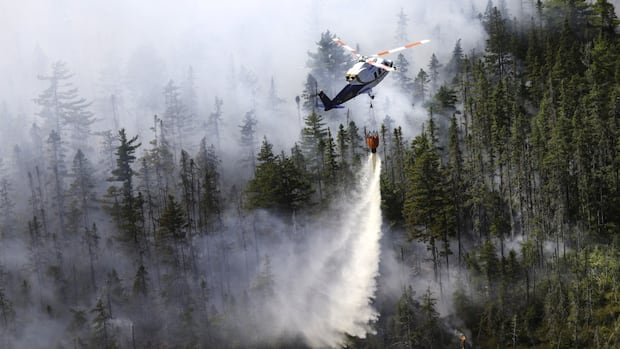
The Long Lake wildfire in Annapolis County remains out of control and has grown to an estimated 1,101 hectares, according to the Department of Natural Resources.
In a media conference Sunday afternoon, Jim Rudderham, the province’s director for fleet and forest protection, said that conditions are hard for the firefighting efforts, with winds moving the fire northeast. That puts it in the West Dalhousie Road area, where 107 homes were evacuated on Thursday.
“Today is very low humidity, and wind, and warm, and is everything we don’t need for helping us put out fires,” said Rudderham.
Measures like sprinklers, hoses and barriers are in place to protect houses in the area, but the fire is now “within kilometres,” said Scott Tingley, manager of forest protection for Nova Scotia’s Department of Natural Resources.
An earlier update from the DNR said “more evacuations possible” but as of 3 p.m. no more evacuation orders had been issued.
Resources on the ground Sunday included four water-skimmer aircraft from the Northwest Territories, two contracted helicopters, 57 DNR staff, five firefighters from P.E.I., and 84 volunteer firefighters.
A 20-member DNR crew returning from helping combat wildfires in New Brunswick, and a team of 20 firefighters from Ontario are also assisting.
In a release Sunday afternoon, the federal government announced it has approved a request for assistance from Nova Scotia.
The full extent of the resources that will be deployed is not yet known, but Eleanor Olszewski, the federal minister of Emergency Management and Community Resilience, said the feds are working with the Canadian Armed Forces and other partners to “ensure Nova Scotia has the support it needs.”
Evacuees allowed to briefly return home
Over the weekend, evacuees were allowed to briefly return home with an escort to pick up clothes and grab essential items like medications.
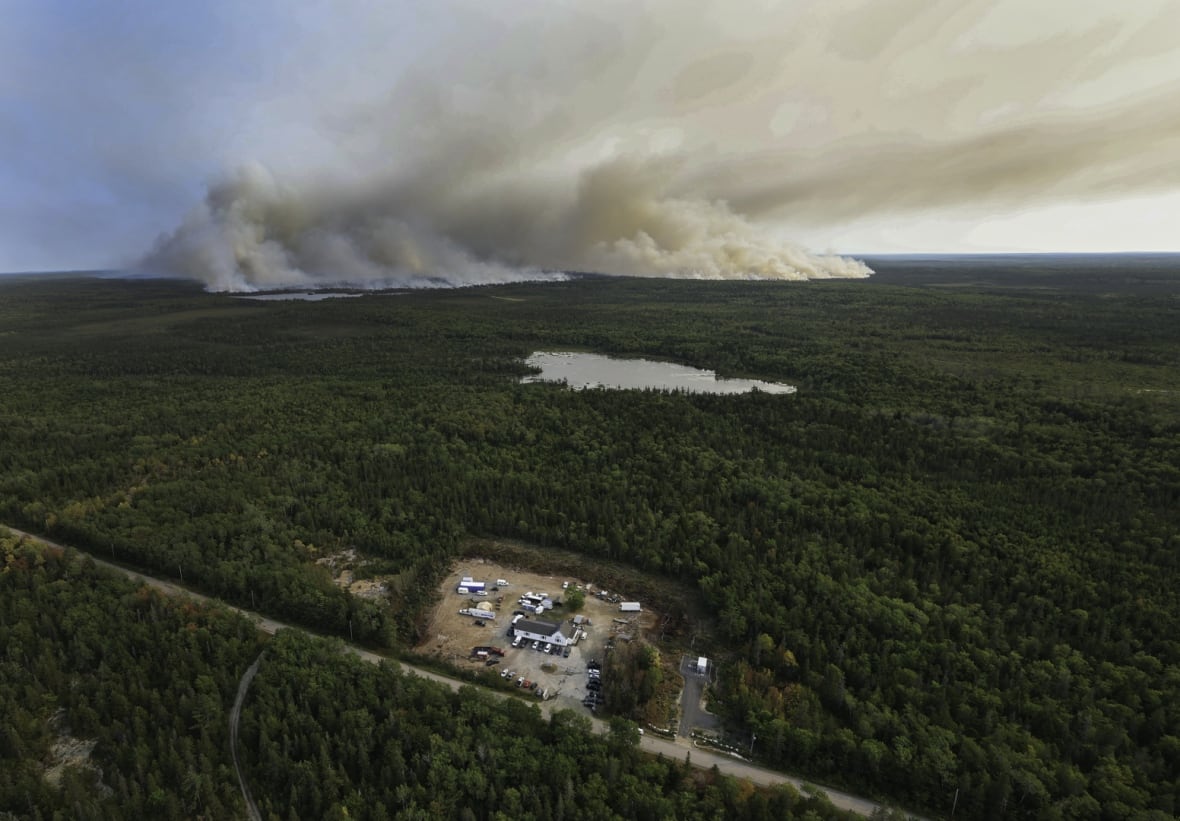 An aerial photo shows the West Dalhousie Community Centre, which is serving as the incident command post for the wildfire. Smoke from the Long Lake fire can be seen in the background. (Province of Nova Scotia)
Dustin Enslow, the deputy warden of the Municipality of the County of Annapolis, said Sunday that most of the 215 people affected are staying with family and friends, but others have been camping.
A community shelter at the Nova Scotia Community College campus in Middleton remains open, but Enslow said nobody has stayed overnight so far.
He said the municipality is exploring further support.
“We know that this is going to to continue for for longer than what we wish, and as things progress, we will be adapting our plan and the supports available for individuals,” said Enslow.
Long Lake wildfire still out of control and has grown to estimated 1101 hectares. Wind has shifted, fire moving back towards West Dalhousie Road area. Sprinklers on all homes, other protection measures in place. More evacuations possible. 1/3 pic.twitter.com/Wkac2C9m9V
—@NS_DNR‘Hot, tiring, hard work’ for firefighters
Rudderham said the firefighters’ morale is a mix of “happiness and sadness” as they take on this “hot, tiring, hard work.”
“I think a lot of them are proud to do the work they’re doing,” he said. “They’re going to soldier on and do the work that needs to be done.”
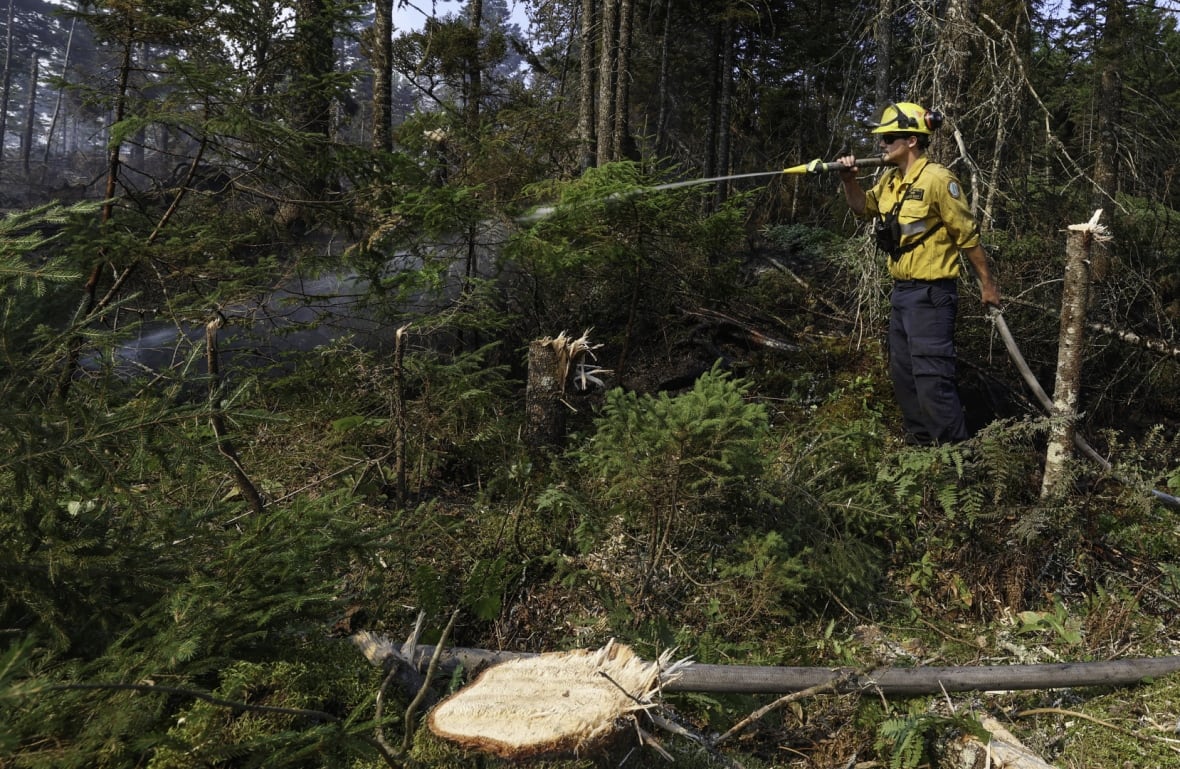 Joseph Daigle, a firefighter with the Department of Natural Resources, sprays down an area near the Long Lake wildfire. (Province of Nova Scotia)
He said Friday’s helicopter accident at the fire scene is weighing on the group. He said the pilot, who was found conscious and taken for medical attention after his helicopter went into a shallow lake, is a friend of many of the firefighters.
Nova Scotia Power said Sunday evening that in order to support firefighting efforts it may need to temporarily turn off power in the Morse Road area so first responders “can work safely around our equipment.”
It cautioned that a power outage does not mean a home is at risk or that evacuation is required.
There are 15 wildfires in the province. Long Lake, which started on Wednesday, is the only one listed as out of control.
Tingley said that while rain in the forecast for Sunday would be appreciated, it won’t be nearly enough to make a measurable impact.
 Smoke is shown over rural Hants County on Sunday morning. Many Nova Scotians woke up to the smell of smoke. Fire departments say the presence of smoke doesn’t always warrant a call to 911. (Melissa Friedman)Smoke around the province
Many Nova Scotians woke up Sunday to heavy smoke, prompting some fire departments in the province to urge residents to remain calm.
“This morning with the cooler temperatures, the cold air actually pushed the smoke down to the ground and into the [Annapolis Valley],” said Chad Schrader, deputy chief for the Wolfville Fire Department. “The smoke was quite bad to the point where people thought there was a closer wildfire burning.”
In a social media post, the fire department says if smoke appears widespread or hazy throughout the area rather than forming a distinct column, it is likely drifting in from ongoing fires and does not require an emergency call.
Emergency calls should be made if there is a clear column of smoke, visible flames, or a concentrated area of heavy smoke that appears local, it says.
The department says residents should call if smoke is coming directly from a building, vehicle or nearby wooded area, or if they believe there may be an immediate fire threat.
Environment Canada’s Air Quality Health Index forecasts a low risk around the province, but notes the possibility of moderate risk in some areas due to the smoke.