
‘Hawkish hold’ expected from Bank of England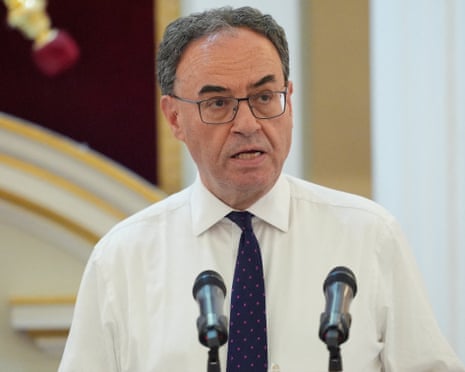 Governor of the Bank of England, Andrew Bailey makes a speech at the annual financial and professional services dinner at Mansion House, in London, on 14 July. Photograph: Yui Mok/Reuters
The Bank of England’s monetary policy committee (MPC) will have decided whether to hold interest rates well before the US Federal Reserve announced its decision last night. However, Bank governor Andrew Bailey will be mindful of that reaction when he talks to the media later this afternoon.
The Bank’s decision is due at midday, with most economists expecting no change. But the question is whether it will be a “hawkish hold” – signalling the likelihood of future hikes.
Suren Thiru, chief economist at the Institute of Chartered Accountants (ICAEW), said:
double quotation markAn interest rate hold at midday looks a near certainty, as the recent run of more dovish economic data should give rate-setters enough comfort to look through the twists and turns of the US-Iran conflict for now.
While the monetary policy committee’s vote split is likely to remain 7–2 in favour of holding rates steady, elevated oil prices will likely reaffirm its hawkish stance, keeping a future rate rise on the table.
The Bank is publishing new economic forecasts in its monetary policy report. They could show an improved economic outlook, but everything will be overlaid by worries over the course of energy prices if – as seems to be the case today – Donald Trump wants to continue waging war on Iran.
Andrew Wishart, senior UK economist at Berenberg, an investment bank, said:
double quotation markWe expect the Bank of England (BoE) to leave its Bank Rate unchanged at 3.75% tomorrow, but threaten to raise interest rates if energy prices rise a lot more or evidence of second-round effects surfaces. This provides a convenient insurance policy for the BoE: every time the Iran conflict flares up, investors revise up their interest rate expectations and mortgage borrowing costs rise, immediately squeezing demand and reducing the risk of persistent inflation.
Some analysts say that the BoE must eventually follow through on its threat for it to remain credible. Recent history argues otherwise – immediately after the 19 March BoE meeting, the market priced in two 25pb hikes to 4.25% by this week’s meeting. Neither has materialised, yet investors continue to price in two or three hikes. We do not think that the BoE will follow through with its threat to raise interest rates for two reasons: 1) Inflation in wages and services prices – the part of inflation that the BoE can best influence – continue to trend lower. 2) We think US President Donald Trump wants to avoid high oil prices because high petrol prices would damage the Republican party’s chances in the 3 November mid-term elections.
Updated at 06.02 EDT
Key events
US borrowing costs highest since global financial crisis Lauren Almeida
US government borrowing costs have hit their highest level since 2007 after the Federal Reserve voted to hold its key interest rate steady, feeding fears that the central bank may not move fast enough to tame a rise in inflation.
The yield – or interest rate – on the 30-year US Treasury bond rose 14 basis points to nearly 5.24%, a 19-year high, after the Fed announced its decision to hold its main rate at between 3.5% and 3.75% for the fifth meeting in a row.
The yield on the US 30-year bond benchmark has risen to its highest level since the global financial crisis, as shown in this chart covering the last 20 years. Photograph: LSEG
Kevin Warsh, the Fed chair, said the bank would “not waver” in its commitment to tackling rising prices.
A prolonged period of high inflation meant that some Americans believed the central bank had an “implicit target” above its 2% target, he added. He said:
double quotation markThere is no soft implicit target: not on this committee’s watch. There’s only a target and it’s 2%. This Fed will not waver … Our credibility rests on performing our duties and delivering on our responsibilities.
The decision to leave rates on hold spooked investors who are worried about the US economy’s ability to absorb a rise inflation triggered by Donald Trump’s war in Iran.
You can read the full story here:
ShareEurozone GDP grew faster than expected in second quarter
That German GDP reading has indeed contributed to the wider eurozone hitting expectations – and then some.
The eurozone economy grew by 0.4% in the second quarter of 2026, according to the preliminary reading from Eurostat – defying the gloom caused by the US-Israeli war on Iran.
It was the fastest quarterly growth since the start of 2025, and also well above the 0.2% growth expected by economists.
Eurozone GDP expanded faster than expected in the second quarter of 2026. Photograph: EurostatShare
Updated at 05.15 EDT
In a busy day on the corporate front, and the Bank of England is due to publish its latest interest rates decision at nooon GMT. But there is also important economic data across Europe.
The latest GDP figures for Germany, Europe’s largest economy, showed GDP increased by 0.2% in the second quarter, marginally faster than the 0.1% expected by economists polled by Reuters.
The German federal statistics office also revised its reading for the first quarter up to 0.4%, after previously reporting it as 0.3% growth. That means that Germany went for a whole year without its economy contracting during a quarter for the first time since the coronavirus pandemic.
German GDP remains lower than it was in late 2022, despite four quarters of expansion. Photograph: Destatis
That puts the broader eurozone on track to hit economists’ expectations of a 0.2% increase, after the bloc’s economy contracted in the first quarter of the year.
Carsten Brzeski, global head of macro at ING, an investment bank, said:
double quotation markIt’s almost too good to be true: the German economy defied the fallout from the war in the Middle East and grew by 0.2% quarter-on-quarter in the second quarter of the year, as some industrial sectors benefited from the fact that Asian competitors were hit harder by the closure of the strait of Hormuz.
This is the first time since the end of the pandemic lockdowns that the German economy managed not to shrink for four consecutive quarters. Still, we must put this into perspective: average quarterly growth over this period has been just 0.1%, and the size of the German economy is still smaller than in late 2022.
ShareFTSE 100 rises to new high
The FTSE 100 is up 0.4%, but that is enough to push it to a record high of 10,978.87 points.
That was slightly up on yesterday’s mark of 10,951.
It appears that a few strong earnings reports – plus an oil price increase that helps the big oil players – have been enough to attract investors to the biggest British companies. But indices tracking smaller companies fell in early trading, amid global worries that the US Federal Reserve may not move fast enough to counter inflation.
Analysts at Panmure Liberum, an investment bank, said:
double quotation markUK and European markets are mixed this morning, with UK large-and mid-caps rising but small-cap and Aim declining. German and Italian indices are lower, whilst French and Spanish rise. This followed yesterday’s announcement that the Fed was leaving interest rates unchanged, with three hawkish dissents.
Updated at 04.35 EDT
The BMW factory in Oxford builds Mini cars, but does not currently make electric versions. Photograph: Graeme Robertson/The Guardian
Carmakers are delaying final decisions to invest in UK factories until electric car sales rules are relaxed, according to the head of the British car industry’s lobby group.
The chief executive of the Society of Motor Manufacturers and Traders (SMMT), Mike Hawes, said those with existing UK operations were considering building new models, but had held back so far.
The British car industry has put heavy pressure on the Labour government to weaken the rules, known as the zero emission vehicle mandate, which forces manufacturers to sell an increasing share of electric cars each year up to 2030.
Calls for the rules to be eased have come as the British car industry struggles with competition from China, US tariffs and the extra costs of investment in electric technology. UK vehicle production fell 7.5% in the first half of 2026 compared with a year earlier, with factories producing 386,000 cars and commercial vehicles, according to the SMMT’s latest figures, published on Thursday.
The electric car charging industry has strongly opposed any further changes, while environmental campaigners are aghast that the government would consider a policy that would result in millions of tonnes of extra carbon emissions.
You can read the full story here:
Updated at 04.25 EDT
The FTSE 100 is still defying the global equities gloom left after the Federal Reserve held interest rates steady (rather than raising them to forestall inflationary pressures). London’s blue-chip index is up 0.3%.
That is thanks in no small part to Rolls-Royce, which is the biggest riser, up 3.2%.
Standard Chartered bank is up 2% after a couple of analysts raised their share price targets.
Lloyds Banking Group gained 1.9% after beating profit forecasts, announcing new share buybacks and an increased dividend, and a new growth strategy.
At the bottom of the table, pest control and cleaning company Rentokil Initial is down 18% after it abandoned a plan to increase profit margins in North America to 20%. The ratcatchers said there was “weakness in North America residential lead flow”, although they retained their outlook for the year.
Rentokil’s chief executive, Mike Duffy, said:
double quotation markWe are not yet delivering on our growth potential, leaving significant opportunities to improve.
Achieving our potential will require disciplined reinvestment primarily back into the North America business which we will fully self-fund through cost savings. Our focus is driving volume growth over short-term margin expansion and this targeted redeployment of resources will enable us, over time, to accelerate organic growth, improve margins and free cash flow and deliver on the clear opportunity for shareholder value creation.
Duffy said the company would simplify its business and cut costs to try to grow. That would include exiting several of the 90 countries in which it operates, and redirecting its spending to the all-important US market.
Updated at 04.20 EDT
There has been a veritable feast of corporate earnings this morning (likely before all the bosses head off for their summer holidays).
Here are some of the top lines as reported by Reuters:
Lloyds Banking Group reported a better than expected statutory pretax profit of £4.3bn for the first half of 2026, as chief executive Charlie Nunn also outlined the lender’s next plan to grow its core businesses and harness technology such as AI to cut costs. It also announced a £1bn share buyback, on top of £1.75bn announced in February, and increased its dividend.
London Stock Exchange Group narrowed its full-year revenue growth forecast to between 7.0% and 7.5% after a spike in trading activity helped it slightly exceed market expectations for first-half sales.
British American Tobacco lifted its annual earnings growth forecast as surging demand for its Velo nicotine pouches and a strong U.S. performance offset a sharp decline in Asia.
Mining company Anglo American said its loss for the first six months of the year more than halved, raised its dividend and said it continued to make progress with a sweeping overhaul of the company and its proposed merger with Teck Resources.
The Budweiser brewer Anheuser-Busch InBev reported forecast-beating revenue, profit and volumes in the second quarter on Thursday, but its shares fell as weakness in China tempered a sales boost from the soccer World Cup.
French bank Société Générale posted record quarterly profit on Thursday and upped its 2026 profitability target.
Updated at 04.04 EDT
Shell doubles profits in second quarter thanks to Iran war oil price jumpLauren AlmeidaA customer filling up with petrol at a Shell fuel station. The company has benefited from higher oil prices during the Iran war. Photograph: Murdo MacLeod/The Guardian
Shell more than doubled its profit in its second quarter of the year, as Europe’s biggest oil and gas company reaped the benefits from the jump in oil and gas prices triggered by war in the Middle East.
The FTSE 100 company’s net profit hit $9.84bn (£7.4bn) in the three months ended in June, more than double compared with the same period last year.
The surge in profit comes as wholesale energy prices have soared because of the conflict in the Middle East, boosting profit margins and activity on Shell’s trading desks.
The global oil price has climbed from about $61 a barrel in January to highs of $126 at the end of April, owing to disruptions to flows of oil and gas through the strait of Hormuz. Brent crude, the international benchmark, traded at $93.18 a barrel on Thursday.
Wael Sawan, Shell’s chief executive, said there had been “severe disruption in global energy markets” due to the war, as the company also reported a 30% drop in production from its integrated gas division on the same quarter last year.
You can read the full story here:
Updated at 04.01 EDT
BAE Systems and Rolls-Royce upgrade profits as defence spending surges
Rolls-Royce is not the only weapons company to report strong demand today: BAE Systems has also said that “sustained increases” in defence budgets around the world meant it had upgraded its profit forecasts.
BAE Systems’s sales rose 9% year-on-year during the first half of the year to £15.8bn, while it recorded orders worth £16.4bn, up £3.2bn from the same period last year.
The company raised its profit outlook to an increase for the full year in the range of 10% to 12%, slightly higher than the range of 9% to 11% it had previously given.
The manufacturer makes a large proportion of the UK’s weapons, ranging from tanks and fighter jets to munitions. But it has also benefited from demand in the US, which had raised weapons spending even before its war on Iran, and other export allies of the UK such as several countries in the Gulf.
The two upgrades helped the FTSE 100 to rise on Thursday morning after initially dropping. Rolls-Royce shares gained 3.7%, while BAE Systems was up 1.1%.
Charles Woodburn, BAE’s chief executive, said:
double quotation markAcross the business, our outstanding teams have delivered another strong period of operational and financial performance, which gives us the confidence to upgrade our full year guidance.
The global threat picture remains highly volatile and governments are responding with sustained increases in their defence budgets. The combination of our proven execution, diverse geographic footprint and continued investment in our technology and facilities, alongside our healthy order backlog and growing opportunities across our markets, positions us to keep delivering long-term growth.
BAE said it had invested in factories in Texas and New Hampshire to support the US Government’s ambition to quadruple production of critical munitions. The company also unveiled a new autonomous fighter drone, called Brontanax, at the Farnborough air show last week. Woodburn said the “loyal wingman”, which would fly alongside a manned fighter jet, had “generated a lot of interest”.
ShareRolls-Royce raises profit forecasts
Rolls-Royce reported £2.5bn in underlying profits for the first half of 2026 and raised its forecasts for profits for the full year as it said its turnaround efforts had brought higher earnings in all its divisions.
Underlying profit before tax for the first half of 2026 rose to £2.5bn, up 48% from the same period a year earlier. Statutory profits halved to £1.9bn, although those figures tend to be volatile because of the timing of payments. Revenues were up by £2bn year-on-year to £11.3bn.
The FTSE 100 jet engine manufacturer has gone through an extraordinary period of growth under chief executive Tufan Erginbilgiç, who was brought in 2023 to turn the company around. Those efforts appear to have paid off so far, with investors welcoming soaring profits.
The manufacturer on Thursday said it expects £4.7bn to £4.9bn in underlying operating profit, up from previous guidance of £4.0bn to £4.2bn. The free cashflow forecast is also up from between £3.6bn and £3.8bn to between £3.8bn and £4.0bn.
The company has benefit from the recovery since the coronavirus pandemic lockdowns in long haul flights, many of which use Rolls-Royce engines. At the same time, defence spending has risen since Russia’s full-scale invasion of Ukraine in 2022, and its power generation unit has benefited from increased demand from datacentres used by AI companies.
In its civil aerospace business the company has also spent heavily on fixes to passenger jet engines to keep them in the air for longer, reducing the number of aircraft on ground (AoG) at any time. It is also pressing ahead with producing small modular reactors to generate nuclear power in the UK, Czechia and Sweden.
Erginbilgiç said:
double quotation markOur transformation continues to deliver, and we are demonstrating that Rolls-Royce is now a very different company to that of the past.
We have made significant operational and strategic progress in the first half of the year. In civil aerospace, where we continued to improve our aftermarket profitability, we have also effectively eliminated aircraft on ground, providing a significant operational benefit to our customers. In defence, we continued to establish our leading position in autonomous propulsion with several key milestones achieved in the period.
In power systems, we captured further profitable growth in datacentres, including growing prime power demand. Following its recent win in Sweden, Rolls‑Royce SMR has now been successful in every competitive European nuclear tender and is uniquely positioned to become a global market leader.
Updated at 04.02 EDT
FTSE 100 set to fall after US Federal Reserve holds interest rates
Good morning, and welcome to our live coverage of business, economics and financial markets.
London’s FTSE 100 is set to fall when it opens after the US Federal Reserve held interest rates steady despite the increasing expectations of inflation, while Donald Trump’s renewed attacks on Iran promised to add fuel to the price rise fire.
Futures prices suggest the FTSE 100 will drop by about 0.6% when it opens. The UK’s blue chip index rose to a new record as high as 10,951 points on Wednesday morning, but fell back later in the day to 10,864.
Analysts at Deutsche Bank led by Peter Sidorov said the market moves were triggered by last night’s “on-hold Fed decision combined with a relative lack of detail from Chair Warsh”.
Kevin Warsh was appointed by Trump after courting the US president with an agenda to lower interest rates. That has put Warsh in a very tricky position as investors expect inflation to rise because of the US-Israeli attacks on Iran, which have caused oil prices to soar.
Bond yields rose after the Fed meeting, suggesting investors doubt whether the Fed can control inflation. Sidorov and co wrote:
double quotation markThis rise in yields ended up weighing on equities after some big intra-day swings. The S&P 500 went from trading more than half a percent down pre-FOMC to higher on the day during Warsh’s press conference but then saw a sharp drop in the final hour of trading to close -1.52% lower. Equities were also weighed down by another rout in chip stocks, with the Philly semiconductor index slumping by -5.33%.
The declines on the FTSE 100 are likely to be moderated by some strong results on a busy day for UK corporate news: among the reporting companies were BAE Systems, Lloyds Banking Group, London Stock Exchange Group, and Shell.
Jet engine manufacturer Rolls-Royce was also among the companies reporting. It raised its profit guidance yet again, continuing an extraordinary run in recent years. It expects between £4.7bn and £4.9bn in underlying operating profit and £3.8bn to £4.0bn in free cash flow for the full year.
More details to come.
The agenda
9am BST: Germany GDP growth (second quarter; previous: 0.3% quarter-on-quarter; consensus: 0.1%)
10am BST: Eurozone GDP growth (second quarter; prev: -0.2% quarter-on-quarter; cons: 0.2%)
10am BST: Eurozone unemployment (June; prev: 6.2%; cons: 6.2%)
12 noon BST: Bank of England interest rate decision (prev: 3.75%; cons: 3.75%)
1pm BST: Germany inflation (July; prev: 2.3%; cons: 2.7%)
1:30pm BST: US core personal consumption expenditure index (June; prev: 0.3%; cons: 0.2%)
1:30pm BST: US GDP growth (second quarter; prev: 2.1%; cons: 2.1%)
Updated at 04.22 EDT