
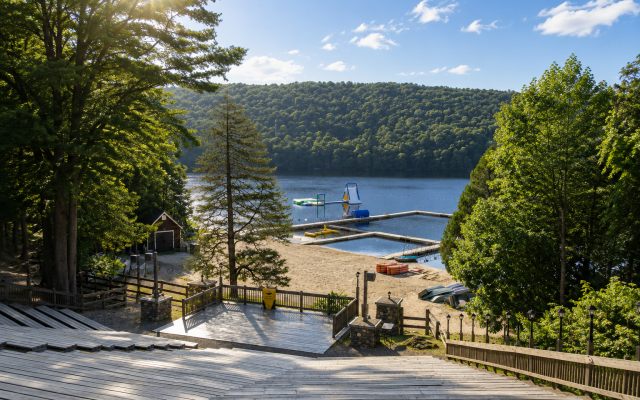
The Lakeside Amphitheater, Camp Ramah in the Berkshires, Wingdale, New York. Digital photograph by Eric M. Leiderman, Summer 2014.
As America celebrated its 250th anniversary this month, American Jews rightly reflected on what this country has given us. Religious liberty. Economic opportunity. The freedom to build one of the most vibrant Diaspora communities in Jewish history. Those blessings are worth celebrating. They also invite a different question. Rather than asking what America has given the Jews, what have American Jews given Judaism? There is no shortage of worthy answers. Federations. Denominations. Jewish Community Centers. Day schools. An enduring partnership with the State of Israel. Yet I have come to believe that our greatest contribution has been something far less obvious. It was not a synagogue, a movement, or a program. It was a way of preserving Jewish time in a society that runs on someone else’s calendar.
The American Jewish story is usually told through its institutions. We celebrate synagogues, camps, schools, Hillels, and countless organizations that have strengthened Jewish life for generations. Viewed individually, each deserves recognition. Together, however, they reveal something much more significant. American Jews did not simply build successful institutions. They built an ecosystem. Each institution was designed to accomplish something the others could not, carrying Jews from childhood through adulthood and ensuring that Jewish life remained continuous rather than episodic. The genius was never any one institution. It was the recognition that Jewish identity is formed through a lifetime of interconnected experiences, each reinforcing the others across every season of the year.
That innovation solved a uniquely American problem. For much of Jewish history, Jewish communities lived close enough together that the rhythms of Jewish life naturally shaped everyday experience. Even as minorities, many Jewish communities were organized around the rhythms of the Jewish calendar. America offered unprecedented freedom, but it also introduced a new challenge. Public schools followed a secular academic calendar. Businesses remained open on Jewish holidays. Summer vacation ignored Shavuot. Tisha B’Av arrived while families were at the beach. Tu B’Av appeared long after Hebrew schools had locked their doors for the season. Judaism had survived exile, empire, and emancipation. It had never encountered summer vacation.
American Jews responded with remarkable practicality. Rather than lamenting the American calendar, they built institutions sturdy enough to preserve the Jewish one. Synagogues anchored Shabbat and the festivals. Hebrew schools extended Jewish learning beyond public education. Youth movements cultivated friendships rooted in Jewish life. Hillel ensured that Jewish identity continued to mature on college campuses. Israel experiences transformed peoplehood from an abstract idea into lived reality. Then came the institution that completed the calendar: Jewish summer camp. Camp was never simply recreation with a Jewish accent. It reclaimed the months when the rest of the educational system paused and demonstrated that Judaism does not take the summer off. While much of America measured the season by vacations and long weekends, Jewish camp measured it by Shabbat, by Havdalah beneath the stars, by the reading of Eichah on Tisha B’Av, and by the quiet accumulation of daily Jewish practice.
Looking back, I realize how deeply that rhythm shaped me. Nearly all of my childhood memories of Tisha B’Av come from camp, where observing the day felt as natural as welcoming Shabbat. There is one exception that has remained with me for nearly two decades. In the summer of 2008, after returning home from Ramah Seminar in Israel, my congregation gathered in my parents’ backyard to read Eichah. Citronella candles flickered across the lawn. Tiki torches kept the mosquitoes away. We mourned the destruction of Jerusalem beneath an unmistakably suburban American sky. At the time, it felt unusual. Today, it strikes me as one of the most authentically American Jewish experiences I have ever had. Nothing about the setting diminished the holiness of the moment because Jewish time had transformed ordinary American space into sacred space. The Torah envisions exactly this kind of Judaism when it commands us to teach our children “when you sit in your house, when you walk on the way, when you lie down, and when you rise up.” Jewish learning was never meant to be confined to a classroom or a sanctuary. It was always meant to accompany life itself.
That is why I worry when our communal conversations reduce Jewish institutions to competitors in the same marketplace. We debate whether camps matter more than synagogues, whether supplementary schools justify their cost, or whether Israel trips produce measurable outcomes. Those questions assume that each institution should stand on its own. The architects of American Jewish life understood something different. A synagogue cannot do what a camp does. A camp cannot replace a Hillel. A Hillel cannot become a family home. Their power lies precisely in their interdependence. Together, they create a rhythm of Jewish living that no single institution could sustain alone.
As America begins its next 250 years, that may be the most enduring gift American Jews have offered the Jewish people. We inherited a society organized around someone else’s calendar and responded not by withdrawing from it, but by building an ecosystem that allowed Jewish time to flourish within it. That achievement did not happen by accident, and it will not survive by accident. The question facing the next generation is not which institution deserves our support. It is whether we still believe in the architecture that made American Jewish life one of the great success stories of the modern Diaspora. If we do, we will continue the work our predecessors began by ensuring that, even in America, the Jewish calendar continues to shape Jewish life.
This essay is the third installment in a multi-part series marking America’s 250th anniversary and exploring the relationship between American Jewish life, Zionism, citizenship, and belonging.
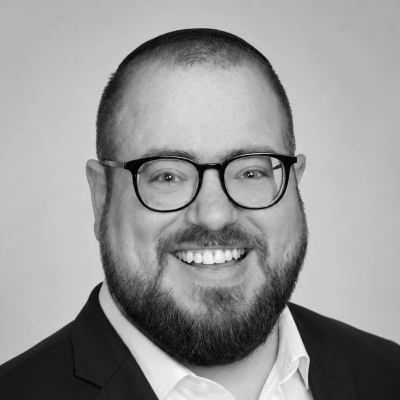
Rabbi Eric Leiderman is a Chicago-based rabbi, educator, and community builder. His work focuses on Jewish peoplehood, Israel education, Zionism, and the future of Jewish communal life. Through teaching, writing, and leadership, he seeks to strengthen connections between Jews, Judaism, and Israel across generations.