
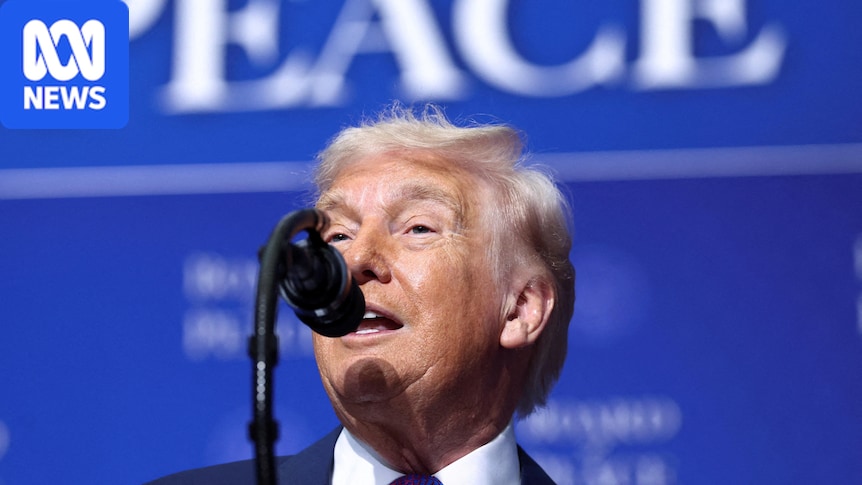
US President Donald Trump has announced what could be a “huge moment in Palestinian history” by declaring the complete disarmament of Hamas.
He said the group relinquishing its weapons would be followed by Israel withdrawing from Gaza, more than half of which is under Israel Defense Forces (IDF) control.
“This is a monumental step toward lasting PEACE and SECURITY,” Mr Trump wrote on social media.
But several Middle East analysts told the ABC they were sceptical the paramilitary group would willingly lay down its arms, or that Israel would agree to totally withdraw from Gaza.
Hamas, the governing authority in Gaza, which has been designated a terrorist group by several countries, including Australia, told news agency AFP “an agreement has been reached regarding the issue of weapons”.
Israel has yet to respond.
Here’s what we know about the agreement and why experts are sceptical it’s a done deal.
How did this come about?
Let’s briefly rewind to October 2025, when a ceasefire between Israel and Hamas was declared after two years of heavy bombardment.
At the time the death toll in Gaza had surpassed 70,000. The vast majority of the dead were civilians, including children, according to Palestinian health authorities.
Israel’s military campaign was launched in response to Hamas’s attacks on October 7, 2023, when almost 1,200 Israelis were killed and about 250 were taken as hostages into Gaza.
Central to that ceasefire deal was a “20-point peace plan” proposed by the United States. The first steps included the repatriation of the surviving Israeli hostages and the remains of deceased hostages in exchange for about 2,000 Palestinian prisoners detained in Israel.
From September 2025: What is in Trump’s peace plan for Gaza?
Another part of the ceasefire deal was that a “Board of Peace” would be put in charge of the transition in Gaza and manage the implementation of the 20 points.
Fast forward to now and Mr Trump has announced two key breakthroughs: that Hamas and “all other armed groups” in Gaza will disarm, and that Israeli forces will withdraw from the territory.
The Board of Peace said the agreement held “the promise of delivering significant benefits to the people of Gaza … and security to the people of Israel”.
Will Hamas disarm?
The Board of Peace said in a statement that “for the first time, Hamas officially has committed to an actionable plan for relinquishing all its weapons”.
Several Middle East experts said it was uncertain whether the agreement would hold.
University of Sydney Middle East politics analyst Martin Kear said the announcement was a “huge surprise” and that a complete disarmament of Hamas would be a “huge moment in Palestinian history”.
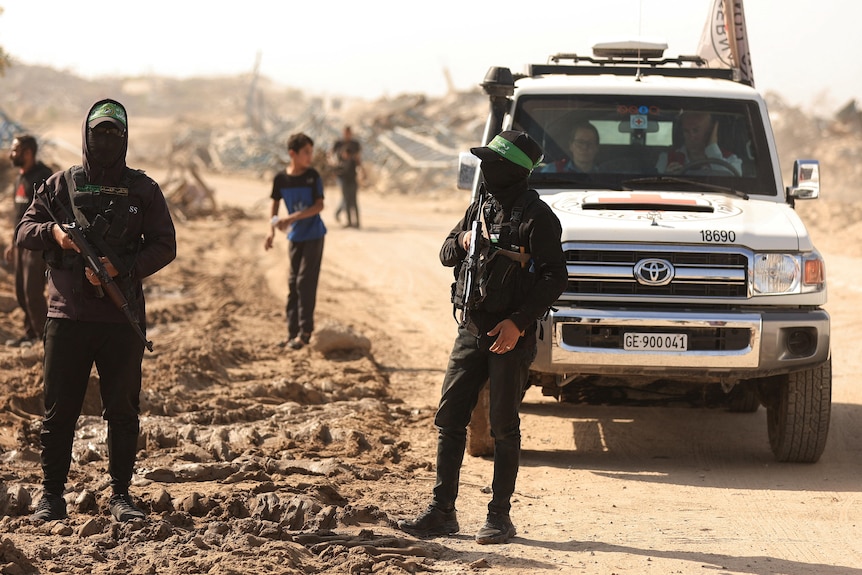
Hamas has previously resisted disarmament, claiming it would be equivalent to surrender. (Reuters: Dawoud Abu Alkas)
“I would find it difficult to believe that Hamas has agreed to completely disarm, because in the past that has always been contingent on Israel ceasing the occupation of the West Bank, Gaza Strip and East Jerusalem, which is never going to happen,” he told ABC NewsRadio.
“We would need to see exactly what Hamas has agreed to [in disarmament], if indeed they actually have agreed to do that at all.”
Hamas told AFP it was making “concessions for the sake of our people in the Gaza Strip”.
But according to Al Jazeera, a Hamas spokesperson said the group “would not implement any part of the agreement if Israeli forces failed to fulfil their obligations”.
“The official said disarmament depended on Israel’s withdrawal from Gaza and progress on reconstruction in the Palestinian territory,” Al Jazeera reported.
Will Israel completely withdraw from Gaza?
Israel has not responded to the latest news, but several experts doubt it will completely withdraw.
Part of last year’s 20-point plan deal was that Israel would pull back to an agreed “Yellow Line” before totally withdrawing from Gaza down the track.
In the months since that line was drawn Israel has taken control of more territory.
Israel recently said it controlled 60 per cent of Gaza’s territory, up from the 53 per cent agreed to in the ceasefire deal, and planned to expand that control to 70 per cent.
Satellite imagery and witnesses inside Gaza have documented the large concrete blocks used to mark the Yellow Line being moved further into the territory.
Israel’s Yellow Line moves further into Gaza
Additionally, earlier this year the IDF issued humanitarian organisations with a map showing a new “Orange Line”, along with a warning that any movement in that zone would require coordination with Israeli authorities.
“Prime Minister [Benjamin] Netanyahu and senior ministers have stated categorically that they would be not willing to give up any ground in Gaza,” Dr Kear said.
“Indeed, they’re actually seeking to cement their control of those areas that they now occupy in Gaza by proposing the establishment of military settlements and agricultural areas.”
What is next for Gaza?
If the plan proceeds as announced by Mr Trump and the Board of Peace, the process will begin “soon”, but an exact timeline has not been given.
“The agreement will be carried out in carefully structured phases. As disarmament is completed, Israeli forces will withdraw,” Mr Trump said.
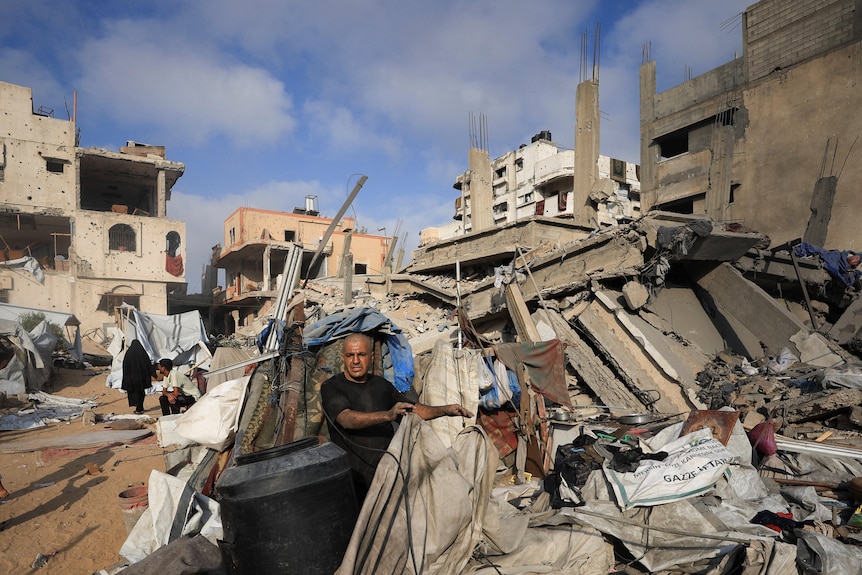
Donald Trump says Israel will withdraw from Gaza as Hamas disarms. (Reuters: Dawoud Abu Alkas)
According to Al Jazeera, the disarmament road map will be prepared within 14 days.
It would then need to be agreed to by all parties and any extensions would need to be signed off by an “international verification body”, the outlet reported.
Hamas said its disarmament depended on Israel’s withdrawal from Gaza. According to the Board of Peace statement, Israel’s withdrawal will come after Hamas disarms.
Middle East analysts say it is not yet clear how exactly this will play out.
From January 2026: The main remaining sticking points in the Gaza peace plan
Several experts also warned against taking the US president’s statements too seriously.
“President Trump has spoken in grandiose terms in the past about developments in the Middle East and they haven’t actually come to fruition,” Australian National University Midddle East analyst Ian Parmeter said.
“The other bit that I’m quite uncertain about is what the Israeli reaction is … If Israel’s unhappy, it’s not going to work, because there’s zero trust between [Hamas and Israel].”
Dr Kear said Mr Trump’s announcement of a deal could have been a tactic to put pressure on Hamas and Israel.
“He’s already announced it — it would be difficult [and] embarrassing — particularly for Israel — to say, ‘Well, no, we’re not going to withdraw,'” he said.
“But there are lots of ifs and buts.”
Donald Trump’s 20-point peace plan, in full:Gaza will be a deradicalised terror-free zone that does not pose a threat to its neighbours.Gaza will be redeveloped for the benefit of the people of Gaza, who have suffered more than enough.If both sides agree to this proposal, the war will immediately end. Israeli forces will withdraw to the agreed-upon line to prepare for a hostage release. During this time, all military operations, including aerial and artillery bombardment, will be suspended, and battle lines will remain frozen until conditions are met for the complete staged withdrawal.Within 72 hours of Israel publicly accepting this agreement, all hostages, alive and deceased, will be returned.Once all hostages are released, Israel will release 250 life sentence prisoners plus 1,700 Gazans who were detained after October 7th 2023, including all women and children detained in that context. For every Israeli hostage whose remains are released, Israel will release the remains of 15 deceased Gazans.Once all hostages are returned, Hamas members who commit to peaceful co-existence and to decommission their weapons will be given amnesty. Members of Hamas who wish to leave Gaza will be provided safe passage to receiving countries.Upon acceptance of this agreement, full aid will be immediately sent into the Gaza Strip. At a minimum, aid quantities will be consistent with what was included in the January 19, 2025, agreement regarding humanitarian aid, including rehabilitation of infrastructure (water, electricity, sewage), rehabilitation of hospitals and bakeries, and entry of necessary equipment to remove rubble and open roads.Entry of distribution and aid in the Gaza Strip will proceed without interference from the two parties through the United Nations and its agencies, and the Red Crescent, in addition to other international institutions not associated in any manner with either party. Opening the Rafah crossing in both directions will be subject to the same mechanism implemented under the January 19, 2025, agreement.Gaza will be governed under the temporary transitional governance of a technocratic, apolitical Palestinian committee, responsible for delivering the day-to-day running of public services and municipalities for the people in Gaza. This committee will be made up of qualified Palestinians and international experts, with oversight and supervision by a new international transitional body, the “Board of Peace,” which will be headed and chaired by President Donald J. Trump, with other members and heads of State to be announced, including Former Prime Minister Tony Blair. This body will set the framework and handle the funding for the redevelopment of Gaza until such time as the Palestinian Authority has completed its reform program, as outlined in various proposals, including President Trump’s peace plan in 2020 and the Saudi-French proposal, and can securely and effectively take back control of Gaza. This body will call on best international standards to create modern and efficient governance that serves the people of Gaza and is conducive to attracting investment.A Trump economic development plan to rebuild and energise Gaza will be created by convening a panel of experts who have helped birth some of the thriving modern miracle cities in the Middle East. Many thoughtful investment proposals and exciting development ideas have been crafted by well-meaning international groups, and will be considered to synthesise the security and governance frameworks to attract and facilitate these investments that will create jobs, opportunity, and hope for future Gaza.A special economic zone will be established with preferred tariff and access rates to be negotiated with participating countries.No one will be forced to leave Gaza, and those who wish to leave will be free to do so and free to return. We will encourage people to stay and offer them the opportunity to build a better Gaza.Hamas and other factions agree to not have any role in the governance of Gaza, directly, indirectly, or in any form. All military, terror, and offensive infrastructure, including tunnels and weapon production facilities, will be destroyed and not rebuilt. There will be a process of demilitarisation of Gaza under the supervision of independent monitors, which will include placing weapons permanently beyond use through an agreed process of decommissioning, and supported by an internationally funded buy back and reintegration program all verified by the independent monitors. New Gaza will be fully committed to building a prosperous economy and to peaceful coexistence with their neighbours.A guarantee will be provided by regional partners to ensure that Hamas, and the factions, comply with their obligations and that New Gaza poses no threat to its neighbours or its people.The United States will work with Arab and international partners to develop a temporary International Stabilization Force (ISF) to immediately deploy in Gaza. The ISF will train and provide support to vetted Palestinian police forces in Gaza, and will consult with Jordan and Egypt who have extensive experience in this field. This force will be the long-term internal security solution. The ISF will work with Israel and Egypt to help secure border areas, along with newly trained Palestinian police forces. It is critical to prevent munitions from entering Gaza and to facilitate the rapid and secure flow of goods to rebuild and revitalise Gaza. A deconfliction mechanism will be agreed upon by the parties.Israel will not occupy or annex Gaza. As the ISF establishes control and stability, the Israel Defense Forces (IDF) will withdraw based on standards, milestones, and timeframes linked to demilitarisation that will be agreed upon between the IDF, ISF, the guarantors, and the United States, with the objective of a secure Gaza that no longer poses a threat to Israel, Egypt, or its citizens. Practically, the IDF will progressively hand over the Gaza territory it occupies to the ISF according to an agreement they will make with the transitional authority until they are withdrawn completely from Gaza, save for a security perimeter presence that will remain until Gaza is properly secure from any resurgent terror threat.In the event Hamas delays or rejects this proposal, the above, including the scaled-up aid operation, will proceed in the terror-free areas handed over from the IDF to the ISF.An interfaith dialogue process will be established based on the values of tolerance and peaceful co-existence to try and change mindsets and narratives of Palestinians and Israelis by emphasising the benefits that can be derived from peace.While Gaza re-development advances and when the PA reform program is faithfully carried out, the conditions may finally be in place for a credible pathway to Palestinian self-determination and statehood, which we recognise as the aspiration of the Palestinian people.The United States will establish a dialogue between Israel and the Palestinians to agree on a political horizon for peaceful and prosperous co-existence.