
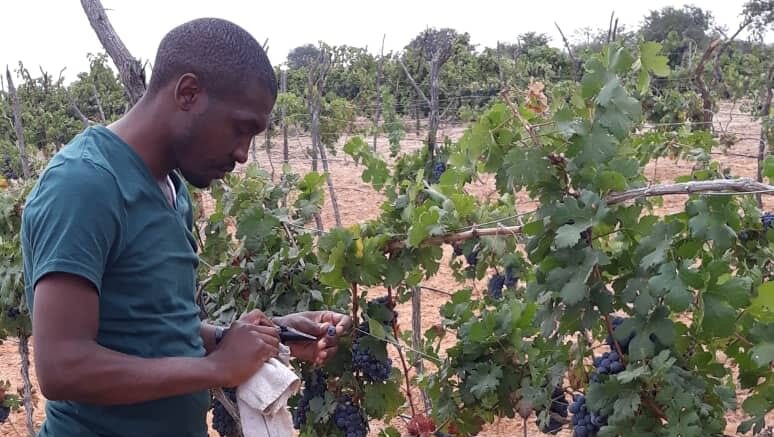
In the vineyards surrounding Tanzania’s capital of Dodoma, an unlikely partnership is taking shape with an ambitious goal: transform East Africa’s only commercial wine industry through Israeli agricultural expertise.
In Israeli Agricultural Expertise Helps Cultivate Tanzania’s Growing Wine Industry, The Media Line’s Keren Setton follows the work of CultivAid, an Israeli nonprofit that is training Tanzanian farmers, researchers and young agricultural professionals in modern grape cultivation and vineyard management. The organization’s focus is practical rather than theoretical—improving irrigation, raising grape yields, strengthening disease management, and developing the next generation of local viticulturists through hands-on experience.
For Jacob Timothy Mwavika, a Tanzanian viticulturist, the partnership has filled a longstanding gap in agricultural education. Having long admired Israel’s innovations in irrigation, desert farming and agricultural research, he said CultivAid gave him the opportunity to apply techniques he had previously encountered only in books. He also credits the program with helping create a pathway for training future grape specialists, something he said had been missing in Tanzania.
The collaboration comes as Tanzania’s wine industry reaches an important moment. Commercial winemaking began only in the early 1960s, and although Dodoma now accounts for most of the country’s vineyards, much of the sector still relies on traditional cultivation methods. Industry experts believe improvements in vineyard management, irrigation, equipment and technical training could significantly improve both production and wine quality.
CultivAid co-founder and CEO Dr. Tomer Malhi believes the opportunity is substantial. The organization has established a six-acre research farm in Dodoma, launched a vineyard management course for 60 local participants and created a vineyard nursery to support long-term expansion. According to Malhi, annual wine production has increased from between 4 million and 5 million liters when CultivAid began operating to 20 million liters today, while many vineyards remain well below their productive potential.
SID Israel CEO Ayelet Levin-Karp argues that projects like CultivAid demonstrate another dimension of Israel’s international engagement—one centered on practical partnerships, knowledge-sharing and long-term economic development.
Setton’s full report offers a look at how Israeli agricultural innovation is helping cultivate not only better vineyards, but also a growing wine industry in a country with significant untapped potential.