
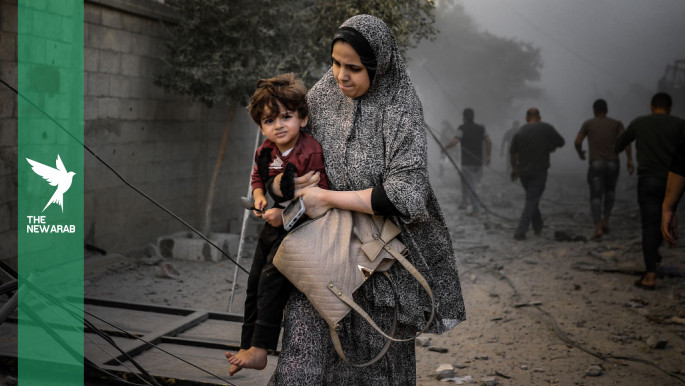
On Sunday alone, the Israeli army carried out more than 10 airstrikes across the Gaza Strip, killing at least 18 Palestinians, including women and children. [Getty]
Despite optimism about a Hamas-accepted Gaza ceasefire roadmap, Israel is intensifying attacks, exposing gaps between negotiations and reality, raising fears of escalation jeopardising the fragile peace.
Hamas’s acceptance of the proposal was expected to mark a turning point after months of stalled diplomacy.
Instead, it led to one of the deadliest days by Israel since negotiations resumed, highlighting a pattern in the nearly three-year war: diplomatic breakthroughs often coincide with intensified Israeli military actions.
On Sunday alone, the Israeli army carried out more than 10 airstrikes across the Gaza Strip, killing at least 18 Palestinians, including women and children, and wounding dozens more, according to Gaza’s Civil Defence.
Mahmoud Basal, spokesperson for the Civil Defence in Gaza, told The New Arab that Israeli drones and helicopters targeted residential buildings, tents sheltering displaced people, civilian vehicles, and gatherings of Palestinians in Gaza City, Deir al-Balah, Khan Younis, and Jabalia refugee camp.
Among those killed was the al-Taif family after an Israeli strike hit their apartment in Gaza City, Basal said.
“The Israeli army wiped out an entire family without prior warning, killing the father, the pregnant mother, their child, and the unborn foetus,” he said.
Salem al-Taif, the family’s uncle, told TNA that the family had been asleep when the strike occurred.
“What was the pregnant mother’s fault? What was the fault of her children? What was the fault of us, unarmed Palestinian civilians, in these political farces for which we have been paying with our children and our lives for more than two and a half years?” he described.
Residents helped in the rescue effort said power outages and continued Israeli overflights delayed overnight searches for victims.
Mohammad Ayyash, who participated in recovering the bodies, told TNA that rescue teams retrieved the body of a foetus after the blast fatally injured its pregnant mother, describing the aftermath as evidence of the heavy civilian toll of the attacks.
The Israeli military did not comment on most of the strikes. In a separate statement, however, it claimed without evidence that its forces had killed three Palestinians whom it identified as members of armed groups planning attacks against Israeli troops.
Diplomacy advances
On Friday, Hamas announced it accepted the mediators’ proposal to complete the US-brokered ceasefire’s second phase, aiming to end the war and enable reconstruction.
However, the movement emphasised that progress on sensitive issues, including heavy weapons discussions, depends on Israel halting military actions, withdrawing from Gaza, and fulfilling initial phase commitments.
While mediators mention “significant progress” and plan Cairo meetings to discuss implementation, Israeli officials still reject key Palestinian demands.
Israeli Energy Minister Eli Cohen claimed there was “no agreement” to stop Gaza military operations, while Security Cabinet member Ze’ev Elkin said Israel won’t withdraw until Hamas is disarmed. He was also unaware of any policy change regarding Gaza.
Hamas accused Israel of deliberately increasing the attacks to undermine understandings reached with mediators. For its part, the Islamic Jihad movement said the continued bombardment highlighted the need for binding guarantees to ensure Israel’s implementation of any future agreement.
The latest Israeli attacks further doubt whether mediators can bring about real change.
Attacks as Israel’s negotiating strategy
Gaza-based Palestinian analyst Mustafa Ibrahim believes the latest attacks should not be viewed as an isolated military episode but rather as part of Israel’s broader negotiating approach.
“The killing of 18 Palestinians in a single day reflects the continuation of Israel’s military doctrine rather than a temporary battlefield development,” he told TNA. “What is happening cannot be separated from the negotiations. This reflects the nature of the Israeli government, which continues to prioritise military pressure and believes force remains its primary instrument in managing the conflict.”
According to Ibrahim, the timing of the strikes, coming immediately after announcements of progress toward implementing the second phase, carries a political message.
“It indicates that the Israeli government is still not prepared to move toward a stable ceasefire. Maintaining military pressure strengthens its negotiating position while keeping Gaza outside any genuine political priority,” he said.
He also questioned whether international guarantees alone would be sufficient to ensure Israeli compliance.
“Even with American commitments and intensive mediation, it is difficult to rely on Israel’s adherence as long as it continues to believe that military operations are more effective than political concessions,” Ibrahim said.
In his assessment, mediators now face one of their most difficult tests since negotiations began.
“A successful agreement requires more than political announcements,” he added. “It requires a real cessation of military operations and the creation of conditions that allow implementation on the ground.”
His assessment reflects a broader concern shared by many Palestinian observers: that diplomacy has repeatedly failed to restrain military realities.
Since the ceasefire entered into force last October, Gaza’s Health Ministry said that more than 1,250 Palestinians have been killed in Israeli attacks, bringing the overall death toll since Israel launched its genocidal war in October 2023 to more than 73,000.
Those figures have fuelled scepticism among many Palestinians who increasingly view ceasefire announcements as offering little immediate protection from continuing violence.
Confidence erodes
Egypt, Qatar, Turkey and the United States remain engaged in efforts aimed at overcoming disagreements surrounding Israeli withdrawal, security arrangements and governance in post-war Gaza.
For its part, the Palestinian Authority presidency on Monday urged the international community to intervene and pressure Israel to immediately implement the agreement’s second phase.
Presidential spokesperson Nabil Abu Rudeineh said the continuing military campaign demonstrated that the agreement remained “ink on paper”, warning that daily attacks were undermining international efforts to end the war.
He also accused Israel of expanding military operations in the occupied West Bank, saying that simultaneous campaigns in Gaza and the West Bank reflected a broader strategy aimed at weakening the Palestinian national project.
Abu Rudeineh called on the UN Security Council and the international community to compel Israel to halt military operations, implement the agreement and provide international protection for Palestinians.
Mohammed Dahlan, a senior Fatah official, also stressed that the roadmap’s success depended on Israel ending daily attacks, while urging Palestinian factions to avoid actions that could provide Israel with grounds to suspend implementation.
Meanwhile, PLO Executive Committee member Ahmed Majdalani argued that Israeli Prime Minister Benjamin Netanyahu remains reluctant to make major political concessions before Israel’s parliamentary elections scheduled for later this year.
He said Egyptian and Qatari mediators were making intensive efforts but warned that continuing military operations risked delaying implementation of the next phase.
Turkey likewise condemned the latest Israeli strikes, saying they demonstrated that the Israeli government “does not want peace with the Palestinians”.
Ankara argued that continued military operations threaten mediation efforts and further destabilise the region.
For diplomats, the central challenge has become increasingly apparent.
The political framework for moving toward phase two appears to be gradually taking shape. Yet the military realities continue moving in the opposite direction.
Core disputes, including Israeli withdrawal from Gaza, Hamas’ future military capabilities, governance arrangements and security guarantees, remain unresolved despite months of negotiations.