
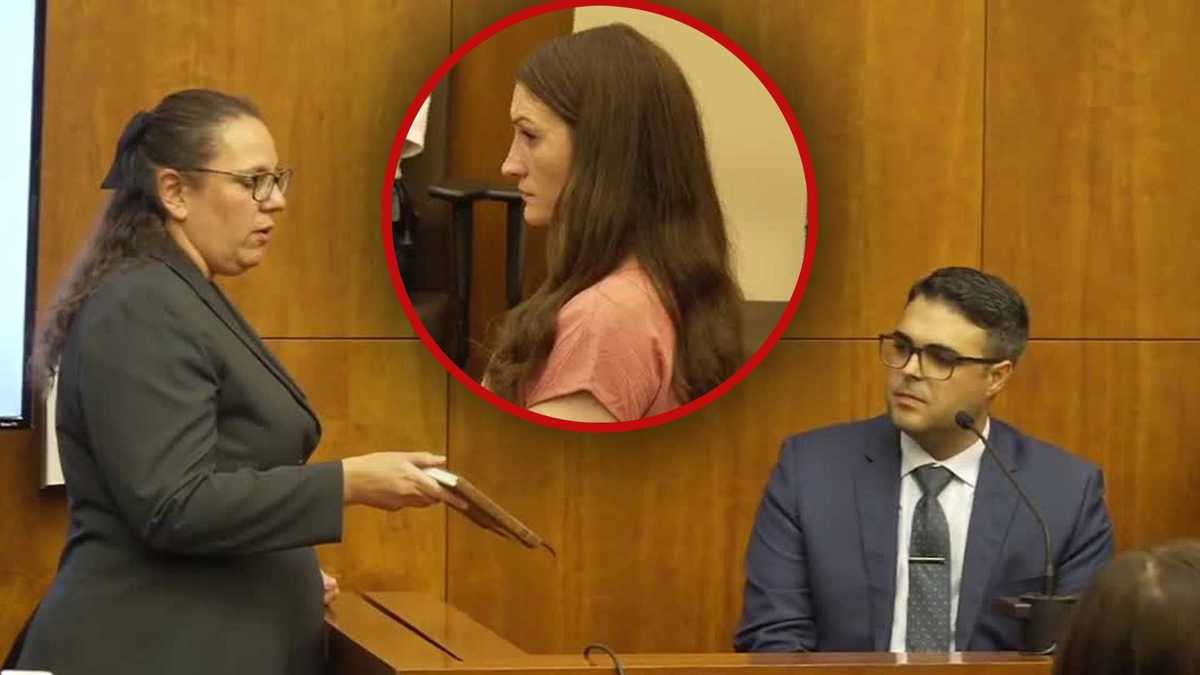
Live Updates: Lindsay Clancy’s journal, medical treatment discussed during 5th day of trial
Emergency room, ICU staff testified earlier Monday
 PLYMOUTH, Mass. —
Attorneys entered a handwritten journal into evidence Monday during the trial of Lindsay Clancy, the Massachusetts mother accused of killing her three children in 2023.
Lindsay Clancy trial Day 5: Key momentsDoctors testify about Cora and Callan: The day began with emergency doctors describing attempts to save two of the children. Cora was pronounced dead in Plymouth; Callan suffered severe brain injury and was later taken off life support.Psychiatrists describe Clancy’s hospital condition: Dr. Jhilam Biswas said Clancy appeared anxious, communicated in writing and asked about an attorney during a brief Jan. 26 evaluation; Biswas said she saw no signs of psychosis. Dr. Sejal Shah said Clancy was initially confused and delirious after spinal surgery, but later denied suicidal or homicidal thoughts and appeared focused on rehabilitation. Clancy also asked for her health care proxy to be changed from her husband to her parents. The state begins laying out evidence from the home: Officers described securing the Duxbury house and collecting devices, hospital paperwork, medication records and handwritten notebooks.Journal entries reveal struggles with sleep and anxiety: Prosecutors read entries from the notebooks describing Clancy feeling overwhelmed by her son Callan’s sleep schedule. On cross-examination, the defense highlighted other entries in which Clancy wrote about wanting to get well, brain fog, guilt, anxiety and concerns about returning to work.
More key takeaways from the trial are here.
Journals become evidence
The journal was introduced to the case by the prosecution during the testimony of Trooper Cory Melo, who was assigned to the Plymouth District Attorney’s Office. The prosecution and defense both read passages from the journal.
“Completely overwhelmed, I feel like I’m drowning,” Clancy wrote in a sentence read by the prosecution.
On cross-examination, the defense read aloud examples of Clancy expressing stress about sleep training her youngest child, Callan; guilt over using family money while not working; and concern about her relationship with her husband, Patrick.
“I want to be well,” Clancy wrote in one passage read in court.
Physicians, nurses describe Clancy’s injuries
Dr. Sejal Shah testified about working with Lindsay Clancy at Brigham and Women’s Hospital, starting on Jan. 29. Shah said Clancy was initially confused and delirious after spinal surgery, but later denied suicidal or homicidal thoughts and appeared focused on rehabilitation. Clancy also asked for her health care proxy to be changed from her husband to her parents.
The defense questioned Shah about Clancy’s diagnoses and medications prescribed before the killings. Shah explained some medications carry warnings about possible suicidal thoughts.
Nurses Rachelle Amedee and Meghan Collins testified that Clancy arrived at the ICU at Brigham and Women’s Hospital early in the morning on Jan. 25, and was assigned constant supervision. Amedee said Clancy required resuscitation that first night.
Amedee said Clancy, who was intubated, was able to use a whiteboard to communicate starting on Jan. 28. The nurse said Clancy described being confused and unable to feel her lower extremities.
On cross-examination, Amedee confirmed that records indicated Clancy had a known history of postpartum depression.
Earlier Monday, prosecutors called emergency department doctors who described treating the children. One described receiving Cora Clancy at Beth Israel, where she was declared deceased. Others described Callan Clancy’s arrival and treatment at Boston Children’s Hospital, where he was eventually declared brain dead, and life support was removed three days later.
The final physician testified about Lindsay Clancy’s arrival at South Shore Hospital with lacerations on her neck and wrist, and a spine injury.
Background of the Clancy case:Lindsay Clancy faces three murder charges in the 2023 deaths of her children, Cora, Dawson and Callan.She also jumped from a second-floor window, leaving her partially paralyzed.In a civil case, Lindsay Clancy alleges a “catastrophic failure” of multiple medical providers in diagnosing and treating her psychiatric condition.Her trial began on July 20. Although her legal team offered to stipulate to the deaths of the children, she has pleaded not guilty.She is being held at Tewksbury State Hospital.The jury is made up of 12 women and six men. They will not know until the presentation of the case is concluded who will deliberate and who will be an alternate.
This case involves issues of mental health. If you or someone you know needs help, you can talk with the Suicide & Crisis Lifeline by calling or sending a text message to 988, or you can chat online here.
Lindsay Clancy jury visits key locations
The first week of testimony in the Lindsay Clancy murder trial ended after the judge, jury and attorneys visited locations connected to the case, including the Clancy family’s former home in Duxbury.
The jury also retraced the route prosecutors say Lindsay Clancy sent her husband, Patrick Clancy, on the day of the killings, including stops at a CVS and a restaurant in Plymouth.
Day 4: Court adjourns after more emotional testimony, tour of Clancy family home
Expert testimony expected to be crucial
Retired District Court Judge Jim Barretto said the case is expected to center on competing psychiatric experts.
“The defense, of course, is expected to call experts supporting its claim that Lindsay Clancy was suffering from postpartum psychosis and lacked criminal responsibility. And of course, we’ll hear from prosecution – the prosecution – who’s expected to present experts, uh, disputing that conclusion,” Retired District Court Judge Jim Barretto said.
The defense is expected to argue that Clancy was suffering from postpartum psychosis and lacked criminal responsibility at the time of the killings.
Prosecutors are expected to present experts who dispute that conclusion.
Video below: Reporter Sera Congi describes court during 911 call
Prosecutors must prove criminal responsibility
The prosecution has the burden of proving Clancy was legally sane when the children were killed.
To secure a conviction, prosecutors must prove the killings were committed with premeditation or with extreme atrocity or cruelty.
Opening statements delivered
The state laid out for the jury of 12 women and six men the alleged events that led up to the children’s deaths on Jan. 24, 2023, and warned the jurors they would hear graphic testimony as she urged the group to use their common sense and life experiences as they listen to the case.
Video below: Prosecution’s opening statement
Plymouth County Assistant District Attorney Shanan Buckingham started by telling the jury the children were strangled “meticulously.”
“One by one, she wrapped exercise bands around each one of the kids’ necks and pulled until their little bodies were limp and lifeless,” Buckingham said.
The state argued Lindsay Clancy understood her actions and made a deliberate choice.
“She heard a voice, a male voice, a voice that she had never heard before, a voice that she had never heard again. That voice told her it was her last chance; she had to kill her kids so she could kill herself. She immediately took action when she heard the voice with no direction or details from this so-called voice, and she killed the children,” Buckingham said.
Video below: Defense’s opening statement
Lindsay Clancy’s defense team plans to use the insanity defense, arguing that she suffered from postpartum psychosis and was overmedicated at the time of the alleged crimes.
In his opening statement, Reddington said his client knows she killed her children but questioned what was going on in Lindsay Clancy’s mind.
“After the second child she had postpartum. … You will hear evidence that was one of the issues that was important because it can lead to (being) bipolar. One of the things you don’t do if someone is bipolar, you don’t put them on an antidepressant, on Zoloft. It messes with your brain, and it was done in this case,” Reddington said.
Reddington showed the jury graphic photos of Lindsay Clancy in the hospital after she jumped out of her bedroom window in an effort to head off any move by the prosecution to make the attempted suicide appear to be fake.
Video: Psychiatrist talks maternal mental health