

The US-backed Board of Peace appeared to change its conditions for the IDF to withdraw from Gaza after its top officials held a meeting with Prime Minister Benjamin Netanyahu in Jerusalem on Monday, shortly before a fresh Israeli airstrike was reported in the enclave.
“Contrary to inaccurate reports, we note that the withdrawal of the IDF beyond the Yellow Line will take place only once decommissioning is complete, as Hamas committed to the mediators. This applies to light weapons, heavy weapons and the tunnels alike,” the Board of Peace, meant to oversee postwar Gaza, said in a statement confirming a Jerusalem meeting between its high representative Nickolay Mladenov, its senior adviser Aryeh Lightstone and Netanyahu.
The Yellow Line is the border demarcated in the October 2025 ceasefire, which roughly split Gaza between zones of Israeli and Hamas control. Since then, the IDF has taken more territory and now controls more than 60% of Gaza.
Israel was expected to initially pull back to the Yellow Line under the terms of a deal to disarm Hamas that was announced last week, a Board of Peace official told The Times of Israel last week, though Monday’s statement does not specify that.
An earlier version of the Board of Peace statement spoke of the “full withdrawal of the IDF.” That suggested that some IDF pullbacks beyond the Yellow Line could take place before the entire disarmament process is complete — as was specified in the Board of Peace’s proposal last week.
Get The Times of Israel’s Daily Edition
by email and never miss our top stories
By signing up, you agree to the terms
But “full” was removed from the Monday Board of Peace statement minutes after it was published.
Regardless, both versions appeared to contradict what Mladenov said last week, when he asserted that “Withdrawal must move in lockstep with decommissioning.”
The apparent shift appeared to be part of the Board of Peace’s efforts to get Israel on board with its disarmament plan, after officials in Jerusalem insisted that no IDF withdrawals would take place until after the full disarmament of Hamas was complete, taking issue with the plan’s envisioning of a phased disarmament and withdrawal process.
But the apparent change to the disarmament terms risks losing Hamas, which only agreed to the original sequencing.

Palestinians cool off in the Mediterranean Sea during a heatwave in Nuseirat, central Gaza Strip, July 30, 2026. (AP Photo/Abdel Kareem Hana)
In its Monday statement on the “constructive” meeting with Netanyahu, the Board of Peace wrote, “The goal is clear and is not in question: the complete decommissioning of weapons in the Strip and the transition away from rule by the gun to civilian governance. Reaching it will be a process. And that process will be set out in the next phase of the work.”
As Israeli officials continue to reject any halt to military operations in Gaza, the Board statement stressed that “continued progress towards implementation in full depends on each side fulfilling its obligations under the agreed framework.”
‘The start of the hard phase’
According to the Israel Hayom outlet, Netanyahu told Mladenov during the meeting that Israel will not hold its fire in Gaza, and will not withdraw from the Yellow Line, due to the ongoing threat posed by Hamas.
The report added that Israel also handed the Board and US officials a list of reservations regarding the disarmament plan, protesting the fact that Jerusalem was not a party to the deal as it was being negotiated in Cairo, and did not get the opportunity to present its opinion.
Long day in Jerusalem, sitting down with Prime Minister Netanyahu and his team. This is the start of the hard phase and I have never pretended otherwise. Not much of what we do now is dramatic. It is slow, grinding and technical work. https://t.co/KQIVRkzBTE
— Nickolay E. MLADENOV (@nmladenov) August 3, 2026
An Israeli official familiar with the matter also told The Times of Israel that Jerusalem also took issue with the Board of Peace’s plans to include representatives from Qatar and Turkey in the International Verification Committee tasked with monitoring the implementation of Hamas’s disarmament. Both countries have hosted Hamas leaders, and Turkey’s relations with Israel collapsed after the Hamas-led October 7, 2023, attack that launched the Gaza war.
The official said Israel also objected to the proposal’s requirement that Hamas weapons merely be put in storage, as opposed to being destroyed.
For his part, Mladenov appeared to tamp down expectations of a breakthrough, writing that it was a “long day in Jerusalem.”
“This is the start of the hard phase and I have never pretended otherwise,” he continued in a post on X. “Not much of what we do now is dramatic. It is slow, grinding and technical work.”
Later, a delegation of Board of Peace officials held a briefing for US Congressional staffers for leaders of both parties to update them on the US-led panel’s efforts.
Board of Peace senior adviser Josh Gruenbaum and security lead Gen. (ret.) Mark Schwartz “emphasized the determination to work with Congress in a bipartisan manner to advance peace, security, governance, and reconstruction in Gaza,” a Board of Peace official said.
New Israeli airstrike reported; IDF announces killing of Oct. 7 terrorists
Hours after the Board of Peace officials’ meeting with Netanyahu on Monday, an Israeli airstrike was reported in the Sheikh Ajlin neighborhood of Gaza City in which two people were killed.
It was the first airstrike in nearly 24 hours, with the brief lull leading some to speculate that progress had been made in the Board of Peace’s efforts to coax Israel into halting its strikes on Gaza.
بعد هدوء مخادع دام نحو 30 ساعة ..
شهيدان ومصابون في استهداف مركبة مدنية من قبل طائرات الاحتلال المسيرة على شارع الرشيد بالقرب من مسجد الشيخ عجلين غرب مدينة غزة. pic.twitter.com/JbU94fnHp0
— الحـكـيم (@Hakeam) August 3, 2026
Meanwhile, the IDF announced that in one of its Sunday strikes before that brief lull, it had killed a Hamas terrorist who invaded Israel during the October 7, 2023, onslaught.
The military said its strike in Deir al-Balah killed Abdallah Adnan Taha Abu al-Tayf, a member of Hamas’s elite Nukhba Force, who invaded Israel on October 7.
A separate strike in the Shati camp of Gaza City killed Jalal Sobieh, identified by the IDF as a commander in Hamas’s Daraj-Tuffah Battalion.
The IDF justified the strikes amid the ceasefire, as it has in previous ones, by claiming that both terror operatives had been advancing attacks on troops and Israeli civilians, and they were “eliminated to remove the threat.”
Earlier Monday, the IDF announced that in an airstrike over the weekend it had killed another Palestinian Islamic Jihad terrorist who invaded Israel on October 7 and who was among those who held hostage Rom Braslavski in captivity.
צה”ל חיסל מחבל גא”פ שפשט ב-7 באוקטובר, לקח חלק בהחזקתו של רום ברסלבסקי בשבי ובטקסי מסירת חטופים
צה”ל תקף במרחב דיר אל-בלח במהלך סוף השבוע, וחיסל את המחבל מחמוד פטאיר, מפקד נוח’בה בחטיבת מחנות המרכז בארגון הטרור גא”פ.
המחבל פשט לשטח מדינת ישראל ב-7 באוקטובר ולקח חלק בהחזקתו של… pic.twitter.com/VHsEOE57Tn
— צבא ההגנה לישראל (@idfonline) August 3, 2026
The strike in central Gaza’s Deir al-Balah killed Mahmoud Fatair, a member of Islamic Jihad’s elite forces, according to the military.
The military said that in November 2023, during the first ceasefire and release of Israeli hostages, Fatair was seen “participating in the hostage handover ceremony of numerous hostages,” including Amit Shani, Ofir Engel, Moran Stela Yanai, Itay Regev, Liam Or-Nassar, Raz Ben Ami, Rantin Phaiboon, Gong Sae Lao, Seekena Jakkapan and Saegkaew Charoemchai.
The IDF claimed that Fatair too had been advancing attacks on troops and Israeli civilians, and was “eliminated to remove the threat.”
Former hostage lauds captor’s killing
Braslavski, who learned Arabic during his two years in Gaza, hailed the killing of Fatair, saying in an Arabic-language video message that he was “another one who destroyed my soul.” His microphone in the video had a yellow ribbon, which symbolized the struggle to free the hostages.
“Yes, you were criminals, and yes, I was weak while with you, and you did whatever you wanted,” he said. “But now, you are being killed one after the other, and not even one will be left of you. Whoever works for Islamic Jihad, Hamas, or any terror group will die, one by one.”
He went on to thank the IDF and the Israeli nation, concluding by quoting the biblical verse: “An eye for an eye and a tooth for a tooth.”
כל כאלב ביג יומו ????
7.10.2023 ????????️ pic.twitter.com/e5PpS9b5fw
— Rom Braslavski (@RomBraslavski) August 3, 2026
Hamas’s disarmament has been a main sticking point in advancing US President Donald Trump’s 20-point plan for Gaza that was unveiled last fall. In announcing Hamas’s approval of the Board of Peace’s disarmament plan on Thursday, Trump said it would be carried out in “carefully structured phases.”
The agreement stipulates that all weapons held by the Hamas-run police will be transferred to the US-backed Palestinian technocratic committee that is meant to run the Strip, known as the National Committee for the Administration of Gaza (NCAG), upon its arrival in the enclave.
The NCAG is supposed to enter Gaza two weeks after the commencement of the disarmament plan. During the first two weeks, the sides are supposed to agree on a timeline for each phase of the weapons handover.
While the Board of Peace wanted the first 14 days of the plan to commence immediately upon Hamas’s approval of the proposal, Israel’s objections to it have left the start date up in the air.
A process to decommission and store heavy weapons and to dismantle military production sites and tunnels is supposed to begin after the arrival of the Palestinian committee and the deployment of international forces. The process will be linked to a phased Israeli withdrawal, according to the agreement.
Eventually, armed groups are to hand over all weapons to the technocratic committee, with the timeline expected to span from eight months to a year.
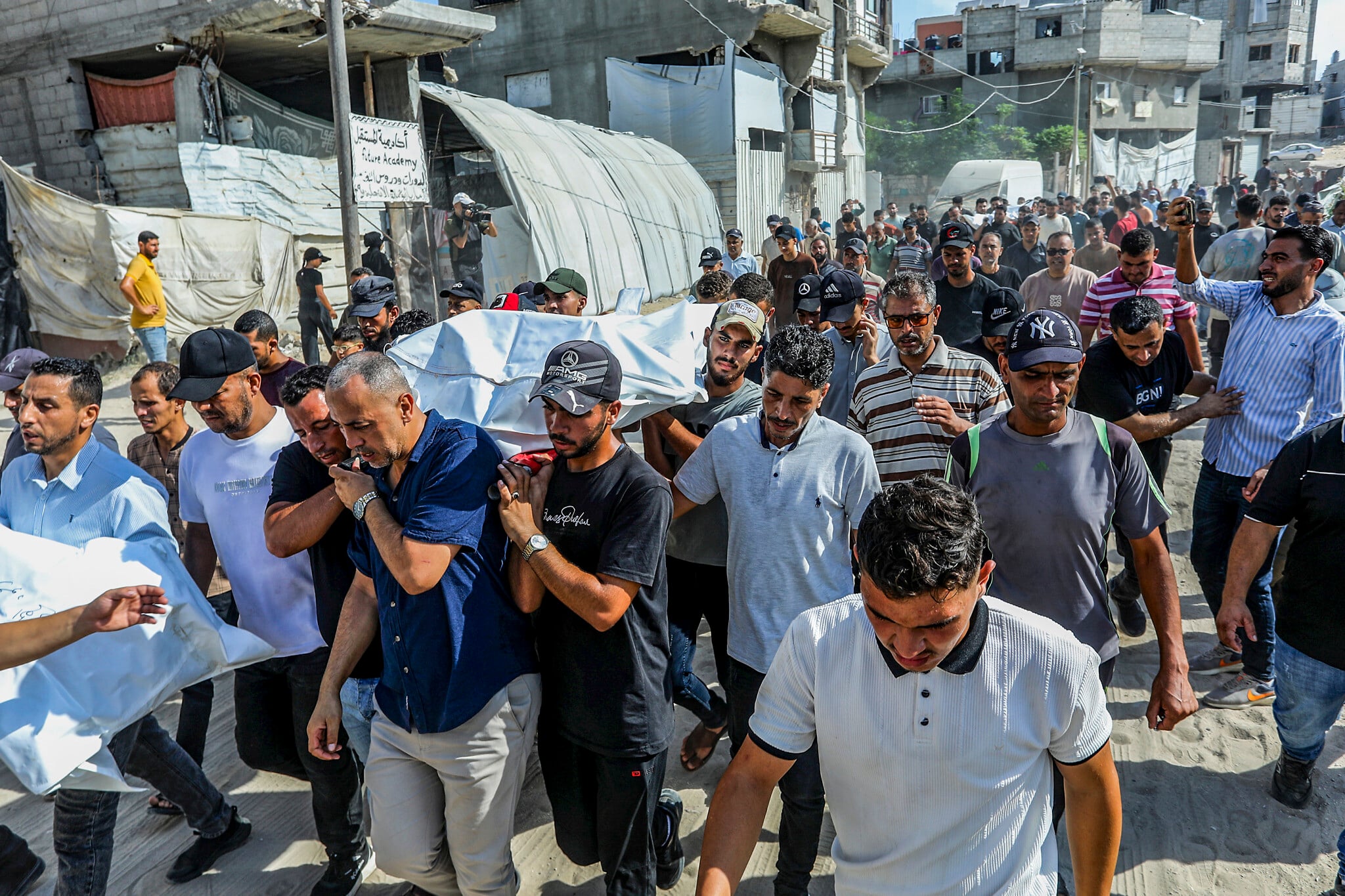
Palestinians carry the bodies of people killed in an Israeli military strike in Khan Younis, in the southern Gaza Strip, August 2, 2026. (Abed Rahim Khatib/Flash90)
The areas Israel controls in Gaza have been mostly destroyed and depopulated. Most of the territory’s 2 million Palestinians are in the Hamas-held part, where hundreds of thousands live in squalid tent camps and destroyed neighborhoods.
Israel appears unlikely to pull back significant forces or make other concessions ahead of its October 27 election. Netanyahu faces a tough reelection battle, with his far-right coalition partners urging him to keep up the pressure on Hamas and leave forces in Gaza; some seek to establish settlements in the territory.
While the heaviest fighting in Gaza has largely subsided, at least 1,230 people have been killed in Gaza since a ceasefire took effect in October 2025, according to the territory’s Hamas-run health ministry. The toll does not differentiate between combatants and civilians and is not verified, though Israel has generally accepted Hamas’s tally.
Five Israeli soldiers have been killed in Gaza since the ceasefire took effect.