
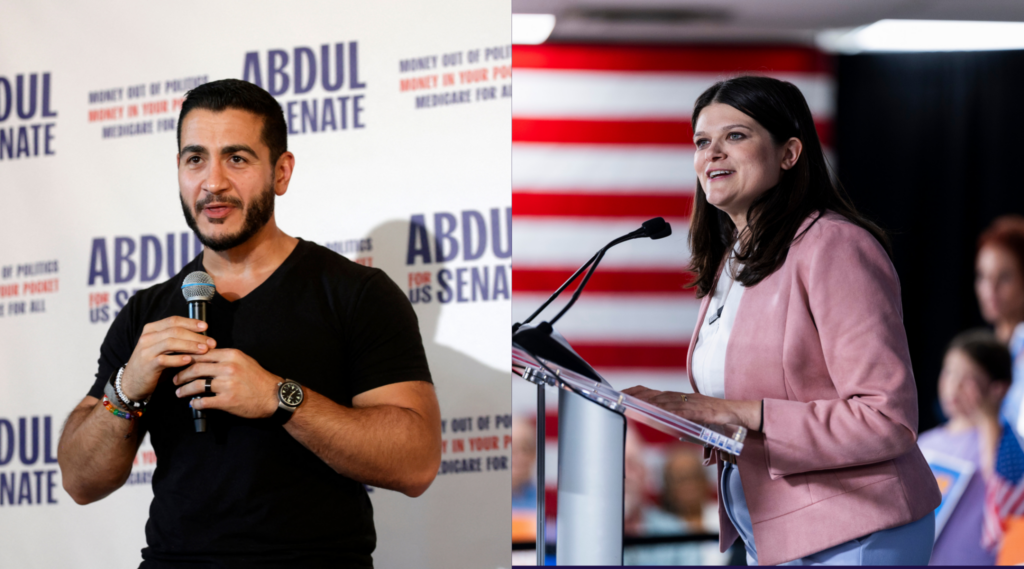
Michigan voters are deciding Tuesday between U.S. Sen. Haley Stevens and former county health official Abdul El-Sayed in a closely watched Democratic Senate primary that has become a national test of the party’s divisions over Israel.
Stevens, a pro-Israel moderate, and El-Sayed, a progressive who has made criticism of Israel a focal point of his campaign, are vying to replace retiring Democratic Sen. Gary Peters and advance to a November matchup against Republican former Rep. Mike Rogers.
The race is widely seen as a must-win for Democrats in their bid to retake control of the Senate, raising the stakes of a primary that increasingly focused on which candidate would be better poised to defeat Rogers. Recent polling in the race shows that Rogers has a slight lead over El-Sayed, while Stevens polled slightly ahead of the GOP candidate.
For many Jewish Democrats in the state, the race has also become a test of El-Sayed’s approach to Israel, with his rhetoric about the war in Gaza and repeated attacks on AIPAC spending in the race alarming voters who might otherwise be drawn to his progressive politics.
With El-Sayed leading Stevens by as much as 16 points in polls going into the primaries, the race could mark the latest victory for the Democratic Party’s emergent progressive wing, which has seen a string of primary victories in races across the country, several of which have elevated candidates sharply critical of AIPAC and Israel.
The fight has particular resonance in Michigan, which is home to sizable Jewish and Arab American populations and has emerged as a battleground for Democratic divisions over Israel since Oct. 7.
Indeed, the starkest divide between the candidates has been over Israel.
Stevens has maintained a strong record of support for Israel throughout her four terms in Congress, while El-Sayed has repeatedly accused the country of committing genocide in Gaza and often framed U.S. funding for Israel as money that should be diverted to domestic priorities. He has also said the Israeli government is as “evil” as Hamas and questioned whether Israel should be a Jewish state.
El-Sayed has also faced scrutiny from Stevens and many Jewish leaders in the state for campaigning alongside anti-Israel streamer Hasan Piker, who has faced accusations of antisemitism.
El-Sayed additionally appalled some Michigan Jews for his remarks following the March attack on Temple Israel in West Bloomfield, Michigan, when he said “hurt people do hurt people” of the attacker, who targeted the synagogue when preschool was in session, and who had family who were killed in an Israeli strike on Lebanon.
Those divisions have been amplified by AIPAC’s record-breaking spending in the race. The group’s super PAC has spent over $31 million to support Stevens, according to AdImpact, which El-Sayed has made one of his most frequent campaign targets.
Many Jewish Democrats in the state have rallied behind Stevens, with some warning that a potential El-Sayed victory could push them to reconsider their allegiance to the party and support Rogers in the general election.
El-Sayed, 41, is a former director of the Detroit Health Department who first rose to prominence during his unsuccessful 2018 bid for Michigan governor, when he ran with the backing of a host of progressive leaders. In the Senate race, he has campaigned on a platform emphasizing affordability and healthcare while railing against money in politics, particularly AIPAC.
Stevens, 43, has represented Michigan’s 11th Congressional District, which spans much of Oakland County, since 2019. A former chief of staff for the Obama administration’s auto rescue task force, she has focused on affordability issues while emphasizing her ability to win in competitive territory.
El-Sayed has drawn endorsements from Vermont Sen. Bernie Sanders and Reps. Ro Khanna and Alexandria Ocasio Cortez, as well as Jewish Voice for Peace Action and Pal Pac, a pro-Palestinian political action committee.
Stevens, meanwhile, has been endorsed by New York Sen. Chuck Schumer, Michigan Gov. Gretchen Whitmer, the Michigan Democratic Jewish Caucus and the Jewish Democratic Council of America.
Reporting the stories that define our era. When history unfolds in real-time, the Jewish world turns to JTA. Your support ensures we can document the complexities of war and the resilience of Jewish communities with integrity.
One-time
Monthly
Choose an amount to donate
$72$180$360$500
Support Us