

Like much of the rest of the planet, I went to see the massively hyped new adaptation of The Odyssey. I have my own reservations about the film, reservations already picked apart in a thousand video essays, but there is one angle I have not heard anyone raise. Sitting in the dark, I heard the mythic words booming from the speakers, and my mind didn’t drift to ancient Greece. It went somewhere a lot more domestic.
Early on, I watched the horse wheeled through the gates of an impenetrable city, and Odysseus and his men spilling out to take it from the inside. And all I could see was our own morning. October 7th, the walls we believed in giving way, the breach that nearly took us down. Troy fell because it trusted what it let inside. I understood the feeling better than I wanted to.
For the rest of the runtime, I watched Odysseus live out Nostos, the agonizing, decade-long struggle simply to get home. It is a pain we now understand intimately. For so many Israelis, there has been no home since October 7th. Entire communities have not returned to their houses on the Lebanese border or around Gaza. They are refugees inside their own country, geographically in Israel but profoundly displaced.
And even those of us whose houses still stand have lost much of what “home” used to mean. My own is one of them. I have had to grab a bag and leave in a hurry when missile debris came down on my neighborhood in Ramat Gan. The structure is still there. The sanctuary it once offered is not. I still wonder when, and whether, that feeling comes back.
On screen I saw the besieged Ithaca: a kingdom reshaped by men who did not belong there, a home stripped of its dignity, shaky and uncertain. That is our psychological landscape. We are living in an Ithaca that feels fundamentally altered, where war has become ordinary, and we have no choice but to wait for the next boom.
But the parallel that held me hardest was the strait, the narrow water between Scylla, the six-headed monster on the cliff, and Charybdis, the whirlpool that swallows ships whole. There it is, the impossible choice made literal: every path costs you something you cannot afford to lose, and still you have to choose, because the ship has to keep moving.
Israel makes those choices by the hour. It starts on the personal level. We are all trying to hold the mundane details of a normal life inside several life-threatening storms at once. Some manage a hollow version of routine. And if, like me, you work in tourism, you are mostly just waiting by a phone that no longer rings while the weather rages overhead.
Then the impossible choices scale up. A country walks a tightrope over a very deep valley, balancing Washington, the shadow of Iran, the Palestinians, the Houthis, and a dozen other existential problems, all while feeling as though the world’s back has turned. Steer away from the monster and you scrape the whirlpool. Every decision extracts its toll.
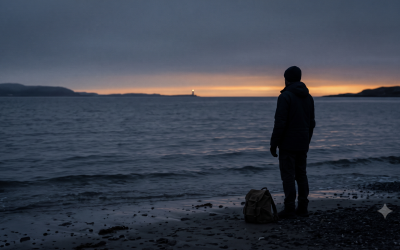
On the drive home, I kept circling one thing (spoiler ahead, skip this paragraph if you haven’t seen it). Nolan doesn’t end it the way Homer does. He gives Odysseus the sunset: Penelope, the sailing away, the neat and almost Disney-bright close. Homer knew better than to let it end clean: the men Odysseus killed had families, and families remember. There are whispers now of a deal, an arrangement with Iran, some broader regional pause that might buy a little quiet. But we know how the older, truer version goes. It is never quite over.
And yet, sitting in that dark theater, I envied Nolan. He got to choose where his story ends. That is the one thing we are still denied: the ability to decide where our own story stops. We don’t get to fade to sunset on command. But the pen is still in our hands, even out here at sea. And if a storyteller can look at the oldest tragedy in the canon and decide it ends in light instead of blood, maybe that is permission to believe our ending is still ours to write.
Ari Melnik is a historian and licensed tour guide who has shown Israel to visitors for twenty years through Exclusive Israel Tours. He is the author of two books, Israel Unfiltered and the memoir Waiting For The Boom: How War Became Ordinary, which he began in his family’s safe room in Ramat Gan, where he lives with his partner and their twin sons.