
Sign up for the Slatest to get the most insightful analysis, criticism, and advice out there, delivered to your inbox daily.
In the 2010s, Tumblr popularized the idea of a problematic fave: a cherished person or work of art whose past behavior or present politics revealed something objectionable or worse. Did you know that Planned Parenthood was founded by a eugenicist? That Taylor Swift once dabbled in high school homophobia? At times it seemed as if no beloved text or personal icon, at least from anything but the most recent past, was free from the possibility that it or they might turn out to have unsavory associations. Not even figures of speech were safe.
It’s not surprising that the poster behind Your Fave Is Problematic turned out to be a high school student, because the concept of an unproblematic fave is a fundamentally immature one. (It belongs to the phase of life before you realize that your parents are human beings.) But if the phrase has passed out of use, the impulse to point out those imperfections, glaring and otherwise, is still very much with us. And so is its inverse, the push to protect the things we love, by rationalizing their faults or using them as springboards for our own more contemporary observations.
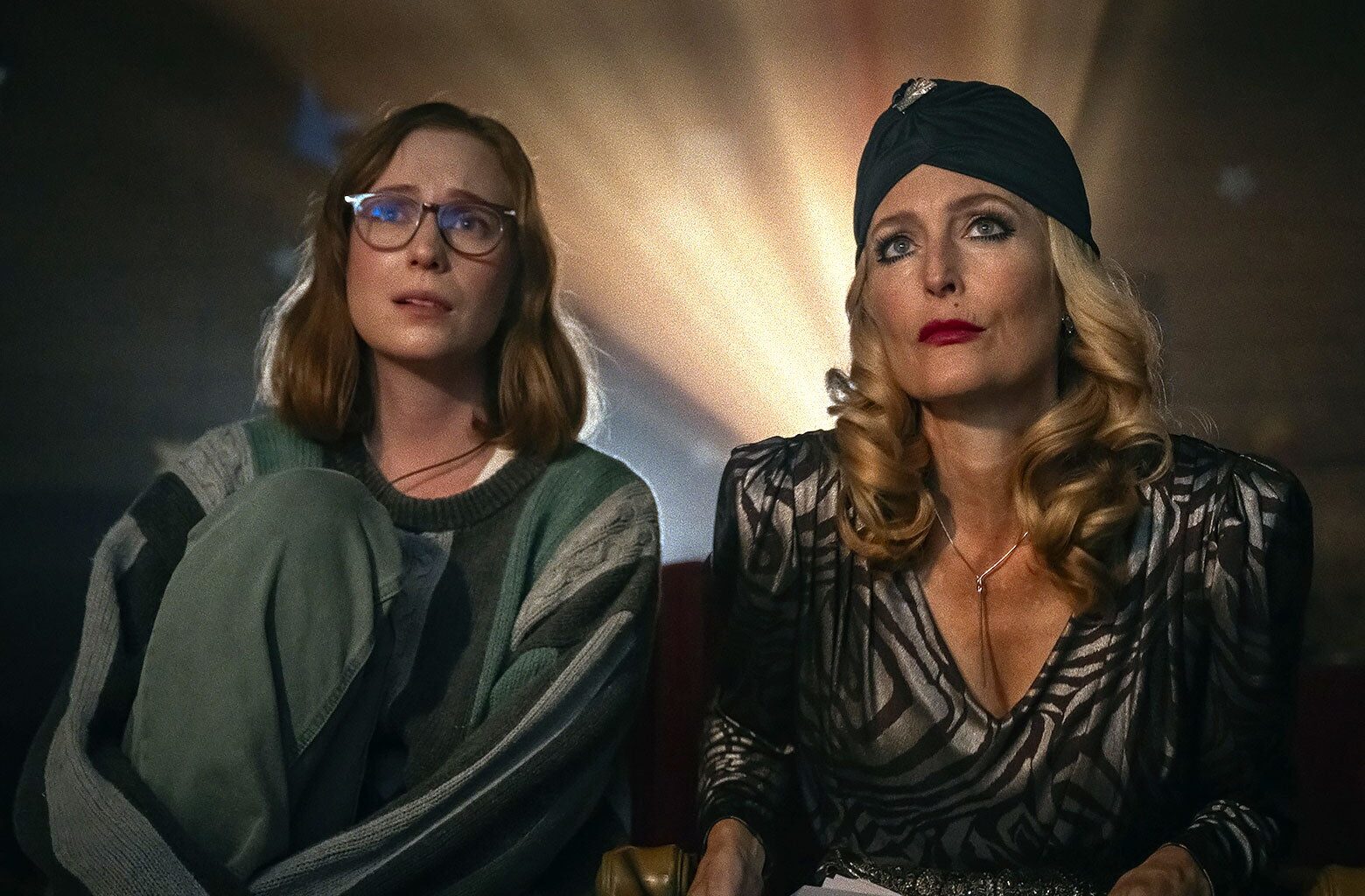
Kris Williams (Hannah Einbinder), the 29-year-old Sundance prodigy in Jane Schoenbrun’s Teenage Sex and Death at Camp Miasma, would have passed through Peak Problematic Fave at an impressionable age, but not before imprinting on the cheesy slasher franchise that gives the movie part of its title. The opening credits walk us through the history, via a collection of well-worn artifacts: action figures of the franchise’s faceless killer, Little Death, who wields a spear and has an air-conditioning vent for a head; articles about its box-office success and eventual diminishing returns; and an ever-growing stack of VHS tapes chronicling the strained attempts to inject life into a flagging formula—Little Death goes to space, Little Death Takes Manhattan. (There’s a “final chapter” followed by a “new beginning,” and several more after that.) Then the bloggers arrive, attempting to reclaim the first movie’s notoriously transphobic twist as a landmark of queer visibility. What if the problematic fave could simply be a fave?
That’s where Kris comes in. The director of a critically lauded but little-seen art-house movie she describes as “Psycho, from the perspective of the shower curtain,” she has been given the task of reviving Camp Miasma’s “zombie IP,” which is rooted in a premise so toxic that not even an industry desperate for familiar content to recycle has scraped that far down the barrel. Kris is, as it turns out, a fan, in no small part because she first saw the film when she was 8 years old, too young to process anything but its dizzying concoction of bloody murder and lurid sex. (As someone who got his first glimpse of both onscreen gore and bare breasts from the opening scene of Jaws, I know the feeling.) But she’s learned to be ashamed of her attachment, and to pretty up that shame with film-school jargon. When she meets Billy Presley (Gillian Anderson), the first Camp Miasma’s final girl, to pitch her on taking a role in the reboot, she explains that her work is about “the intersection of, um, queerness and cultural depictions of monstrosity.” But Schoenbrun posits another, equally valid reason for Camp Miasma’s hold on Kris: It turns her on.
At the end of Schoenbrun’s I Saw the TV Glow, which tracks two high school students’ obsession with a cult TV show called The Pink Opaque, the movie suggests that the clips of the show we’ve been seeing throughout the film are actually the protagonist’s memories, warped by time and infused with all the feelings it brought out and helped them through. When they finally look back at the real thing, it’s cheap and cheesy, but it’s what the show became, and not what it was, that matters. Teenage Sex and Death at Camp Miasma builds an entire movie around that insight. We see snatches of the actual movies, usually accessed through physical media: the DVD of Part VI that Kris picks up at a gas station and watches in her hotel room; the 16 mm print of the original Camp Miasma that Billy projects in the abandoned summer camp where the movie was shot, which is also where she now lives. But we see at least as much of the movies as they live inside their heads, notably in a phantasmagorically gory sequence in which Little Death eviscerates—and I mean that literally—a group of camp counselors, blood arcing dozens of feet in the air as a sappy Counting Crows ballad incongruously blares.
Teenage Sex is clearly inspired by the eccentric 1983 slasher Sleepaway Camp, which ends with the out-of-nowhere revelation that not only is the vicious killer a teenage girl named Angela, but that girl—to put it in the movie’s terms—is really a boy named Peter, compelled to change her gender presentation by the mentally unbalanced aunt who took her in after her father was killed in a freak motorboat accident. (The role, as Kris knows by heart, was played by Felissa Rose in the first movie and Pamela Springsteen—Bruce’s sister—in many of the sequels.) The movie discloses this information in the crudest and most literal way imaginable, by pulling back from a shot of Angela’s naked torso to show a penis hanging between her legs, freezing on that deliberately grotesque tableau as a dissonant score sounds like an air-raid siren. It’s the equivalent of the screamed punch line to a campfire horror story—and hanging from the car door … WAS A HOOK—which is also how we learn Little Death’s backstory in Teenage Sex. “This part’s transphobic,” Kris whispers to Billy as a counselor recounts the legend of how Little Death was forced to dress as a boy one day and a girl the next, until the strain of swapping genders destroyed their mind and turned them into a raging killer. Billy just shushes her.
Keith Phipps
It’s One of the Most Beloved Horror Films of the 1980s, but There’s One Controversy About It That Will Never Die
Read More
Teenage Sex draws not only on Sleepaway Camp. The Camp Miasma franchise’s increasingly thirsty sequels include several references to the Friday the 13th series, whose second movie inspired the Camp Miasma kill that is the locus of Kris’ erotic fixation on the series: two lovers impaled by a fishing spear while they’re having sex. The beginning and ending of the original Texas Chain Saw Massacre are visually referenced, Psycho’s own gender-bending twist is alluded to, and both the original Halloween and its recent revival are invoked by the studio executives behind Kris’ own attempted reboot. It’s a movie born of a lifetime soaking in low-grade slasher movies, their forerunners, and, eventually, their more reputable descendants, fragmented and recombined by the dictates of memory and desire—a word Kris jots down in all caps as she’s watching a Camp Miasma, underlining multiple times for emphasis.
But even taking into account that it came at a stage before the genre’s codes had fully hardened, Sleepaway Camp is a particularly odd entry in the genre. Though the movie builds suspense around the identity of its killer by keeping her offscreen, there’s never a plausible alternative—time and again, the camp’s cook or one of its snootier counselors does something cruel to Angela and ends up dead shortly thereafter. It’s circumspect about its kills (the reason we’re here, after all), and yet revels in their aftermath: We don’t see the cook, who openly proclaims his lust for the teenage campers, tumble into a man-size pot of boiling water, but we’re treated to a lingering shot of his patchy, blistering flesh after the deed has been done. In short, it’s very weird about bodies. And so, more knowingly, is Schoenbrun’s movie.
This Content is Available for Slate Plus members only
I’m Beginning to Feel a Little Disturbed by a Certain Pattern in Netflix’s Movies
This Content is Available for Slate Plus members only
The Brilliant, Funny, Strange New Movie That Grapples With a 1980s Cult Classic
Kris eventually reveals to Billy that she tends to dissociate during sex—that she can orgasm only by imagining herself in a different place, and that place is Camp Miasma. In other words, she’s horny for the movies. She’s built a life, and an approach to her work, that holds that fact at a safe distance, insulated by layers of academic terminology. (Her Sundance breakout film is called Jouissance, after Jacques Lacan’s heavily theorized version of orgasmic pleasure, and she casually drops the words gender trouble in front of Billy, as if a reclusive final girl is likely to be versed in the writings of Judith Butler.) Technically, Kris is in a polyamorous relationship, but that mostly seems to involve having a girlfriend who sleeps with guys named Thor. It’s a great understated joke that Kris makes being poly seem like the most boring and conventional thing in the world.
Eventually, Kris comes to terms with the idea that desire—for movies, for people, or both—is too messy and personal to fit neat definitions or tasteful ideologies. The body wants what it wants, and it’s hard enough to figure that out without feeling as if you have to come up with an intellectual justification for what gets you hot. Between sexual partners, as between movies and their audiences, anything is fair game as long as everyone’s on the same page.
I don’t know if Teenage Sex and Death at Camp Miasma quite gets as far as its protagonist does. For all the fluids it spews—and it’s a lot—there’s something a tad studied about its excesses. Schoenbrun tips their hat to David Lynch (Mulholland Drive’s Patrick Fischler makes a prominently unnerving cameo) but never quite taps into the dreamlike intuitiveness of his best work. Maybe it’s fitting that a movie about desire ultimately leaves you wanting.
Get the best of movies, TV, books, music, and more.