
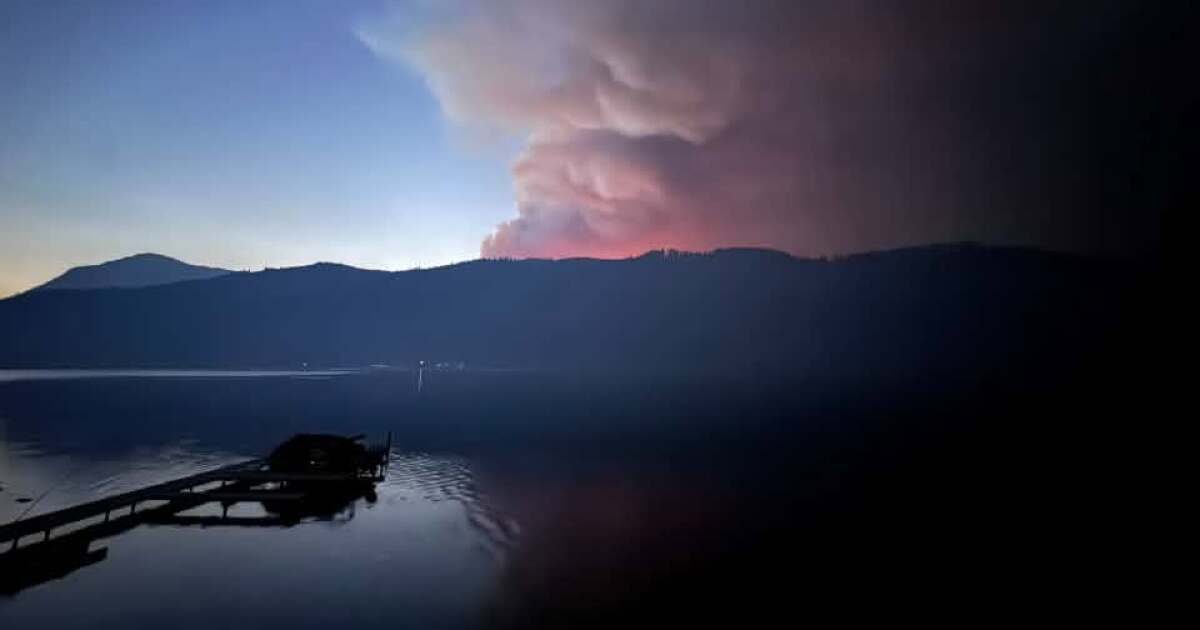
Each morning, a wave of firefighters has been coming into Plain Hardware in the tiny Cascades mountain town of Plain, Washington, for daily necessities.
The main basecamp for fighting the Little Giant Fire, currently the state’s third-largest and the closest major fire to the Seattle area, is just up the road. Nearly 1,700 people are taking on the Little Giant.
“In the mornings, coffee and bar and chain oil, and tent stakes when it’s windy,” said Plain Hardware owner Will Lindblom, listing some popular items. “It changes day to day.”
Lindblom said he has seen a shift in what his community needs, too, since lightning ignited bone-dry vegetation near the trailhead for Little Giant Pass in the Glacier Peak Wilderness on July 15. As of Friday, the Little Giant Fire’s nearest edge was 10 miles from Plain.
“Air filters, N95 masks, a place just to get out of the smoke and come visit and be with their friends and family,” Lindblom said.
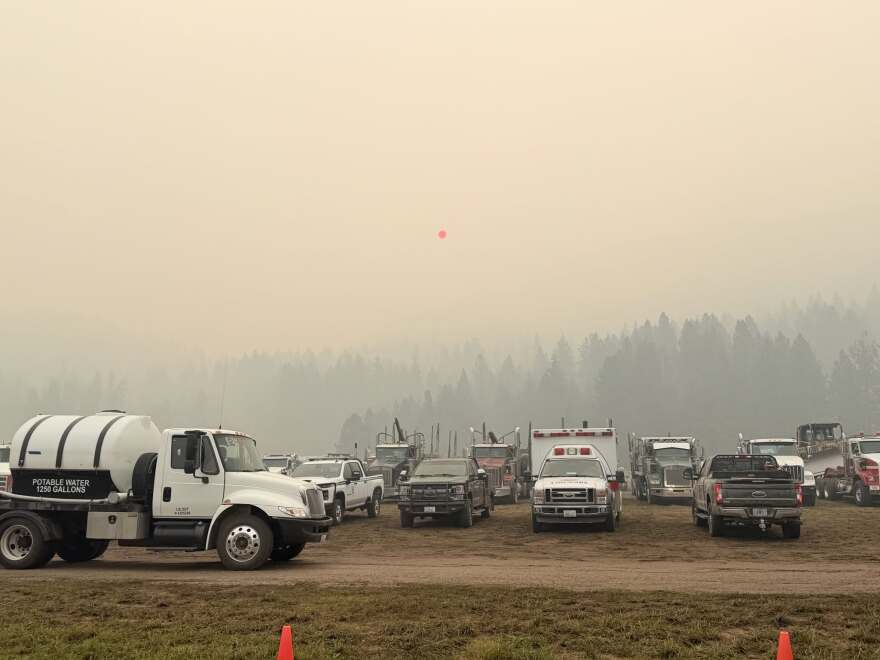
Courtesy of California Interagency Incident Management Team 2
Firefighting vehicles are parked beneath smoky skies at basecamp for the Little Giant Fire near Plain, Washington, on Aug. 6, 2026.
With thick smoke sometimes reaching hazardous levels, the store has been giving out free masks, provided by Lake Wenatchee Fire and Rescue.
Communities downwind of the fire, including Cashmere, Entiat, Leavenworth, Manson, and Plain, have seen air quality plummet deep into the “hazardous” category at times.
“We really saw it get dramatically worse in the last two days, and a lot of construction workers and people that are working outside have held off from work for the last couple days, hoping that it gets better soon,” Lindblom said.
No days off for the firefighters: They have been working day and night shifts to hold back the Little Giant.
The firefighting team held a community meeting on Monday in Entiat for anxious neighbors to learn more about the nearby hazard, with a stream of speakers getting applause after each finished.
Operations section chief Kristian Litz described how strong winds and exceptionally dry conditions led to extreme fire behavior.
“That fire that you saw, there was a pyrocumulus that reached about 30,000 feet tall,” Litz said, referring to the billowing white clouds that form above massive wildfires. “What it means is there’s going to be erratic and extreme fire behavior.”
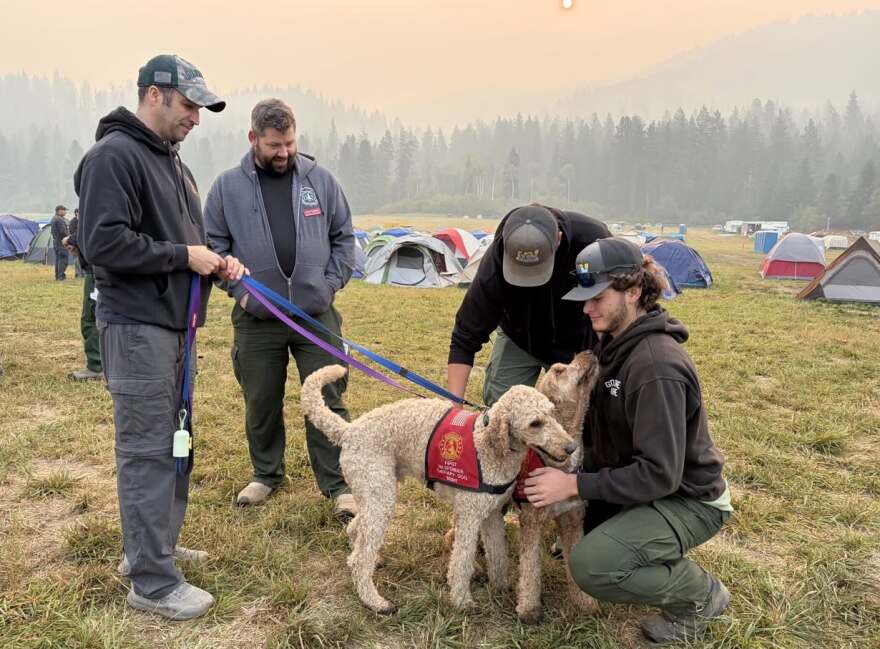
Courtesy of California Interagency Incident Management Team 2
First responder therapy dogs Scout and Piper visit firefighters to boost morale at the Little Giant Fire basecamp near Plain, Washington, on Aug. 7, 2026.
The Little Giant Fire has been spreading east toward Lake Chelan, a mile-wide, 50-mile-long glacial gouge that forms one of North America’s deepest gorges.
The deep, wide lake should have acted as a natural firebreak. It did not.
“I’m not from around here, but everybody I’ve talked to was pretty sure that it was not going to jump the lake,” Litz said. “Unfortunately, it happened.”
Officials said strong winds carried an ember two and a half miles over the lake before it ignited a blaze on the far shore.
Lake Chelan is much wider than the fire breaks that crews have been digging and bulldozing into the rugged forested landscape to stop the fire’s advance.
The Little Giant Fire is mostly on the Okanagan-Wenatchee National Forest. As of Friday, officials said no buildings have burned, but about 1,800 buildings were threatened.
One of them is a rustic wooden cabin that Lisa Port and her family own on national forest land up the Entiat River Valley.
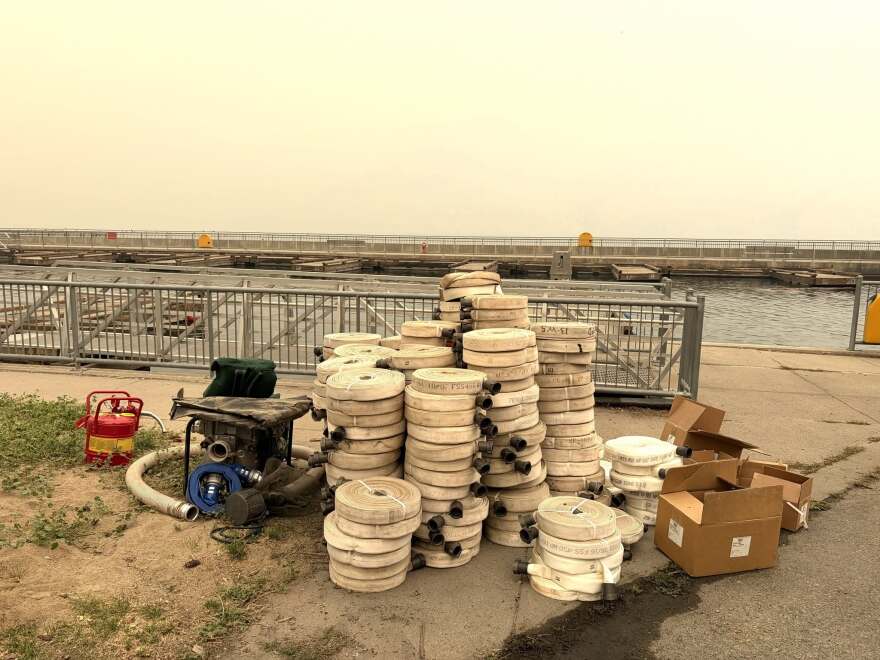
Courtesy of California Interagency Incident Management Team 2
Firehoses for fighting the Little Giant Fire are staged on the smoky shores of Lake Chelan, Washington, at Twenty-Five Mile Creek State Park on Aug. 5, 2026.
“There’s no electricity. There’s no running water. You’re just in a very rugged kind of rural cabin, really, cabin in the woods,” Port said. “That’s the beauty, I guess.”
The wooden cabin on U.S. Forest Service land has been in her family for more than 50 years. Her parents built it in 1970 to replace a family cabin destroyed in a fire farther down the Entiat River Valley.
Port, who lives in Lake Forest Park near Seattle, was given 30 minutes to rush in and remove family photos and other valuables. She said she is on pins and needles to see whether it survives.
“It’s excruciating not knowing exactly,” she said. “But I also know that these Forest Service guys, and all the guys from California, and all the people that they’re bringing up from all over the place are fighting their asses off fighting this fire.”
Fire researchers say burning is an inevitable, even necessary, part of life in the American West. But as pollution from fossil fuels keeps making the planet hotter, fires are burning longer and hotter in much of the world.
“ We see that in Washington state. We see that across the broader West. We see that in a lot of other places globally,” University of California Merced climatologist John Abatzoglou said.
In the inland Northwest, a buildup of flammable vegetation during decades of fire suppression has also left landscapes ripe for extreme conflagrations.
“It’s not just a question of if a fire is going to come, it’s just when and how much we can be prepared to adapt to those conditions,” Abatzoglou said.
As more people seek to live or have a second home near fire-prone landscapes, the challenges for firefighters inevitably grow.
“The only exception might be if you build vertically, you increase density, in an urban core within Spokane or Yakima or something like that,” Abatzoglou said.
Cities are safer from wildfires, but recent fires from Spokane to Pasadena show they are not fireproof.
Abatzoglou said efforts to reduce fuel build-up in forests and near residences have not matched the scale of the problem.
“We really need to figure out a way to increase the pace and scale of fuel management in these areas, probably prioritized around areas of value – communities, culturally important areas,” he said. “There’s been a lot of talk on that over the last decade or two and just not enough action.”
Long-term drought conditions as well as past fire suppression have made 2026 an exceptionally bad year for wildfires in the Northwest.
“ Washington, Oregon, and Idaho are all well ahead of schedule in terms of just how dry things are,” Abatzoglou said.
Dennis Burns, fire behavior analyst for the team fighting the Little Giant Fire, said vegetation was as dry and fire-prone as had ever been recorded for the beginning of August in the area.
More than 650,000 acres have burned in Washington in 2026, making it the state’s worst fire year since 2021, with months still left in the ongoing fire season.
Two megafires, the Sinlahekin near the town of Tonasket, and the Kaiser Canyon Fire on the Colville Indian Reservation, have each burned more than 120,000 acres.
The rapidly growing Little Giant Fire is not far behind. It has more than doubled in size in five days. By Friday, it had burned 82,659 acres — an area larger than the city of Seattle and Vashon Island combined.
Fighting the Little Giant has caused one injury and cost about $18 million to date, according to the Northwest Interagency Coordination Center, which provides logistical support to wildland firefighters in the region. No estimate was available of the economic toll of the smoke keeping visitors away from the Cascades during the peak of tourism season, harming locals’ health, or forcing outdoor workers to stay inside.
People in the tourist town of Leavenworth reported chunks of ash falling from the sky.
Cashmere Community Farmers Market canceled its Wednesday market due to the smoke.
“We cannot open in these conditions,” the market’s Facebook page said.
Whatever the cost, in Plain, neighbors have been expressing gratitude for firefighters at the hardware store.
“We currently have gift cards at the hardware store for all the firefighters that are supported from the community and funded from the community, and that covers any food and drinks that they want for the whole duration of their stay here,” owner Will Lindblom said. “It’s been really cool to witness and see.”