
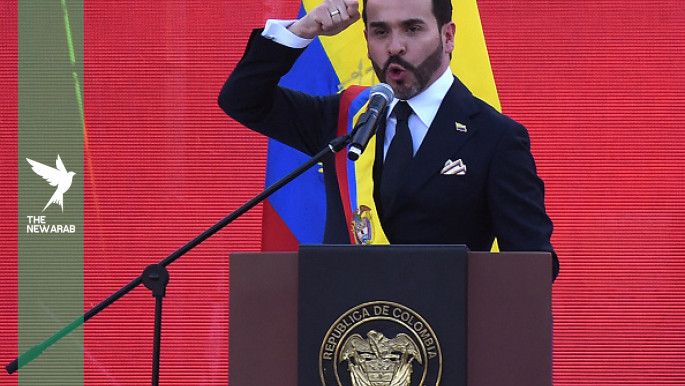
Abelardo De la Espriella’s government has announced plans to deepen trade, technology and investment ties with Israel following Petro’s diplomatic break. [GETTY]
Colombia’s new right-wing government, led by President Abelardo de la Espriella, has outlined plans to restore diplomatic and economic relations with Israel, marking a significant reversal after the country’s previous administration severed ties two years ago over the genocidal war in Gaza.
Bogota cut diplomatic relations with Israel in May 2024 following months of escalating tensions.
Then-president Gustavo Petro said he could not maintain relations with what he described as a “genocidal government”, amid Israel’s nearly three-year war in Gaza.
Since taking office however, De la Espriella has moved quickly to strengthen Colombia’s ties with Israel and pursue a markedly different foreign policy from his predecessor, including plans to withdraw Colombia’s intervention in the International Court of Justice (ICJ) case concerning Gaza.
The New Arab examines how Colombia’s rapprochement with Israel represents a sharp foreign policy shift as De la Espriella seeks to reverse key elements of Petro’s approach to Israel and its devastating war on Gaza.
Succeeding Petro following a closely contested run-off election last month, De la Espriella is seen as part of the wider rightward shift across much of Latin America. He received the backing of US President Donald Trump during his campaign.
De la Espriella plans to restore relations with Israel while severing diplomatic ties with Cuba and Nicaragua, which he considers “tyrannies”.
He has also outlined further measures to deepen ties with Israel, including appointing ambassadors, lifting visa requirements and relocating Colombia’s embassy to Jerusalem.
De la Espriella has also agreed to resume Colombian coal shipments to Israel, while Bogota is expected to withdraw from South Africa’s case against Israel at the International Court of Justice (ICJ).
Mariano Aguirre Ernst, a researcher at the Barcelona Centre on International Affairs (CIDOB) and associate fellow at Chatham House, told The New Arab that De la Espriella’s new Israel policy “will be an important change”.
He noted Colombia’s historically close relationship with Israel over several decades, particularly under former right-wing President Ivan Duque, before Petro’s vocal criticism of Israel’s war in Gaza altered the country’s course.
“Israel has been diplomatically strengthening the links with Latin America in order to gain allies in the UN, selling weapons, sending military trainers, and promoting Israeli business and investments,” Aguirre told The New Arab.
Aguirre said Petro had “adopted a very confrontational position towards Israel”, which he argued resulted in measures that were “very divisive in the Colombian society, as Petro’s constituency supported the Government but many political and business sectors opposed them”.
According to Aguirre, the new government’s pro-Israel stance therefore represents a significant shift, particularly as international efforts continue to end the war in Gaza following the implementation of Trump’s October 2025 ceasefire plan, despite Israeli forces continuing to carry out near-daily strikes on the territory.
“Restoring diplomatic relationships and the will to move the Colombian embassy to Jerusalem provides strong messages of solidarity to Israel and the US Trump Administration,” Ernst said.
“In the broader context of the rise of far-right pro-Trump and pro-Israel [leaders] in Latin America, recognition of Israel and denying the Gaza genocide is and will be a ‘sign of identity’ in which direction other governments of the same political faction may move to.”
Amid the ongoing US-Israel war on Iran, now in its fifth month, Aguirre argued that De la Espriella would continue to “demonstrate his goodwill toward Israel and the United States”, potentially by condemning Iran and cutting diplomatic relations with Tehran.
“There will be opposition from different sectors in the Colombian society, but the domestic agenda will be hectic and probably will shadow this wrong step, coherent with its ideology, by the new presidency,” he added.
Vice President Jose Manuel Restrepo has since announced the creation of a bilateral economic commission with Israel and plans for an official visit by a Colombian delegation in October.
Restrepo also said Colombian officials met Israeli Foreign Minister Gideon Sa’ar and the Israeli delegation on Friday, describing the talks as the beginning of “a new stage” in bilateral relations.
Alongside reaffirming his alignment with Washington and Israel, De la Espriella has pledged a hardline programme of “all-out war” against armed groups, the construction of “mega-prisons” and a reduction in the size of the state.
The Colombian leader has also proposed forging a military alliance with the United States and Israel to support his campaign against guerrilla groups.
His so-called “Plan Colombia II” is a reference to a multimillion-dollar agreement with Washington in the 2000s aimed at combating drug cartels and left-wing armed groups.