
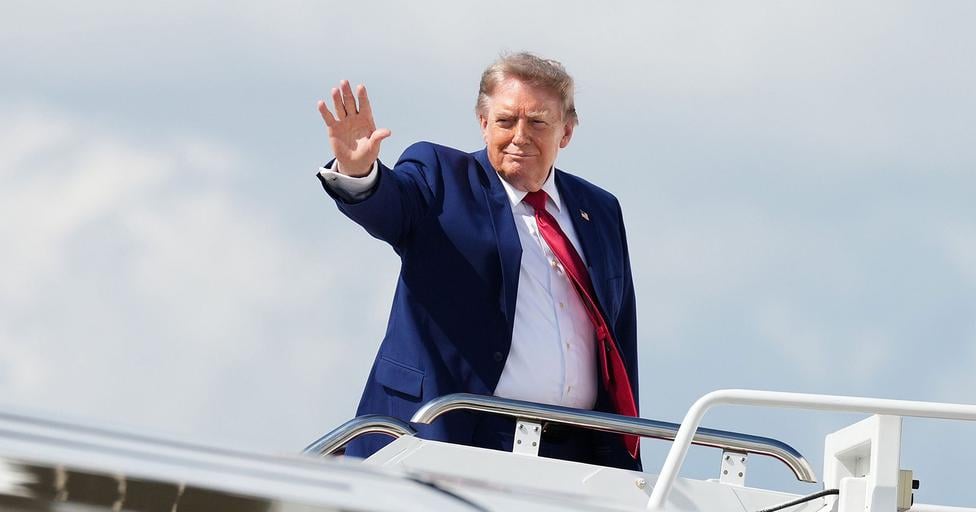
U.S. President Donald Trump said in an interview with Axios on Sunday, August 9, that his administration currently intends to increase economic pressure on the Islamic Republic and pursue a more cautious approach toward Iran instead of launching a new military operation.
When asked by Axios about the status of talks with Iran, Trump said, “We’re taking it easy.” He added: “We’re negotiating with them half-heartedly. We’re just keeping an eye on Iran, with massive inflation and the fact that it has no money.”
Trump noted that the Islamic Republic is in “a very bad situation” economically and lacks sufficient funds even to pay its military forces. According to him, the U.S. naval blockade has further exacerbated the Islamic Republic’s economic crisis.
At the same time, he mentioned that the drop in oil prices to just over $75 per barrel has reduced the economic pressure of the war on American consumers. Regarding the confrontation with the Islamic Republic, Trump said: “Everything will be fine. It always turns out fine. It’s like a game of chess.”
Trump’s comments come as an agreement involving Iran, Oman, and the United States to establish a framework for maritime traffic through the Strait of Hormuz remains stalled.
According to Axios, under this proposed agreement, the Islamic Republic was expected to gain limited control over transit through the Strait of Hormuz for the first time since the outbreak of war. Qatari and Pakistani mediators had previously hoped the deal would be announced on Wednesday, but prospects for reaching an agreement have dimmed since then.
On Saturday, Mohammad Baqer Zolqadr, Secretary of the Islamic Republic’s Supreme National Security Council, announced new conditions for reopening the Strait of Hormuz. Under these terms, the U.S. must commit to refraining from threatening or insulting the Islamic Republic in any language, permanently cease the war against Iran and its allies in Lebanon, Gaza, Yemen, and Iraq, lift the naval blockade, and withdraw its military forces from the region surrounding Iran.
Zolqadr also demanded full compensation for war damages, the lifting of all sanctions, and the unfreezing of blocked Iranian assets.
Axios reported that these demands were part of the Islamic Republic’s conditions for reaching a nuclear agreement just weeks ago, but Tehran is now setting them as prerequisites for reopening the Strait of Hormuz.
A diplomat from one of the mediating countries also told Axios that Zolqadr’s statements reflect internal political divisions within the Islamic Republic.
Divisions Within Iran’s Regime Over Confrontation With the U.S.
According to Axios, U.S. officials state that there are conflicting views inside the Islamic Republic over how to handle U.S. pressure. One faction, led by Masoud Pezeshkian, is deeply concerned about economic collapse and believes Iran should reach a deal with the United States, while another faction, led by Islamic Revolutionary Guard Corps (IRGC) commander Ahmad Vahidi, opposes making any concessions.
U.S. officials also noted that Trump was inclined toward resuming large-scale military operations against Iran a week ago, but ultimately chose to avoid escalating the conflict for now.
According to a U.S. official, a continued war allows the Iranian regime to avoid confronting the economic fallout of the conflict, the infrastructure damage, and the deep economic crisis that has emerged. He stated that once Iran is no longer engaged in war, it will be forced to face a harsh reality without viable solutions.
The U.S. official also claimed that approximately eight million barrels of oil leave the Persian Gulf nightly via the southern sector of the Strait of Hormuz under U.S. military coordination, and Washington will seek to increase these oil shipments until an agreement is reached.
U.S. Vice President JD Vance also told Fox News on Saturday that the confrontation with Iran is far from over.
“This story isn’t over,” Vance said. “We’re clearly not at the beginning. We’re in the middle game, using a combination of tools – diplomatic, economic, and military – to ensure we achieve the best outcome for the American people.”
Axios emphasized that Trump’s current stance toward Iran marks a shift from a week ago, when the U.S. president was on the verge of deciding whether to resume large-scale military operations against the Islamic Republic.