
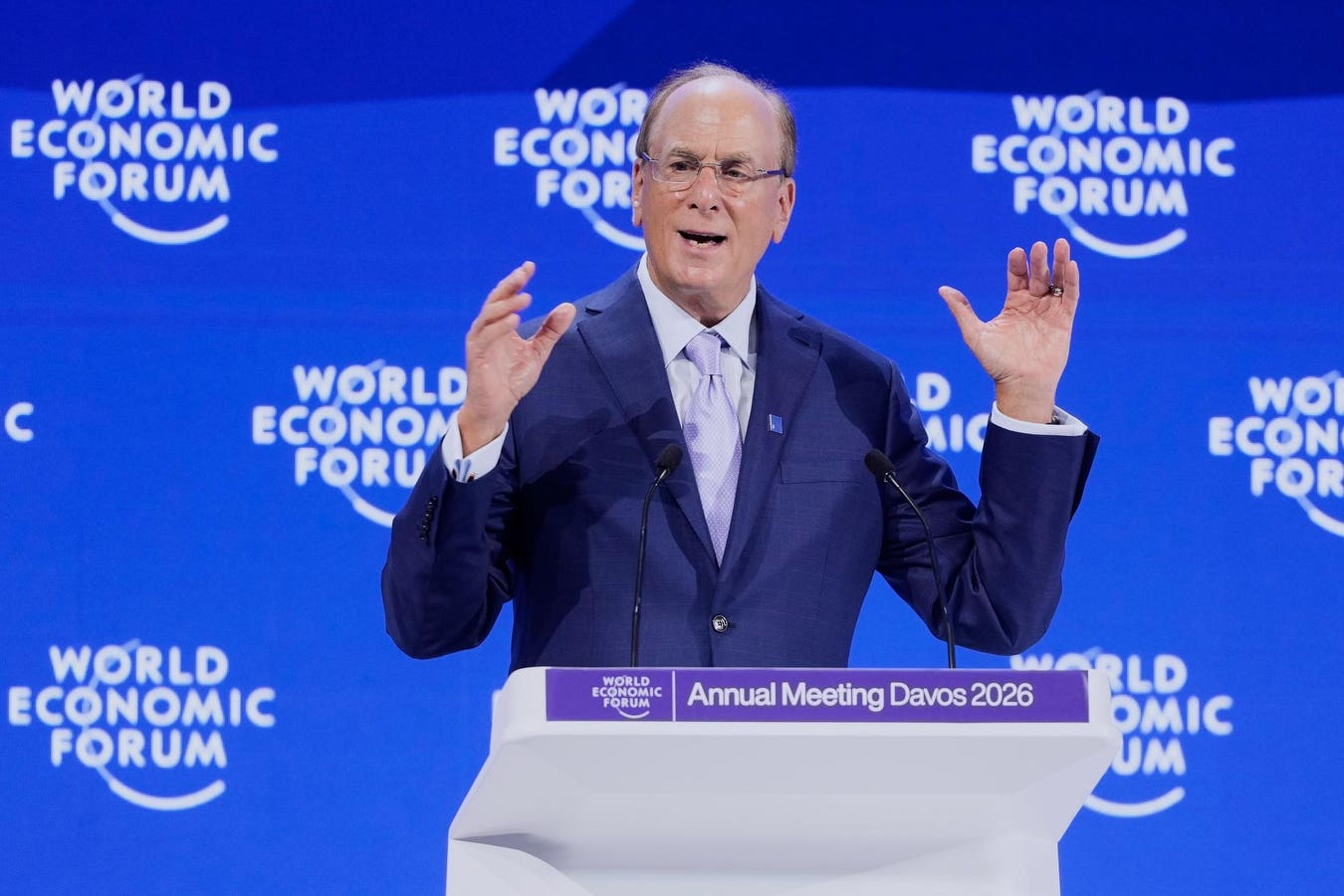
Larry Fink, CEO of BlackRock, the world’s largest asset manager with $15 trillion in assets, Tuesday, Jan. 20, 2026. (AP Photo/Markus Schreiber)
Copyright 2026 The Associated Press. All rights reserved
Last week Wells Fargo, the country’s fourth-largest bank with about $2.3 trillion in assets, said it would offer tokenized deposits to corporate and commercial clients this fall. Not long ago, the announcement would have been written off as yet another blockchain trial balloon. Today, it looks more like keeping up with the competition.
JPMorgan and Citigroup already operate similar services. JPMorgan’s Kinexys network processes more than $7 billion a day and has handled over $4 trillion since launch. Both banks along with Wells Fargo, Bank of America and more than a dozen other large lenders are also participating in an initiative operated by The Clearing House, a bank-owned payments company, like Zelle, that is developing a shared system for moving tokenized deposits between institutions.
The market’s plumbing is moving in the same direction. The Depository Trust & Clearing Corporation, which clears and settles some $15 trillion in U.S. securities trades per day, processed its first live transactions using tokenized securities in July and plans to launch the service in October. The world’s largest asset manager, BlackRock, introduced two tokenized money market products this month.
Citi estimates that tokenized securities could reach approximately $5.5 trillion by 2030, while Boston Consulting Group and digital-securities exchange ADDX put the potential market for tokenized illiquid assets at $16.1 trillion. The figures describe different markets, but they capture the scale of the bet. Tokenization is at last becoming a Wall Street business, not merely a crypto slogan.
So what is tokenization, and why does it actually matter?
Tokenization is a mechanism for representing an asset, or a claim on one, with a digital token on a blockchain, which is an immutable digital ledger. The asset might be a stock, Treasury bill, money market fund or bank deposit. Sometimes the token is part of the official ownership record; sometimes it is effectively a receipt for an asset held elsewhere.
What tokenization changes is not the asset, but how its ownership is recorded and transferred. In a conventional securities trade, the broker, clearinghouse, custodian and bank may each update a separate system, then check that their versions agree. Blockchain technology, first devised by Bitcoin’s pseudonymous creator Satoshi Nakamoto, can give them a synchronized record of who owns what and who owes whom.
The improvements come from removing steps. If the security and the money used to buy it are recorded on systems that can communicate, they can change hands at the same instant: the buyer receives the asset as the seller receives the cash, and neither is left exposed while the other side settles. The token itself can carry code that pays interest, releases collateral or blocks an ineligible investor from receiving the asset.
24/7 settlement gets much of the attention, though most investors do not need an Nvidia trade to clear on Sunday morning. It matters more to institutions moving money and collateral across time zones. A tokenized money market fund could be transferred overnight to meet an obligation elsewhere instead of sitting idle until the relevant banks reopen.
None of this is free. Immediate settlement can require more cash. Firms now offset a day’s trades against one another and move only the net difference; settling each trade on its own means funding each one in full. Nor does a shared ledger guarantee one shared market. Exposure to Tesla, for example, can come as an ordinary share, a token authorized by Tesla, a token backed by shares held by a custodian, or a contract that merely tracks Tesla’s price. Each can carry different rights and trade in a separate pool of liquidity. More on this later.
Why is tokenization gaining momentum now?
Wall Street has been experimenting with tokenization for years. Overstock.com, an online retailer turned unlikely crypto pioneer, completed a $5 million blockchain-based tokenized bond in 2015. When Forbes launched its Blockchain 50 in 2019—an annual list of large enterprises using the technology—its first edition included DTCC’s plan to put records for $10 trillion of credit-derivatives contracts on a distributed ledger. JPMorgan had already built Quorum, a private version of Ethereum, and announced JPM Coin for institutional payments.
Those projects proved that one part of a transaction could operate on a blockchain. They did not create complete markets. In many cases, the asset moved on-chain while payment still arrived by bank wire, custody remained on conventional systems, and the parties reconciled their records afterward.
What changed first was the money. Stablecoins—digital tokens designed to remain worth one dollar—have grown into a roughly $300 billion market. They gave tokenized markets both a means of payment and a large population of users already holding dollar tokens on blockchains. As interest rates rose, tokenized Treasury funds became a natural companion. Investors could move from stablecoins, which generally pay no interest, into government debt that does, without first cashing out to a bank and transferring the money to a conventional brokerage account.
The GENIUS Act reinforced that trend. The federal law, enacted in 2025, requires regulated payment stablecoins to maintain reserves of at least one dollar for every coin and bars issuers from paying interest to holders. The reserves may earn money for the issuer; the stablecoin itself generally does not pass that return along. Stablecoin companies therefore need large pools of safe, liquid assets, while stablecoin holders seeking a return must buy a separate product. That is how the growth of digital dollars spilled into demand for tokenized Treasurys. (See the largest tokenized Treasury products below)
The rules have also become clearer. In December 2025, SEC staff cleared the way for DTCC’s depository subsidiary, the Depository Trust Company, to run a three-year tokenization pilot. The following month, three SEC divisions described the legal differences among tokens issued by companies, tokens backed by securities held by custodians, and synthetic products that merely track an asset’s price. In March, the commission approved Nasdaq rules allowing eligible tokenized securities to trade alongside their conventional counterparts during the DTC pilot. Federal banking regulators also clarified that when a tokenized security carries the same legal rights as the conventional version, a bank generally does not have to hold extra capital merely because it is recorded on a blockchain.
So now banks are creating tokenized deposits, asset managers are issuing tokenized investments, exchanges are preparing to trade them, and DTC is building the custody and settlement layer. BlackRock’s billionaire CEO Larry Fink has described the shift as an update to the plumbing of financial markets, comparing its potential to that of the internet in the mid-1990s. “Every stock, every bond, every fund—every asset—can be tokenized,” he wrote.
The state of tokenization
For all the trillion-dollar forecasts, the market for tokenized assets today is considerably smaller. As of August 6, data provider RWA.xyz tracked about $37.7 billion of “distributed” tokenized assets, excluding the hundreds of billions now in stablecoins. Distributed means investors can hold the tokens in their own wallets and transfer them—not merely that an institution has recorded a reference to the asset on a blockchain.
U.S. Treasury products account for $16.1 billion, more than 40% of the total. Their lead is not surprising. Treasurys are liquid, standardized and easy to value, and they meet an immediate demand: stablecoin holders can move idle digital dollars into an interest-bearing asset without first returning to a brokerage account. Institutions can also use the tokens for cash management or collateral.
Four products account for nearly 60% of the category. Circle’s USYC, a tokenized money market fund, leads with $3 billion. BlackRock’s BUIDL, also a money market fund tokenized by Miami-based fintech Securitize, follows with $2.7 billion. Ondo Finance’s USDY, a tokenized note secured by short-term Treasury assets and bank deposits, has $2.1 billion. Franklin Templeton’s iBENJI, which represents shares in an institutional money market fund, has $1.7 billion.
Across all asset classes, RWA.xyz ranks Securitize as the largest tokenization platform, with $4.9 billion across 24 products.
Beyond Treasurys, tokenized credit—including private, corporate and structured debt—accounts for about $7.1 billion. Commodities, overwhelmingly gold, stand at $4.8 billion. Private equity and venture capital total roughly $2.3 billion, as do public stocks. Distributed tokenized real estate amounts to only about $203 million.
Much of the activity in tokenized funds and private credit consists of investors buying tokens directly from issuers, redeeming them for cash or moving them as collateral, rather than trading with one another. Elsewhere there is real secondary trading—CoinGecko estimated $90.7 billion of spot trading in tokenized gold and $15.1 billion in tokenized stocks in the first quarter of 2026—but it remains small. The five largest stock tokens, among them Alphabet, Tesla and Nvidia, account for less than 1% of trading volume in traditional stock markets.
A July Broadridge survey of 200 North American financial executives found that 84% considered tokenization strategically important, but only 26% said their firms were in production. Many of the largest offerings are still restricted to institutions, wealthy accredited investors or customers outside the United States.
Outside the United States, tokenization is gaining momentum at both ends of the market. Japanese brokers have been selling blockchain-based real-estate investments to ordinary investors since 2021, including newer offerings for as little as ¥100,000, or roughly $630. At the other end of the market, the government-owned Hong Kong Mortgage Corporation raised HK$12 billion, or $1.5 billion, in the largest digital-bond sale to date in June.
Are you buying the asset or a wrapper?
What do you get when you purchase a “tokenized stock”? The label can describe several different legal arrangements.
The most direct version is issuer-sponsored tokenization, sometimes called native issuance. The company authorizes the tokens, and transfers on the blockchain become part of—or feed into—its official shareholder records. Tokenization infrastructure provider Securitize took this approach when its common stock began trading on the New York Stock Exchange in July under the ticker SECZ. Eligible U.S. investors can hold those shares in tokenized form on the Avalanche or Solana blockchains. The token is not an unaffiliated product tracking Securitize’s stock. It is the common stock itself, recorded differently.
More common are custodial wrappers. A third party holds conventional shares and issues tokens representing an interest in them. Kraken’s xStocks, for example, are backed one-for-one by stocks and exchange-traded funds held in custody and are offered to eligible customers outside the United States. New York-based tokenization infrastructure provider Ondo offers hundreds of similar products. These tokens can move between wallets and trade while U.S. exchanges are closed, but voting, dividends and redemption depend on the issuer’s terms.
Synthetic products sit one step further away, providing a stock’s economic return without ownership of the stock. Robinhood made the distinction vivid in 2025 when it gave its European customers promotional tokens labeled OpenAI and SpaceX. OpenAI promptly said that the tokens were not its equity, that it had not approved any transfer, and that it did not endorse the offering. Robinhood said the products gave customers indirect exposure through a special-purpose vehicle. In other words, buyers got a claim designed to follow a valuation, not a place on OpenAI’s shareholder register.
For many investors, the distinction does not really matter. Someone buying a token tied to Tesla usually just wants Tesla’s price to rise, not a ballot at its annual meeting, and a reliable wrapper may provide everything that investor wants. Conventional investing is already heavily intermediated as most Americans hold shares through brokers and never appear directly on company books.
Still, price exposure is not ownership. A share carries legal rights; a wrapper carries whatever rights its issuer promises. That determines how dividends, voting and corporate actions are handled, whether the token can be redeemed, and what happens if the issuer or custodian fails. So it is important to read the fine print in any tokenized security prospectus.
Why do banks want tokenized deposits?
Tokenized deposits are effectively the banks’ answer to stablecoins. Both allow dollars to move on a blockchain, but they leave their holders with claims on different institutions and different protections if something goes wrong.
If Wells Fargo issues a tokenized dollar, Wells Fargo owes the holder a dollar, just as it does with the balance in a conventional deposit account. The usual banking rules and federal deposit-insurance limits apply where applicable. A stablecoin like USDC, by contrast, is issued by a company (in this case, Circle) against reserves of cash and short-term securities like U.S. Treasurys. It is designed to remain worth one dollar, but it is not an insured bank deposit.
Why put a deposit on a blockchain at all? Banks already operate round-the-clock domestic payment systems such as FedNow and The Clearing House’s RTP network, so speed alone is not revolutionary. The stronger case is for corporate clients moving money across currencies and time zones, programming a payment to occur when specified conditions are met, or using bank money to settle a tokenized security without returning to conventional payment rails.
Banks also have an obvious commercial reason to build them. Deposits finance lending and keep customers inside a bank’s payment ecosystem. Stablecoins do not necessarily remove money from the banking system—their issuers keep reserves at banks—but they can redirect deposits and payment activity toward stablecoin companies like Circle or El Salvador-based Tether. Tokenizing deposits lets banks offer similar functionality while preserving their franchise. The trade-off is that a tokenized deposit carries the issuing bank’s credit risk and is not interchangeable with another bank’s. A fully reserved stablecoin avoids the leverage behind a deposit but substitutes the issuer’s own risk: the holder is trusting a company to hold and manage the reserves as promised.
That fragmentation is the constraint. A token issued by one bank cannot yet be paid to a customer of another. The Clearing House network is meant to close that gap, letting tokenized deposits move between member banks. The reported target launch is the first half of 2027, with multinational corporations as the first users.
The bottom line
Tokenization is no longer merely a collection of pilots, but neither is it yet the wholesale transformation of finance its promoters have promised. It can make an asset easier to transfer, but it does not make a bad investment a good one, create liquidity where none exists, or turn a wrapper into the security it tracks.
That banks, asset managers, exchanges and clearinghouses are now building at scale makes tokenization difficult to dismiss as another technology experiment. However, the real measure of progress will not be how much of Wall Street moves onto blockchains, but whether the financial industry operates meaningfully better once it gets there.