
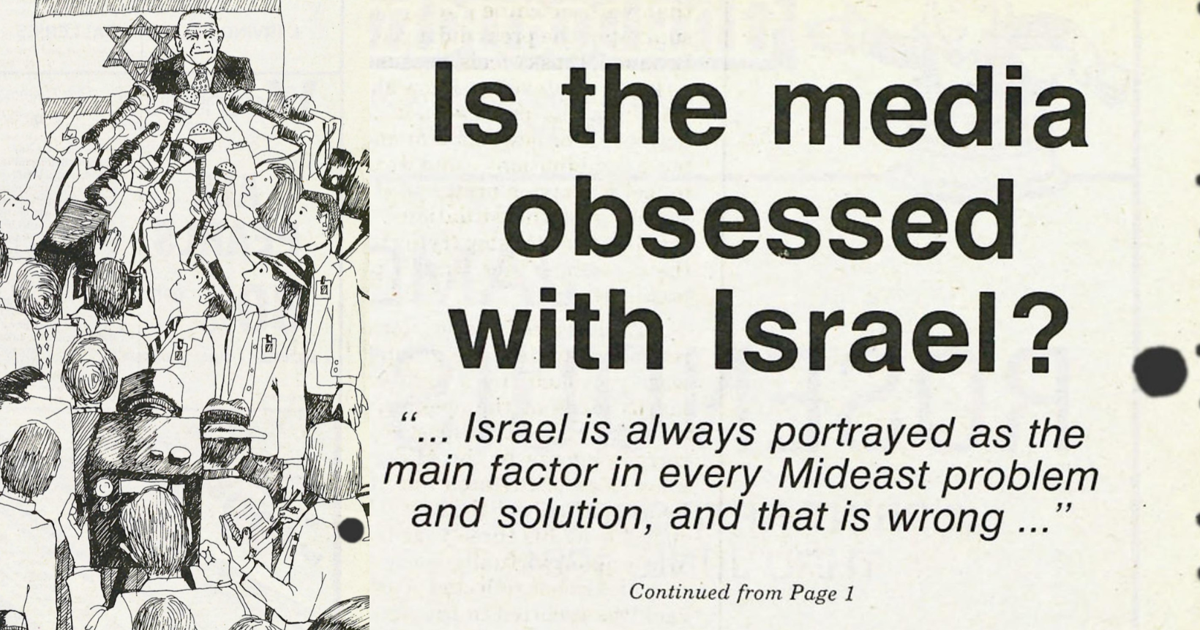
if Israel ceased to exist tomorrow, what other country in the world would media focus so many resources upon?
Israel, once the darling of the media and portrayed as a tiny democracy surrounded by hostile neighbors, has for the last decade been characterized as a powerful military state threatening its neighbor’s territory, as Goliath rather than David. Has Israel changed or has the press altered her image?”
This was the introduction for “Is the media obsessed with Israel?” — then-editor Gary Rosenblatt’s front-page story for the May 11, 1984, JN. His essay was a reflection upon a two-day conference, “Perspectives of Israel in the American Media,” held in New York City that month.
More than 60 Israeli and American journalists attended this event, representing such publications as the Jerusalem Post and Ha’aretz in Israel, mainstream American journals such as the Wall Street Journal, New York Times, Newsweek and Time Magazine, and Jewish-centered media such as the Jewish Telegraph Agency and Detroit Jewish News. A few prominent public officials were also present. All of them came to debate the primary question that Rosenblatt framed in his essay.
“Fast-forwarding” to 2026 (using a term popularized by video cassette recorders that were present in almost every American home in 1984), I wondered — has anything changed? Is the media still obsessed with Israel?
Different Decades, Same Disagreements
In 1984, as one might imagine, the conference featured a wide range of opinions. At least, I can guarantee you that this factor has not changed in today’s world!
There were many disagreements over the causes and effects of media obsession with Israel at the conference. No universal rationale or doctrine was discovered and settled. Rosenblatt concluded that, while the discussions were “enlightening,” there was no order to the dialogue.
“In other words,” he wrote, “it really didn’t go anywhere.” Moreover, “maybe it was unrealistic to expect otherwise.” Rosenblatt did, however, relate several interesting observations in his summary essay.
Speaking as the former Israeli Ambassador to the U.S. regarding press coverage of Israel, Ephraim Evron felt that “the fascination, even the obsession went over the boundaries in an effort to distort, and I had no one to appeal to correct his imbalance.” And his opinion was a decade before the internet came into citizens’ lives with its extreme capability to allow users to “distort” facts and reality in an instant.
Lou Cioffi, the ABC-TV newsperson in Israel, noted that “Israel has changed; American interests have also changed. People want to know why we are always on the verge of war because of Israel.”
He also noted that journalists are not historians, but their reporting about the Middle East conflict is covering a major historical topic. Of course, much has indeed changed for both Israel and the U.S. over the past four decades.
Several participants noted that the American press loves the underdog, but the underdog in the Middle East was now the Palestinians. The plucky Israelis of the 1950s and 1960s, struggling to build a nation, had been supplanted.
Professor Elihu Katz of Hebrew University thought that Israeli human-interest stories such as advancements in medicine and science were now overwhelmed by preoccupation with security issues. He also thought that “Israel has a prominence in the U.S. media that is out of all proportion to its size or importance.” Furthermore, Katz believed that Israel is judged in “relation to abstract ideals.”
On a similar note, Professor Daniel Pipes of Harvard University thought that American journalists were only interested in two topics: Israel and America. In this respect, he maintained that the issue was not “falsehoods but [it was] distortions,” and that a narrow view prevailed as the Middle East is always seen through the “prism of Israel.”
The Shift in Public Sentiment
Yet, despite the negative press cited at the conference, polls at that time show that the general American opinion of Israel was about 70% positive. When compared to current attitudes toward Israel, the difference from 1984 is stark. Recent polls find that about 60% of Americans hold negative views of Israel … and it gets worse when reviewing the data from young voters.
In 2026, the media is still obsessed with Israel. It still dominates media headlines as well as the discourse of current elections. The obsession, however, is much different in today’s world. The Middle East may still be viewed through an Israel prism, but how it’s viewed is much different.
First and foremost, perhaps, is that we are now fully immersed in the digital age. As the famous Canadian philosopher Marshall McCluhan so succinctly observed in the 1960s: “The medium is the message.”
At that time, McCluhan was assessing the impact of the dominant personal media of the day, a medium that reached into almost every home — television. Today, in the digital age, his assessment is still valid when applied to social media. This medium allows anyone to broadcast their opinion, their version of world events — whether informed and accurate or not — to millions of global social media users within seconds. No waiting for the morning newspaper or nightly TV news report that was the work of professional journalists.
Opinions and news about Israel are constantly and instantly generated in social media. Many themes would be familiar to readers and TV viewers 40 years ago: conflicts between Israel and its neighbors, Israeli politics and the battle against terrorism. Now, however, the obsession has gone beyond criticism of particular Israeli policies and actions. It has morphed into decidedly anti-Israel, antisemitic protests couched in pro-Palestinian sympathies.
Campus Protests and Political Realignment
Such animosity is most evident on college campuses and among a current set of radical political actors; i.e., far-left progressives and far-right conservatives. At times, it seems they are using Israel as a sort of reverse prism, using it as a protagonist to validate their opinions and values. And it has permeated politics to the point that many candidates for political office decide to declare their level of support for Israel. Many of them have taken a decidedly anti-Israel stance to garner votes.
Another factor may be that Israel is a victim of its own success. Over the past two decades, the “start-up nation” has become a global technological powerhouse. Some of the technical achievements of Israel have been reported, but most often such stories are about advanced military technology and/or the application of the same in current conflicts.
Technology that helps human endeavors are not emphasized in the media. Take the “Waze” GPS system used by millions of Americans to navigate U.S. roads. How many users realize that Waze was created in Israel in 2006? Or medical advances developed in Israel that are used around the world? Just Google “Israeli medical breakthroughs” and you will see what I mean.
Political factors do play a key role in the obsession with Israel, and in many cases, deservedly so. For example, the current conflict between America and Iran — is it a war by definition? This event has had an impact on global economies and politics. It began as a partnership between Israel and the U.S. to supposedly rid the world of nuclear threat from a fanatical regime. But, many Americans think the war was an Israeli plot, that the U.S. was duped into the conflict.
There is also the internal Israeli polity to consider. Israeli Prime Minister Benjamin Netanyahu and the Likud party have dominated Israeli politics for nearly three decades. He is a divisive figure, to say the least. Of course, in America, we have our own divisive leader in President Donald Trump. Combined, their actions are heavily scrutinized. Certainly, the media is obsessed with these two international figures.
When all is said and done, unfortunately, Israel is often indeed judged by “abstract ideals” that apparently only apply to Israel. False characterizations of Israel as an “apartheid state” or as a nation conducting “genocide” can be found every day on social media.
Israel certainly has its issues, and they deserve to be reported upon just like serious issues in other nations around the globe. Is the main difference simply that the majority of Israelis are Jewish?
In the end, yes, the media is still obsessed with Israel and will continue to be for some time hence. Some of the obsession is political, but on the positive side, some of it is a fascination with a remarkable nation that produces a lot of good for the world. And it does so under tremendous pressure from outside forces, while remaining a democracy in a hostile neighborhood.
A Nation of Survivors
In his essay, Rosenblatt related that the words of Shalom Rosenfeld of the Israeli newspaper Ma’ariv left an impression upon him. “England is an island and that explains everything,” he said, “It could be said of Israel that we are a nation of survivors and that explains everything.”
JN’s Rosenblatt supported this idea, concluding that, “indeed, this is the story that will ultimately be acknowledged, and reported, by the press of the United States and the world.” In the meantime, the media will remain obsessed with Israel.
Put it this way — if Israel ceased to exist tomorrow, what other country in the world would media focus so many resources upon? None.
The Detroit Jewish News has been supported by readers like you since 1942. Support independent, local, Jewish journalism with a donation today.