
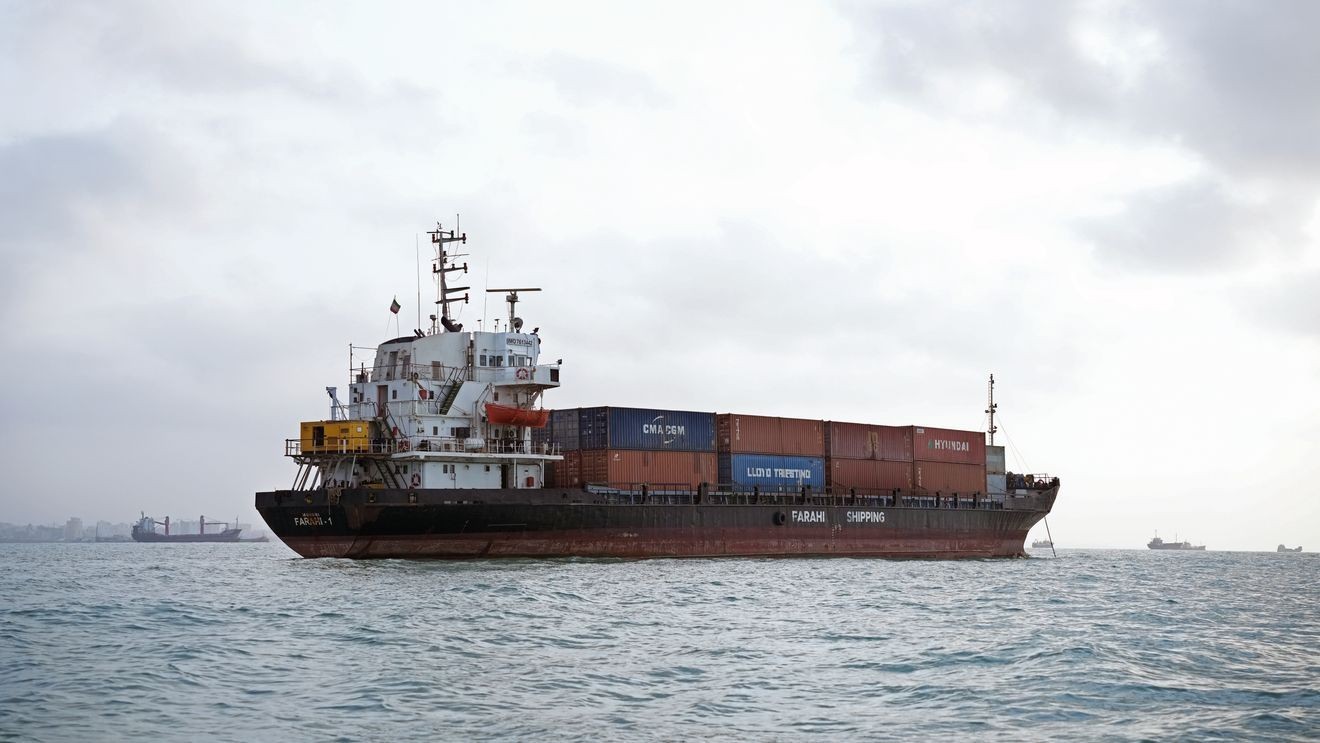
WASHINGTON (TNND) — Tightening its grip on a key maritime trade route, Iran issued a list of demands for the United States to meet before shipping traffic in the Strait of Hormuz can resume. All of the demands appear to be non-starters for the White House.
Tightening its grip on a key maritime trade route, Iran issued a list of demands for the United States to meet before shipping traffic in the Strait of Hormuz can resume. All of the demands appear to be non-starters for the White House. (TNND)
Iranian leaders said the United States must lift its blockade on Iranian ports, withdraw American forces surrounding Iran, lift sanctions, unfreeze Iranian assets, refrain from using insulting and threatening language toward Iran, and pay Iran for damages caused by the war.
In a social media post Monday, President Donald Trump said the last demand on that list was never brought up during past talks with Iran.
“But it is an interesting idea because now I am likewise demanding compensation from Iran, for all of the people that they have killed and gravely wounded with their roadside bombs and many conflicts, for which they are famous, as led initially by General Soleimani, including the families of those killed on the USS Cole, and thousands of others killed in combat,” Trump said.
Trump said Iran should also compensate “families of the hundreds of thousands of innocent protestors that Iran has killed over the last 50 years, not to mention the 52,000 that have been killed in the last five months.”
The president said he instructed his team to include this demand in future negotiations with Iran.
As for the current state of negotiations, Trump told Axios, “We are low-keying it” and “only semi-negotiating with them.”
“It will work out. It always works out. It’s like a chess game,” the president told the outlet.
In a war waged over a nuclear threat, getting the Strait of Hormuz open has become the most urgent objective for the United States. On Monday, the U.S. Department of Energy released data showing the strategic oil reserve fell to its lowest level since 1983.
“We’re talking to the Iranians, of course. We’re trying to maximize the amount of oil and gas that are coming out of the Strait of Hormuz. That’s the thing we’re most focused on right now,” Vice President JD Vance said in an interview Saturday, hours before Iran issued its demands.
Iranian leaders have been increasingly vocal about exerting their leverage.
“The Strait of Hormuz is no longer merely a waterway for us, nor merely an economic waterway,” said Islamic Revolutionary Guard Corps spokesperson Hossein Mohebbi. “Rather, it is a capability and a source of power that the Islamic Republic of Iran possesses by virtue of its geography, and it will make use of that geography.”