
Notable Faculty Networks, Organizations and Unions
The following details some of the major faculty networks, organizations, and unions that are driving some of these efforts on campus. While each operates independently, their combined reach across U.S. campuses is significant and still growing.
Faculty and Staff for Justice in Palestine (FSJP)
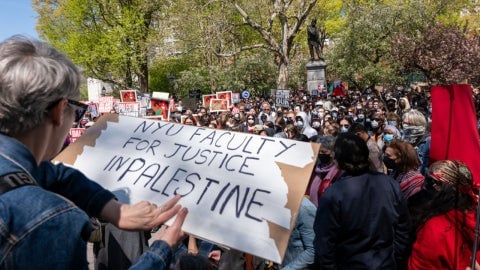
Faculty and Staff for Justice in Palestine (FSJP) is a growing network of more than 130 affiliated university faculty and staff groups, principally operating in the United States with some chapters in Canada. The network formed in February 2024 after several academic groups banded together to organize, partly in response to a call by the U.S. Campaign for the Academic and Cultural Boycott of Israel (USACBI).
Through their authority, tenure protections, and access to administrative channels, FSJP chapters actively support local Students for Justice in Palestine (SJP) chapters and anti-Israel campus unions, amplifying their influence and working to protect them from disciplinary consequences by university administrations.
FSJP chapters endorse BDS efforts, particularly against Israeli academic and cultural institutions, and promote activities supporting the “cause of Palestinian liberation.” For example, a Pratt Institute FSJP solidarity letter calls for a full ”academic and cultural boycott of Israel.” Rutgers FSJP posted a statement in March 2024 endorsing the Rutgers University Student Assembly (RUSA) Spring 2024 divestment referendum and alleging that “Israeli universities, including TAU, are complicit in this campaign of ‘cultural genocide.'”
FSJP promotes the belief that Israel is a settler-colonial, racist, and apartheid state, and that Israel and Zionism must be understood as part of “interlocking systems of oppression underpinned by global white supremacy and racial capitalism.”
The group’s organizing is strategic. Dana Morrison of the FSJP chapter at West Chester University in West Chester, Pennsylvania, noted in a November 2025 interview that faculty on her campus are careful to develop faculty-oriented divestment campaigns instead of starting campus-wide efforts, so students can learn to organize themselves. At the University of Massachusetts Amherst (UMass Amherst) in Amherst, Massachusetts, FSJP members said the chapter focuses on supporting student divestment campaigns and carving out spaces for anti-Israel advocacy in the face of the “repression of the free exchange of ideas.” Cedric de Leon, a university faculty and FSJP member, noted in a January 2026 interview that the campus chapter had “organized a lot of direct action,” which he described as “petition campaigns, sit-ins, and of course our encampment.”
In some cases, various chapters have also deployed overtly antisemitic rhetoric. For example, in May 2025, the FSJP chapters at the University of Pennsylvania, Drexel University, and Bryn Mawr-Haverford College (Bico) were among the co-organizers of a protest where protesters displayed the flag of the Popular Front for the Liberation of Palestine (PFLP), a U.S.-designated terror organization, along with signs reading “Long Live the Intifada” and “Victory to the Resistance” a phrase commonly used to euphemistically indicate support for U.S.-designated terrorist groups, including Hamas and others.
In August 2025, FSJP Bryn Mawr-Haverford College (Bico) posted a cartoon to its Instagram story of a character with a Jewish Star of David on his chest first attempting to hide or downplay news about the war in Gaza. The next panel shows the character appearing to deny or care about the news once they “realise [sic] there are no consequences.”
The reach of FSJP chapters is broad and consequential. In the 2025 ADL/AEN survey, 44% of respondents were aware of a chapter on their campus, with the overwhelming majority reporting those chapters organized protests (79.4%), hosted anti-Israel programming (77.2%), and endorsed divestment campaigns (84.8%). When faculty, staff, and administrators legitimize this activity, there is a risk of emboldening antisemitic attitudes among students.
The American Association of University Professors (AAUP)
Founded in 1915, AAUP’s stated mission is to advance academic freedom, shared governance and the economic security of faculty and academic professionals. It counts over 500 chapters at accredited colleges and universities nationwide.
In practice, a number of AAUP’s publications and positions have minimized antisemitism on campus and adopted rhetoric hostile to Israel. In one publication, the organization characterized the establishment of the State of Israel in 1948 as “the contemporary world’s most egregious instance of settler colonialism” and “ethnic cleansing,” language that goes beyond any criticism of Israeli policy.
AAUP has also actively pushed back against key tools used to identify and address campus antisemitism. In a November 2025 report titled “Discriminating Against Dissent,” the organization framed the International Holocaust Remembrance Alliance (IHRA) definition as problematic, arguing that many Title VI complaints relying on IHRA examples improperly frame anti-Zionism as “necessarily antisemitic” and recast “speech supporting Palestinian armed resistance as antisemitic harassment.” The report downplays these complaints as politically motivated and argues that the IHRA definition turns what the AAUP characterizes as political criticism into hate speech, impacting academic freedom. It offers no alternative framework to the IHRA and no actionable tools to address the genuine safety concerns of Jewish students while focusing almost exclusively on protecting anti-Zionist speech.
In 2025, a coalition of major Jewish organizations sent a letter to AAUP noting that the organization “now appears to have become yet another anti-Zionist labor union.”
The California Faculty Association (CFA)
The California Faculty Association (CFA) is a union representing over 29,000 professors, lecturers, librarians, counselors and coaches across the California State University (CSU) system.
In late 2025, mainstream Jewish organizations accused CFA of antisemitism when the organization asked in a candidate questionnaire whether respondents have “endorsements or take contributions from groups and sectors like AIPAC/JPAC, the oil industry, the tobacco industry, police associations, etc.” CFA said the faculty union won’t support candidates who accept money from groups that “harm working people.” It later apologized.
The CFA also denounced California Assembly Bill 715 as a “threat to free speech and academic freedom” and has faced criticism for antisemitism within its ranks. AB 715, signed into law in October 2025, strengthens protections for Jewish and Israeli students against antisemitism and other forms of discrimination in California’s K-12 public schools. It does so by imposing clearer obligations on districts, educators, and instructional providers, and creates the role of an Antisemitism Prevention Coordinator to educate teachers and school leaders about antisemitism. In September 2025, Melina Abdullah, CFA’s Political Action & Legislation Committee chair, streamed a class where she advocated for students to urge the governor to veto AB 715. Describing bill co-authors Rick Zbur and Dawn Addis as “two Zionist state legislators,” she also claimed that “AIPAC has bought and paid for almost every single member of Congress,” invoking the antisemitic trope of Jewish money controlling U.S. politics.
The CFA has also explicitly made anti-Israel rhetoric a major priority for union business, which too creates a hostile environment for Jewish and Israeli members of educational communities. At its Fall 2025 Assembly, a CFA leader declared: “Palestine is a labor issue… Faculty are workers, and communities are our core and our center.”
Months earlier, in April 2025, the CFA adopted a resolution calling on California State University to end study-abroad programs and partnerships with Israeli universities, a core pillar of the BDS movement.
The Coalition for Action in Higher Education (CAHE)
The Coalition for Action in Higher Education (CAHE) is an organizing collective formed in 2023 that describes its vision for higher education as “truly anticolonial, antifascist, antiracist, anticapitalist, feminist and free.” Its membership includes campus faculty, staff and organizations such as AAUP and Jewish Voice for Peace (JVP), an anti-Israel and anti-Zionist activist group that advocates for the eradication of Zionism and the boycott of Israel. While CAHE frames its mission around access and academic freedom, much of its organizing centers on Palestinian solidarity.
CAHE organized Days of Action in 2024, 2025, and 2026, where supporters held rallies, teach-ins, and event tabling. The 2026 Day of Action claimed to be about free education in every sense, tuition-free and free to dissent, but most sessions were focused on Palestine or academic freedom issues related to the conflict. A press release for the 2025 Day of Action claimed that a major goal of the day’s events was “to link the struggle for free speech around Palestine to the financial, political, and ideological assaults on higher and public education.”
There is significant overlap with CAHE and AAUP, with many coalition organizers drawn from AAUP networks. AAUP was a major organizer of activities for CAHE’s 2024, 2025, and 2026 Day of Action events.
At the 2026 CAHE Day of Action webinar announcing the launch of a new initiative titled “Conscientious Objection Pledge to End Complicity in Genocide & Apartheid,” Professor Barry Trachtenberg of Wake Forest University in Winston-Salem, North Carolina, said that institutions “cannot cooperate with Israeli universities, research centers, libraries, grants, and language academies while also claiming to oppose apartheid and genocide.”
He also described the period after the Spring 2024 encampments as an opportunity to work “hand-in-hand with student groups to be laying foundations that can be more sustainable beyond those brief moments of intense activism.”
The Sanctuary Campus Network (SCN)
Launched in December 2024, Sanctuary Campus Network (SCN) is a “coalition of students, faculty, and staff organizing to protect and support those most vulnerable against state repression and violence under the current administration.” Though primarily focused on protecting marginalized students, particularly immigrants, SCN links much of its work to Palestine solidarity organizing.
SCN has organized with and supported SJP chapters, encouraged work with faculty senates, invited Jewish Voice for Peace (JVP), an anti-Israel and anti-Zionist activist group that advocates for the eradication of Zionism and the boycott of Israel, to speak at meetings, and recommended JVP’s toolkit as a campus organizing resource. In early planning meetings, SCN meeting participants drew inspiration from FSJP’s organizing model. Some SCN members are also active with FSJP.
SCN was identified as critical to organizing within academic unions by CAHE leader and AAUP member Professor Bill Mullen of Purdue University. This recognition, alongside SCN’s organizational ties to FSJP and JVP and its integration into faculty senates, makes it a network worth noting as the movement continues to evolve and expand its infrastructure.